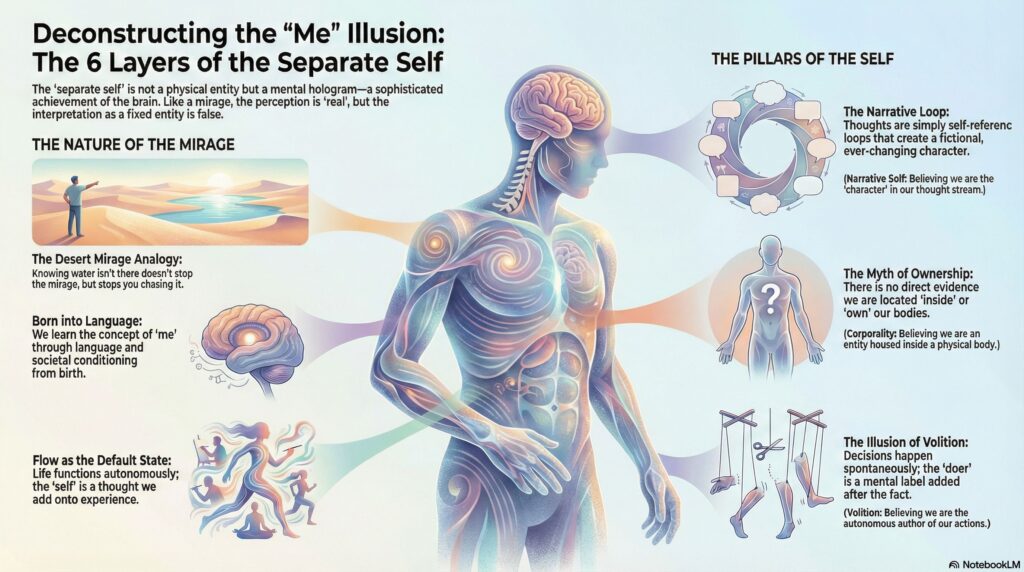
The following ai-generated content has been generated based on Heloisa’s Substack-series “Nondual Misunderstandings“:
How can I distinguish between intellectual understanding and true realization?
Distinguishing between intellectual understanding and true realization requires looking at whether your clarity is a product of thought or a recognition of what precedes thought. Intellectual understanding operates within the mind, reorganizing concepts and logic, whereas realization is the recognition that the mind itself—including all understanding—appears within awareness.
Here are the key ways to distinguish the two based on the sources:
1. The Nature of the “Clarity”
• Intellectual Understanding: Often feels like “intellectual neatness” or an airtight logical conclusion. It provides emotional reassurance and relief because existential confusion seems to dissolve. However, this relief is an experience that can fluctuate, while recognition is not an experience.
• True Realization: Is the quiet noticing that understanding itself is appearing. It is not a new insight or a “content” added to the mind, but a shift in position: moving from thinking about nonduality to being the openness in which thought appears.
2. Dependency on Language and Formulation
• Intellectual Understanding: Clarity often feels strongest when the “right” words are present or when you are reading, discussing, or thinking about the teaching. If the certainty fades when the explanation is absent, it is likely conceptual.
• True Realization: Is what is aware of ideas. It does not depend on refined phrasing or accuracy, because “accuracy is not actuality”. Realization remains “unspoken and unheld” even when words dissolve.
3. How it Responds to Lived Experience
A primary way to distinguish the two is how they manifest during moments of friction or intensity:
• The “Ownership” Stance: Intellectual understanding often carries a subtle sense of ownership, such as the thought “I get this”. Realization is “intimacy without ownership,” where life responds intelligently without a central “self” managing the meaning.
• Arguing with Reality: If you find yourself using nondual concepts to argue with your experience (e.g., thinking “I know there is no self, so this reactive emotion shouldn’t be happening”), you are likely in intellectual understanding. Realization does not remove the emotion; it removes the resistance to it and the belief that it defines someone.
• Spiritual Bypassing: Understanding often uses “oneness” as a way to dismiss pain or conflict (e.g., “It’s all one anyway”). Realization, however, does not bypass the body or feelings; it includes them fully as “undivided appearing”.
4. The “Direct Check”
To distinguish them in this moment, the sources suggest a simple inquiry:
• Is there an understanding occurring right now?
• Is there an awareness of that understanding?
• Is the awareness itself something you “understand,” or is it simply present?
Notice that what knows the understanding is not itself an understanding. Understanding can be refined and elegant, but realization is simpler: it is what is already aware of the understanding.
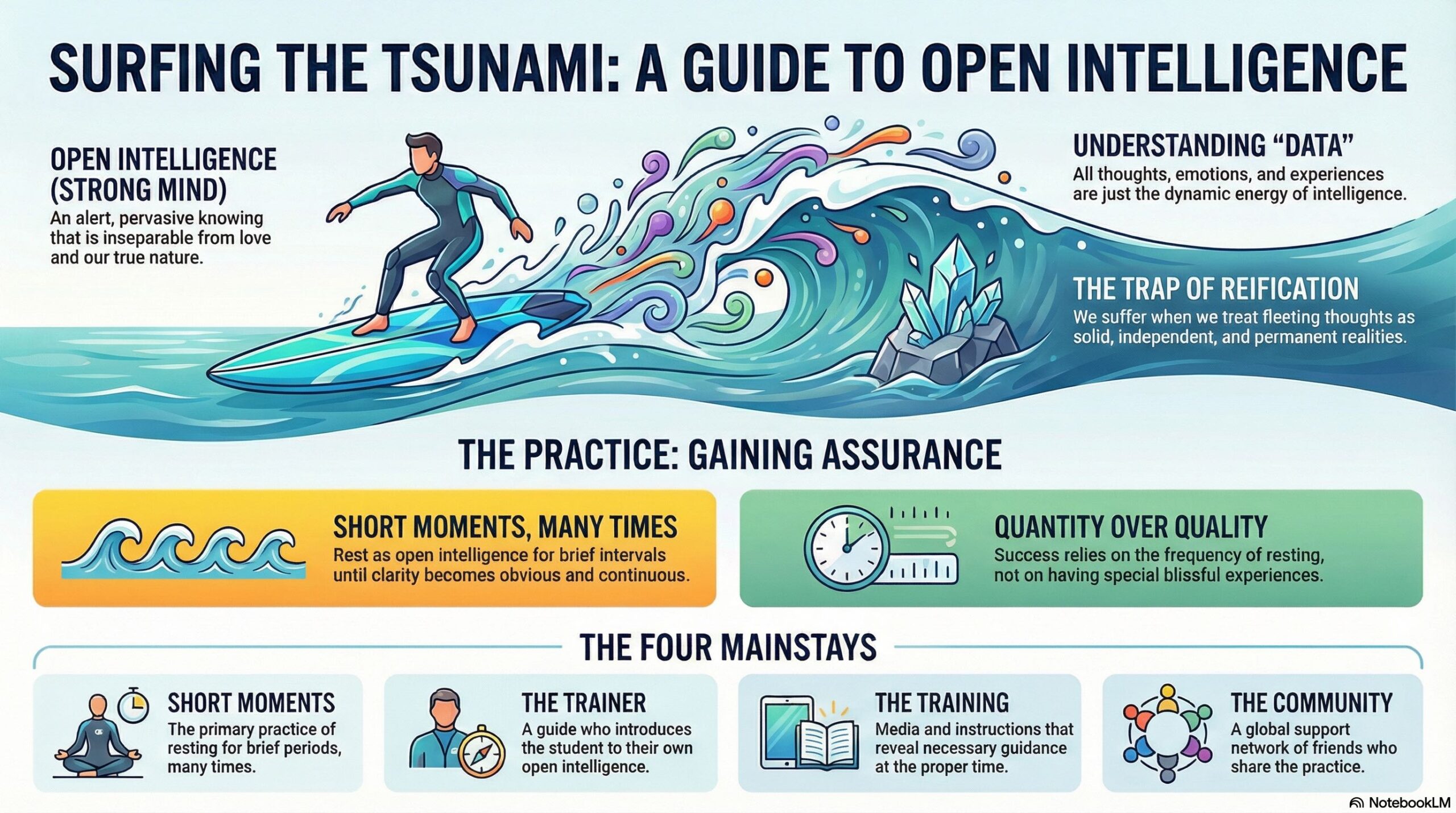
The following has been generated by ai, by notebooklm.google.com, from the source When Surfing a Tsunami, by Ziji Rinpoche. Thank you Ralph!
Stop Fighting Chaos: 5 Ancient Secrets to Surf Life’s Tsunamis
Introduction: The Constant Overwhelm
Does life ever feel like a tsunami? A relentless, overwhelming wave of thoughts, emotions, deadlines, and anxieties that threatens to pull you under. In the chaos of modern existence, it’s a feeling most of us know well. Our default response is to fight back—to try to control the thoughts, fix the feelings, and build walls against the external pressures. We brace ourselves against the chaos, but it often leaves us exhausted and no safer than before.
Ancient wisdom, however, offers a radically different approach. It suggests that our struggle is not with the wave itself, but with our attempt to fight it. What if, instead of trying to stop the tsunami, we could learn to surf it with skill and grace? What if the very energy that feels so threatening could become the source of our momentum and freedom?
This article distills five of the most surprising and impactful takeaways from the Dzogchen teachings of Ziji Rinpoche, as presented in the book When Surfing a Tsunami. These teachings reveal that the problem isn’t your thoughts but your belief in them; that the most potent practice is simple rest; and that even the greatest challenges, from emotional tsunamis to the reality of impermanence, can become allies on the path to a happiness that lasts.
1. Your Thoughts Aren’t the Problem—Your Belief in Them Is
From the moment we are born, we are enrolled in a kind of “reification boot camp.” We are trained to treat our inner world as solid, real, and defining. This teaching gives a name to this habit: “reification,” the process where “we give people, places, things, thoughts, emotions, sensations and experiences an independent nature.” In short, we make them solid.
This is a profoundly counter-intuitive idea. We spend enormous energy fighting negative thoughts and clinging to positive ones, convinced that the content of our mind is the problem we must solve. But this wisdom suggests the real issue is our near-religious devotion to them—what the source calls “the worship of thoughts, emotions, sensations and experiences.” By automatically believing our anxious thoughts are fundamentally real and powerful, we give them power over us. The path to freedom isn’t about changing the thoughts, but about ceasing to worship them.
No one wants to live in a continuous emotionally embattled state, but when we think that reifying thoughts and emotions is all that we’ve got, then we go ahead in that direction. But when everything is left as it is, we’re leaving the dynamic energy of open intelligence as it is, no matter what we might be calling it.
2. The Most Powerful Practice Is Deceptively Simple: Just Rest
If the problem is our belief in thoughts—our lifelong “reification project”—then the solution must be something other than more thinking. In a world saturated with complex self-improvement hacks, the core practice offered here is almost shockingly simple: “resting for short moments, many times.” This means allowing brief moments of pure awareness—what the teachings call “open intelligence”—by leaving everything exactly as it is. For just a second, you don’t try to change your thoughts or fix your feelings. You simply rest.
This practice directly counteracts the feeling of being “down-pressed, op-pressed and de-pressed” that comes from the constant effort of managing our inner state. The most radical instruction is that the quantity of these moments is far more important than their quality. This brilliantly removes the pressure for a “perfect” meditation. It doesn’t matter if the moment of rest is chaotic or calm. All that matters is that you do it, again and again. Each short moment is a drop of water that, over time, fills an ocean of clarity.
Drop by drop, the quantity of short moments is important, not the quality. Whatever the ups and downs, whatever the tsunami may be—quantity, quantity, quantity. Quantity, not quality, because quality is impermanent.
3. You Don’t Have to Fight the Tsunami—You Can Surf It
This practice of “short moments, many times” is what builds the stability needed to face life’s biggest waves. It is the training that allows us to move from theory to practice when the tsunami of emotion arrives. Intense feelings like grief or panic can feel like a destructive force, separate from us and threatening to annihilate us. We instinctively try to build a sea wall or run for higher ground.
But this teaching offers a paradigm-shifting metaphor: what if you could surf that wave? The core insight is that the tsunami of emotion is not separate from the vast, calm ocean of your fundamental nature. The wave is made of the very same “water.” The key is to stop identifying with the fragile surfer being tossed about and instead learn to surf by “resting as the peaceful equalness and evenness of open intelligence that is inseparable from the data that appear.”
This reframes crisis completely. An overwhelming emotional event is no longer an attack to be defended against, but a powerful energetic experience to be skillfully navigated. By resting in our own stable, open nature, we find the balance to ride even the most intimidating waves life throws at us.
When we feel ourselves under assault by afflictive emotions, they can appear to us like a tsunami of negativity. But instead of being overwhelmed and washed away by it, what if we remained as the open intelligence that is in fact the basis of the apparent tsunami? What if, instead of drowning, we were able to surf that tsunami, no matter how powerful it appeared to be…?
4. Real Enlightenment Isn’t About You
The modern spiritual marketplace often frames enlightenment as the ultimate personal achievement. The goal becomes, “I want to get enlightened for myself—to end my own suffering.” But these teachings challenge this self-focused view directly, calling it a “very small space to live from.”
True enlightenment, from this perspective, is not a personal project but an aspiration for the benefit of all beings. This shift in motivation is profound. When we adopt this view, “the internal preoccupation with ‘I, me and mine’ can come to an end.” The goal expands from a narrow focus on self-improvement to a vast, compassionate concern for everyone.
The surprising twist is that when you work for the enlightenment of all, your own is naturally included. You are, after all, one of the beings you are striving to help. By dropping the self-centered goal, you paradoxically find the most direct path to the freedom you were seeking for yourself all along.
The enlightenment of all beings is at the forefront, and whatever we do to ensure the enlightenment of all beings, we are ensuring the enlightenment of ourselves, because after all, we are already one of those beings that we are striving to enlighten!
5. Impermanence Isn’t a Threat, It’s Your Greatest Ally
Few truths are more unsettling than impermanence. We are wired to fear change, loss, and the ultimate uncertainty of death. We spend our lives trying to build permanent structures to feel safe from the constant flow of life.
This teaching presents a deeply counter-intuitive perspective: impermanence is not a curse but a “friend of practice” and a “blessing.” The logic is simple yet revolutionary. Because everything is constantly changing, every single moment is a fresh opportunity for realization. This ceaseless flux “motivates practice” and, as the source states, “by understanding impermanence, you realize genuine emptiness.”
Furthermore, the more intense the impermanence we face—a major loss, a crisis—the greater the potential for a profound awakening. Instead of being a threat to our stability, these moments are supercharged opportunities to see the nature of reality clearly.
If we have just a small run-in with impermanence, we get a small bit of realization, but if we have a big run-in with impermanence, we get big realization! So that’s why, seen from the vantage of open intelligence rather than reified thinking, impermanence is a friend along the way.
Conclusion: Finding Your Permanent Happiness
The thread connecting these five insights is a radical shift in perspective: from struggling against the nature of reality to relaxing into it. It is the understanding that peace is not found by winning a war against our thoughts and circumstances, but by recognizing the indestructible calm that already exists beneath them.
This path points toward a discovery that everyone longs for. As the text states simply and powerfully, “Enlightenment is permanent happiness.” This isn’t a fleeting good mood, but a happiness that persists “no matter what tsunami may come.”
The discovery of this permanent happiness is not about controlling life’s chaos, but in realizing the indestructible calm that is its very source. It is an invitation to stop fighting the waves and, instead, to recognize that you are—and always have been—the ocean.
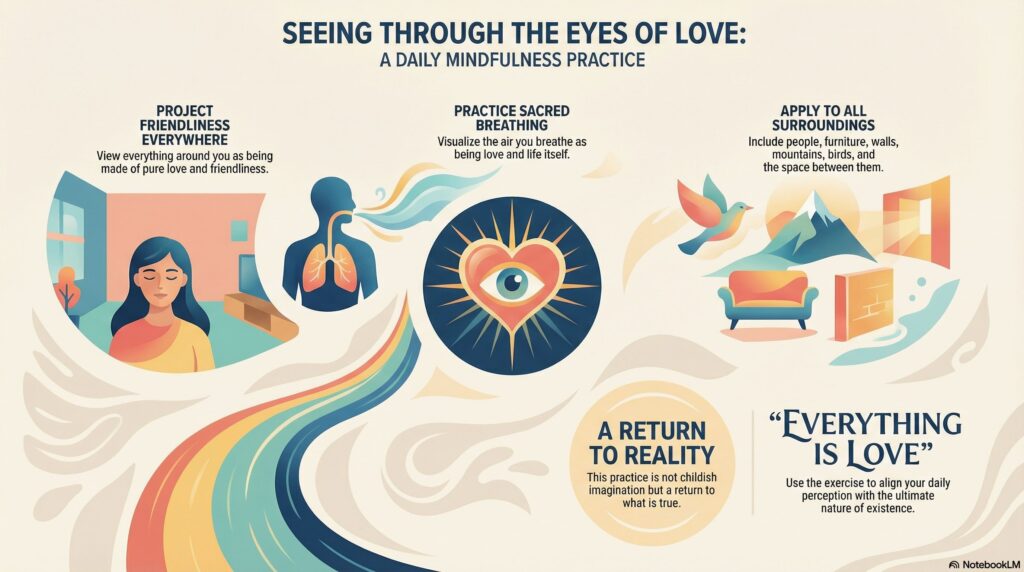
Notebooklm: In the video “An Effortless Exercise for Daily Life,” Francis Lucille teaches a spiritual practice centered on perceiving the world through the lens of universal love. He suggests that individuals should consciously visualize their surroundings and the air they breathe as being composed of this divine essence. While such an exercise might appear simplistic or childish, the author argues that it is a valid method for aligning one’s perception with ultimate reality. By viewing people, nature, and even inanimate objects as manifestations of love, a person can return to a state of truthful awareness. Ultimately, the source promotes a transformative mindset where love is recognized as the fundamental fabric of all existence.