Tag: Joel S. Goldsmith
-

Personal God?
The following are two answers by ai (notebookLM.google.com), based on 35 resources written by Joel S. Goldsmith:
Can we have a personal relationship with God?
NotebookLM.Google.com:
According to the sources , you can have a relationship with God that is intimate and personal, but it is not a relationship between two separate beings. True spiritual relationship is based on the realization of oneness, where the sense of a selfhood apart from God is overcome.
From Duality to Oneness
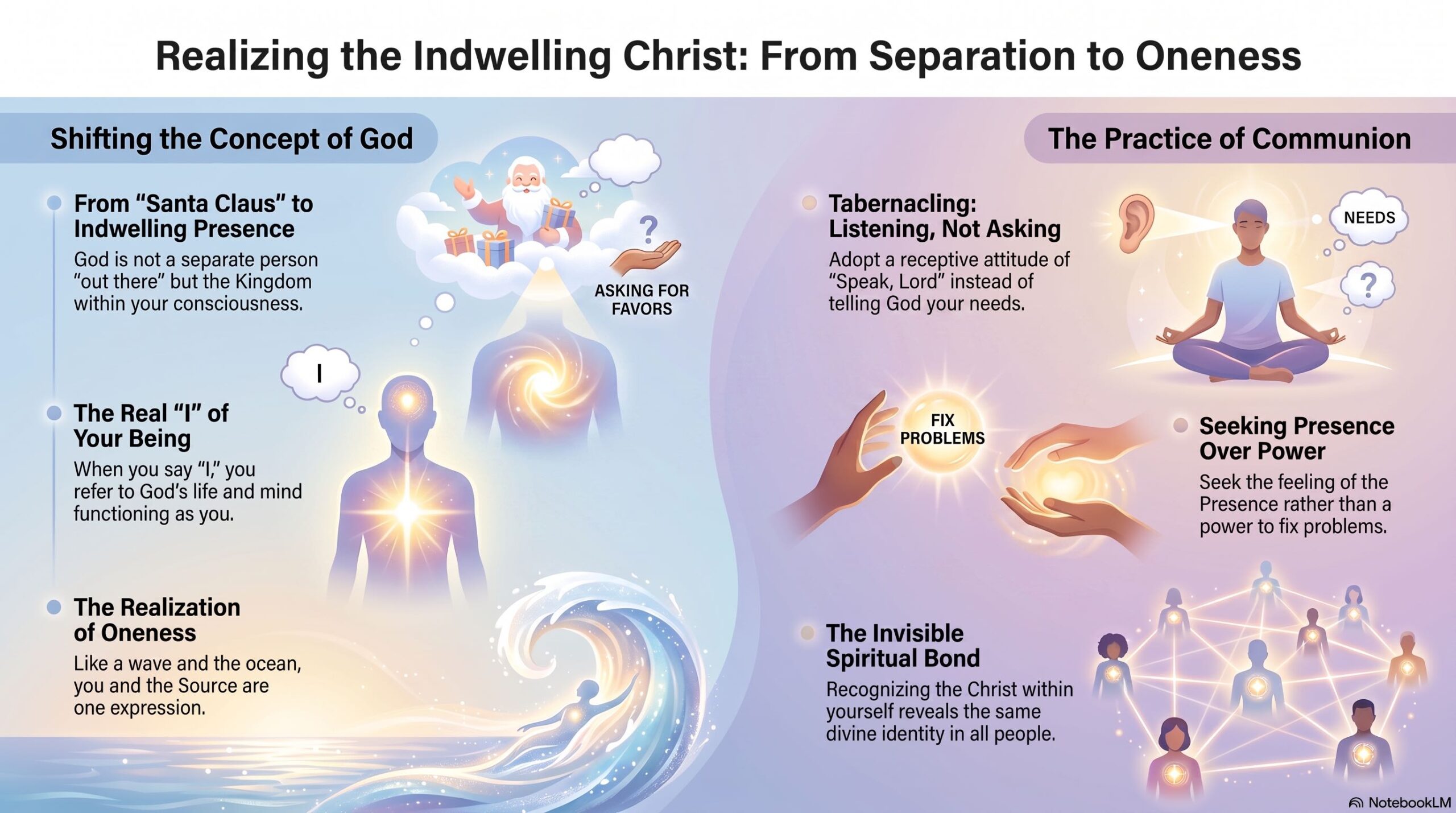
The sources emphasize that the traditional concept of a “personal relationship”—where a human being on earth reaches out to a God in heaven—is a form of duality or “twoness” that actually creates a sense of separation.
- The Error of Separation: Believing that you are “wo/man” and that somewhere else there is “God” is described as a “pagan” concept that was later incorporated into Christianity.
- The Reality of Oneness: The core relationship revealed by mystics is: “I and my Father are one”. This means God is not an entity external to you, but is the very substance, life, and consciousness of your individual being.
An Intimate, Inner Experience
While God is universal and impersonal in nature, the experience of God becomes deeply personal when realized within one’s own consciousness.
- Intimate Titles: The sources note that throughout scripture, individuals have known God in personal ways: Abraham knew God as “Friend,” while Jesus revealed God as “Father”. Others have experienced God as “Mother” or “Father-Mother”.
- Closer than Breathing: This relationship is described as being “nearer than hands and feet” and “closer than breathing”.
- The Inner Sanctuary: You do not find this relationship in holy temples or through rituals, but in the “inner sanctuary” of your own consciousness. It is an “inner communion” or “tabernacling” with the Spirit within.
The Role of the Indwelling Christ
The “personal” aspect of the relationship is often experienced as a connection between the individual’s outer human self and the indwelling Christ (the Son of God within).
- The Mediator: This divine Center within acts as a “Mediator” or “connecting link” between the individual and the absolute Source.
- Divine Partnership: This is described as a “divine partnership” where you are no longer fighting battles alone, but realize that “I and my Father” are together.
- Spiritual Companionship: By finding this inner relationship with God, you also find a “spiritual bond” with all people, which enhances human companionships and removes barriers of race or religion.
The Ultimate Goal: Conscious Union
The goal of the spiritual life is to move from “talking about God” to a God-experience.
- Listening, Not Telling: True relationship involves a “listening ear” and a “silent communion” rather than attempting to influence God or tell Him what you need.
- Disappearance of the “I”: In the highest state of this relationship, called conscious union, the separate, personal selfhood disappears, and only God is felt to be present.
- Self-Completeness: In this union, you discover you are “Self-complete in God,” meaning you no longer look to any human being or external circumstance for your fulfillment, health, or supply.
Is the relationship to God personal?
NotebookLM.Google.com:
According to the sources, the relationship to God is both universal and impersonal in its nature, yet deeply intimate and personal in its individual realization.
God as Universal and Impersonal
God is understood as universal Being whose laws function without exceptions or favoritism. In this sense, the relationship is not personal because:
- God has no favorites: God is no respecter of persons, religions, races, or nationalities.
- Impartial Activity: God’s activity is not directed at one individual over another; His grace falls on the saint and the sinner alike.
- No Personal Influence: Human beings cannot influence, sway, or persuade God through rituals or pleading to do something special for them.
- Universal Provision: God does not “set a table” for one person specifically but provides for the entire universe.
God as Individual and Intimate
While God is universal, the sources emphasize that God is incarnated as individual consciousness. This makes the relationship profoundly personal to the individual:
- The Father Within: Jesus referred to this relationship as the “Father within,” indicating an intimate, indwelling presence.
- Intimacy of Experience: Once God is felt and experienced, He ceases to be an abstract principle and becomes a “gentle friend,” “divine love,” or “Father”.
- Closer Than Breathing: God is described as being closer than one’s own breathing and nearer than hands or feet.
- The True Identity of “I”: The ultimate intimate revelation is that the “I” of your being is God. In this realization, you are not separate from God; God constitutes your very mind, soul, and life.
The Relationship of Oneness
The core relationship taught in the sources is oneness—a state of divine sonship that is indivisible and indestructible.
- Individual Union: Although God is universal, each person must find their own center in God individually; one cannot enter “heaven” two by two.
- Tabernacling: Spiritual living involves “tabernacling” or communing with God at the center of one’s own being in sacredness and secrecy.
- Self-Sufficiency: In this relationship, an individual finds their sufficiency within their own “Self” (God), rather than looking to other people or external circumstances.
In summary, while God is an impersonal, universal Principle that does not grant personal favors, the experience of God is the most personal and intimate relationship an individual can have, as it is the discovery of God as one’s own spiritual identity and life.

-

Tabernacling
NotebookLM.Google.com:
Tabernacling is the spiritual practice of inner communion and constant companioning with God/Reality/Life at the center of one’s own being. It is the act of entering the “silent sanctuary” or “Holy of Holies” within consciousness to dwell with the Divine Presence.
According to the sources (books by Joel S. Goldsmith), tabernacling involves the following key elements:
1. The Sanctuary of Consciousness
Tabernacling is not something done in a physical building or geographical location; the true “tabernacle” is individual consciousness. To tabernacle with God is to “shut out the world,” close the doors of the five physical senses, and retire into the “secret place of the most High” within oneself.
2. A Listening Attitude
The practice is defined by a receptive, listening attitude rather than a vocal or pleading one. It is characterized by the humble address, “Speak, Lord; for thy servant heareth”. Instead of telling God what is needed, the individual “rests back” in a state of expectancy, allowing the “still small voice” to provide direction, instruction, and peace.
3. Seeking the Presence, Not “Things”
The sources emphasize that the purpose of tabernacling is not to influence God or seek personal favors. Rather, it is to:
- Know God for God’s sake alone.
- Experience the realization of oneness with the Father.
- Rest in the assurance that God’s grace is “sufficient” for all needs without personal “thought-taking”.
4. Tabernacling with Others
The concept extends beyond the individual’s relationship with God to their relationship with others:
- Spiritual Identity: To tabernacle with others is to look past their human appearances (health, wealth, or behavior) and recognize the indwelling Christ or spiritual identity as the only reality of their being.
- Spiritual Household: It involves communing with those of one’s “spiritual household”—fellow seekers and the “saints and sages of all ages”—within the shared bond of spiritual consciousness.
5. Secrecy and Sacredness
Tabernacling is a sacred and secret activity. The sources warn against “casting pearls before swine” by discussing these inner experiences with those who are not ready to understand them. The spiritual fruitage of tabernacling should be revealed by its effects—such as increased peace, harmony, and healing—rather than through audible preaching.
6. A Way of Life
Ultimately, tabernacling is described as “praying without ceasing”. It is an hourly and daily practice of maintaining a continuous awareness of the Divine Presence while engaged in normal human activities like business, housework, or travel. By tabernacling in secret, the individual becomes a “transparency” through which God’s grace and peace can reach the rest of the world.
-

Recognition Prayer vs Petition Prayer
The following content has been generated by ai – notebooklm.google.com, based on this video:

Recognition prayer versus petition prayer
The primary difference between petition and recognition prayer lies in the starting point of the person praying: one begins with a sense of lack and separation, while the other begins with a sense of fullness and unity.
According to the sources, petition prayer seeks to change God’s mind or circumstances, whereas recognition prayer seeks to change the individual’s awareness to perceive a reality that is already complete.
Petition Prayer: The Act of Asking
Traditional petition prayer is often characterized by a “beggar” mentality where the believer pleads for divine intervention.
• Foundation of Separation: It operates under the belief that God is an external deity separate from the individual.
• Focus on Lack: The practitioner prays as if they are missing something, saying, “Please give me what I lack”.
• Attempt to Persuade: It involves begging, pleading, or bargaining, assuming that God must be convinced or informed about a problem.
• Reinforces the Problem: By focusing on the absence of a desired quality (like health or money), petition prayer can inadvertently reinforce the belief in that lack, which may explain why such prayers often feel unanswered.
Recognition Prayer: The Act of Realizing
Recognition prayer is described as a “mystical secret” where the practitioner acknowledges that the answer already exists in divine consciousness before the prayer is even uttered.
• Foundation of Unity: It is based on the understanding that the individual and the Father are one, and that divine consciousness is already present within.
• Focus on Completeness: Instead of asking for something to be created, it acknowledges that wholeness, abundance, and peace are already established in spiritual reality.
• Spiritual Awareness: Rather than a monologue of requests, this prayer is a moment of spiritual realization—seeing through the “world of appearances” to the eternal truth.
• Restful Engagement: Because it assumes the supply is already present, recognition prayer is “restful instead of desperate”.
Comparison at a Glance
Feature Petition Prayer Recognition Prayer Primary Goal To get God to do or send something. To recognize what God has already done. Mindset Emptiness and lack. Fullness and unity. Belief God is external and must be persuaded. God is the “infinite consciousness” that you are. Outcome Often leads to struggle or “white-knuckle” effort. Leads to a life that is “sustainable” and “effortless”. The Shift in Perspective
The sources suggest that moving from petition to recognition transforms the nature of your requests. Instead of asking God to “remove a difficulty,” a person practicing recognition (or “abiding”) might ask to see how divine glory is already being displayed through the situation. This shift is compared to a light switch: you do not generate the electricity (the power); you simply connect to a source that is already flowing.
By recognizing that you are a branch connected to the vine, you stop trying to manufacture “fruit” (results) and instead allow the life of the source to flow through you naturally.