Tag: veil

  • The Veiled Christ

    The Veiled Christ

    “The most impossible sculpture…
    Recall.it ai summary


    Introduction to the Veiled Christ and Its Impact

    • The point where skill becomes extreme is when people start calling it something else, such as magic or the impossible, and this is what happened when a young sculptor in Naples created a sculpture called the Veiled Christ in 1753, which has left people in awe for nearly three centuries (00:00:05).
    • The Veiled Christ is a life-size figure of Christ after the crucifixion, lying on a marble bed with two pillows beneath his head, and everything, including the shroud, body, pillows, pliers, shackles, and crown of thorns, was carved from a single block of Carrara stone by a 32-year-old sculptor named Giuseppe San Martino (00:00:39).


    Technical Description of the Sculpture

    • The shroud is made of marble and appears to cling to Christ’s body, following the contours of the rib cage, throat, and collarbone, creating an effect where the cloth seems to be a separate material entirely, even though it is made of the same stone as the body (00:01:34).
    • A study published in Scientific American found that sculptors working in this tradition do not carve a continuous thin layer of stone over the features beneath, but instead selectively render the face and body as if the veil is not there, and then insert narrow ridges and subtle texture shifts to suggest the presence of cloth (00:02:18).


    The Prince of Sansevero and the Commission

    • The man who commissioned the sculpture was Raimondo di Sangro, Prince of Sansevero, a grandmaster of the Neapolitan Masonic Lodge, a practicing alchemist, and an inventor, who built a carriage with cork horses and developed fireworks that detonated with the sound of bird song (00:03:06).
    • A legend emerged that the prince had taught San Martino a secret chemical process for transforming real linen into crystalline marble, but the documentary record, including a payment receipt and correspondence from the prince, confirms that the veil was carved from the same block as the figure (00:04:21).
    • Despite the evidence, the legend persists, possibly because it is harder to accept that a young man with a chisel could create such a masterpiece by hand from a solid block of stone with no tricks and no chemistry (00:04:52).


    Coredini’s Earlier Work and San Martino’s Commission

    • Coredini’s statue of modesty is a technical marvel, featuring a fully veiled female figure whose body is visible through carved stone drapery, and it still stands in the same chapel (00:05:16).
    • After Coredini’s death in 1752, the commission passed to San Martino, who ignored the older sculptor’s model and started from scratch, producing a work that Antonio Kenova later admired and would have given 10 years of his life to have created (00:05:32).


    Details and Artistic Mastery of the Veiled Christ

    • The Veiled Christ sculpture features intricate details, including a single vein visible through the veil on the forehead, which requires anatomical accuracy and the illusion of transparent fabric carved from the same piece of stone (00:06:16).
    • The sculpture also features the instruments of the passion at the feet, with different surface textures for metal, fabric, and flesh, all achieved from a single slab of marble, demonstrating San Martino’s technical skill (00:06:38).


    Interpretations and Theological Significance

    • Art historian Rudolph Witkau dismissed the veiled Christ as a hypertrophic effort, but Ruth Lockheart interpreted the veil as a theological threshold, representing the boundary between the human and the divine, and the visible and the invisible (00:07:09).
    • The veil can be seen as either a burial shroud, functioning as a final act of mercy, or as a means of exposing Christ’s wounds, making every rib more defined and every trace of suffering more legible than if the body were shown bare (00:07:47).


    Legacy and Viewer Interpretation

    • The Veiled Christ sculpture still sits in the center of the chapel in Naples, forcing viewers to choose between trusting the documents or their own eyes, as they are presented with two different interpretations of the sculpture’s meaning (00:08:43).

    Holger:

    In the above video it is mentioned that the artist uses one substance to create the impression of flesh, transparent veil, soft cloth, plus the hammer and the crown.

    In our seeming ignorance – born from below – we believe to be flesh and overlook the one substance everyone and everything appears from: Awareness, Consciousness, Christ, Love, (the words are secondary).


    In the Bible Christ is described as the Wisdom and Power of God.

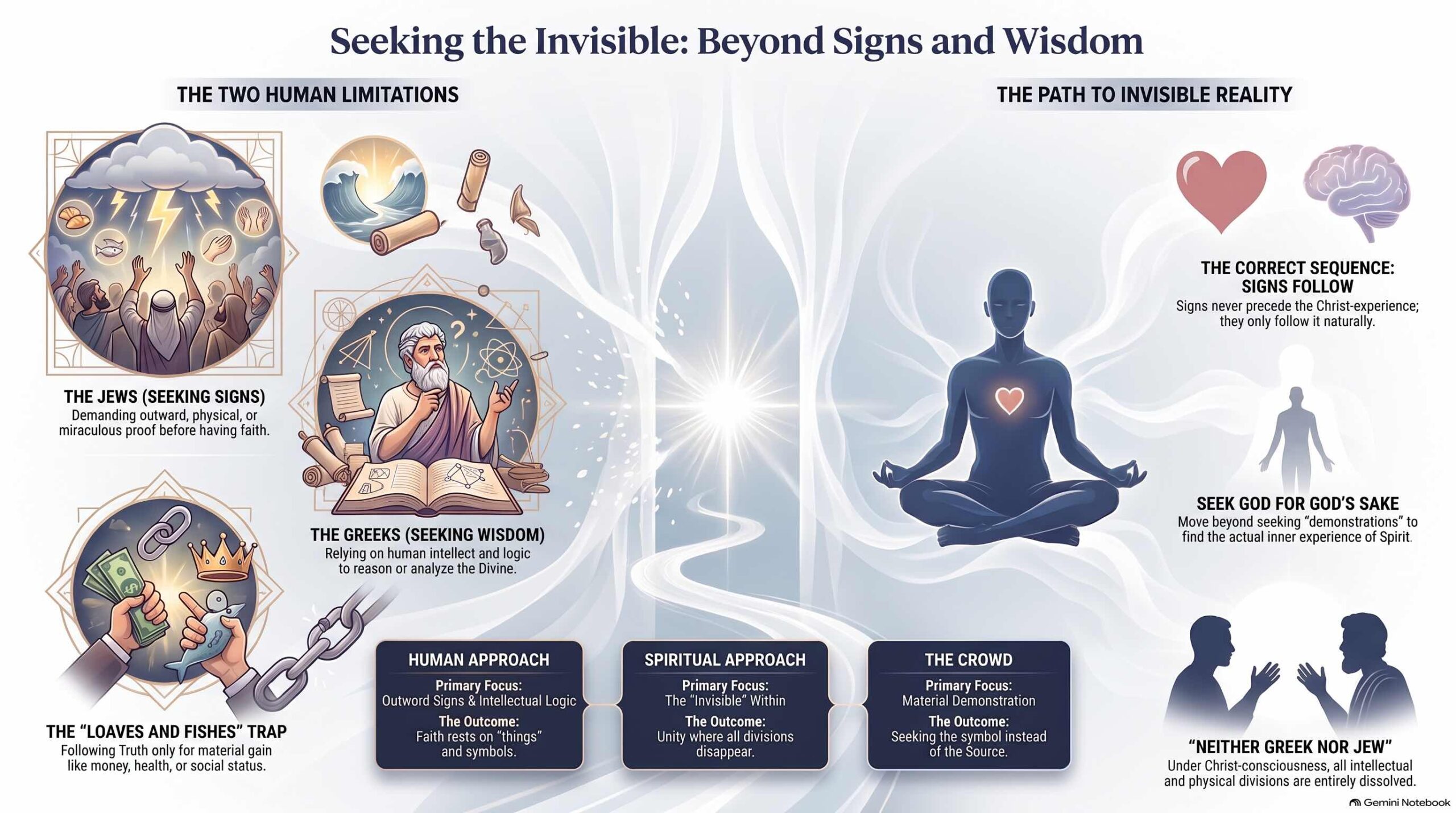
    1 Corinthians 1:18–25


    “I will destroy the wisdom of the wise;
    the intelligence of the intelligent I will frustrate.”

    1 Corinthians 1:18–25


    What is the veil that seemingly separates us from being the gift of Life?

    As long as “I am” stuck in language, concepts, beliefs, assumptions, muscle-memory, there is two – you and me, this and that.

    Jesus says “I and the father are one”; not symbolically, but literally:
    Subject and Reality are the same substance.

    Jesus’ questions are your own questions:
    Who do you say “I am”?

    “It is your Father’s good pleasure to give you the kingdom.”

    “Before Abraham was I am.”

    “I am the Light, I am the way, I am with you always…”

    In thinking we are forever lost and hungry; the strange thing is that the veil is imagined.

    Love.