The following content has been generated by ai – notebooklm.google.com, based on this video:
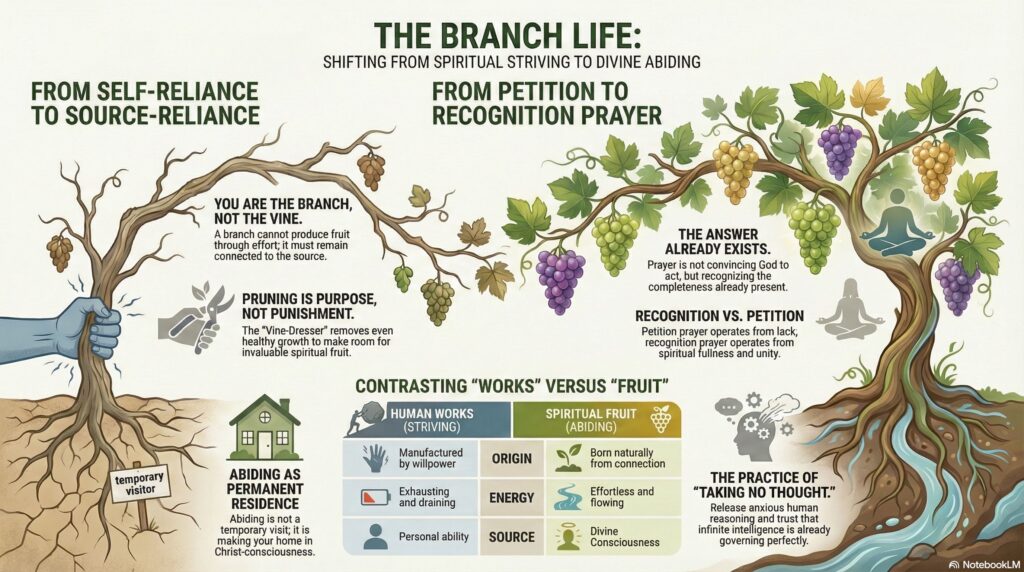
Recognition prayer versus petition prayer
The primary difference between petition and recognition prayer lies in the starting point of the person praying: one begins with a sense of lack and separation, while the other begins with a sense of fullness and unity.
According to the sources, petition prayer seeks to change God’s mind or circumstances, whereas recognition prayer seeks to change the individual’s awareness to perceive a reality that is already complete.
Petition Prayer: The Act of Asking
Traditional petition prayer is often characterized by a “beggar” mentality where the believer pleads for divine intervention.
• Foundation of Separation: It operates under the belief that God is an external deity separate from the individual.
• Focus on Lack: The practitioner prays as if they are missing something, saying, “Please give me what I lack”.
• Attempt to Persuade: It involves begging, pleading, or bargaining, assuming that God must be convinced or informed about a problem.
• Reinforces the Problem: By focusing on the absence of a desired quality (like health or money), petition prayer can inadvertently reinforce the belief in that lack, which may explain why such prayers often feel unanswered.
Recognition Prayer: The Act of Realizing
Recognition prayer is described as a “mystical secret” where the practitioner acknowledges that the answer already exists in divine consciousness before the prayer is even uttered.
• Foundation of Unity: It is based on the understanding that the individual and the Father are one, and that divine consciousness is already present within.
• Focus on Completeness: Instead of asking for something to be created, it acknowledges that wholeness, abundance, and peace are already established in spiritual reality.
• Spiritual Awareness: Rather than a monologue of requests, this prayer is a moment of spiritual realization—seeing through the “world of appearances” to the eternal truth.
• Restful Engagement: Because it assumes the supply is already present, recognition prayer is “restful instead of desperate”.
Comparison at a Glance
| Feature | Petition Prayer | Recognition Prayer |
|---|---|---|
| Primary Goal | To get God to do or send something. | To recognize what God has already done. |
| Mindset | Emptiness and lack. | Fullness and unity. |
| Belief | God is external and must be persuaded. | God is the “infinite consciousness” that you are. |
| Outcome | Often leads to struggle or “white-knuckle” effort. | Leads to a life that is “sustainable” and “effortless”. |
The Shift in Perspective
The sources suggest that moving from petition to recognition transforms the nature of your requests. Instead of asking God to “remove a difficulty,” a person practicing recognition (or “abiding”) might ask to see how divine glory is already being displayed through the situation. This shift is compared to a light switch: you do not generate the electricity (the power); you simply connect to a source that is already flowing.
By recognizing that you are a branch connected to the vine, you stop trying to manufacture “fruit” (results) and instead allow the life of the source to flow through you naturally.