Source: https://bible.intheiam.com/4707/
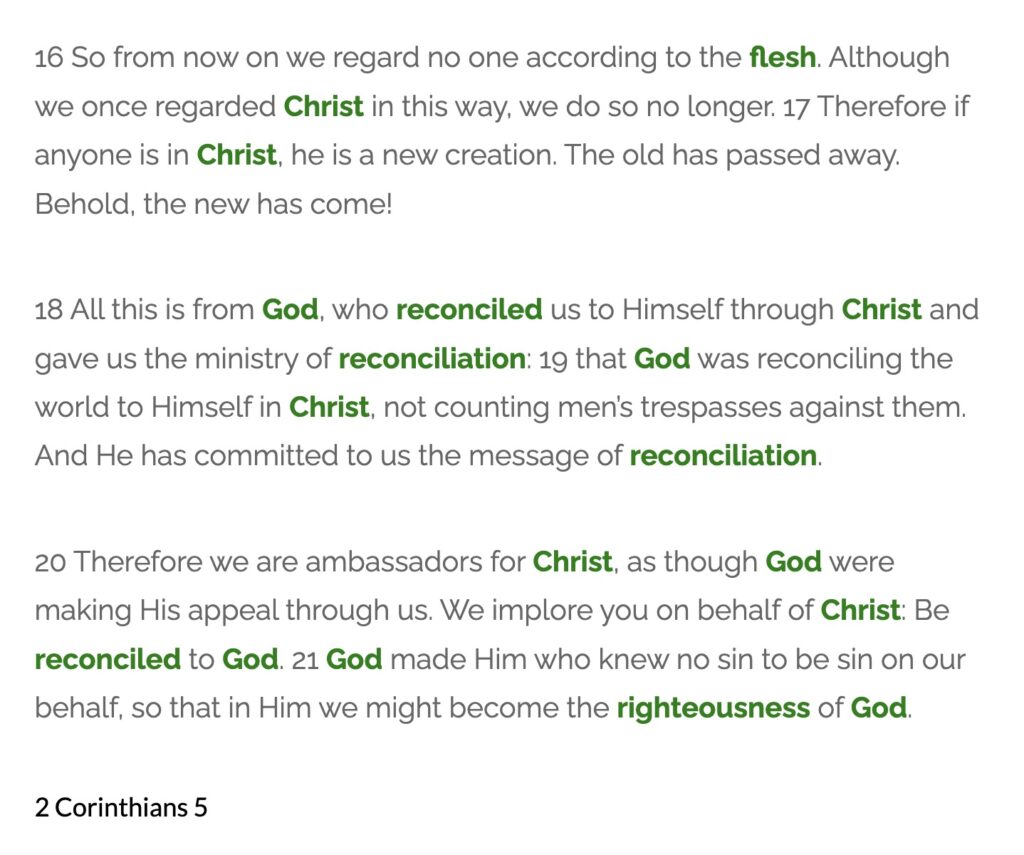
16 So from now on we regard no one according to the flesh. Although we once regarded Christ in this way, we do so no longer. 17 Therefore if anyone is in Christ, he is a new creation. The old has passed away. Behold, the new has come!
18 All this is from God, who reconciled us to Himself through Christ and gave us the ministry of reconciliation: 19 that God was reconciling the world to Himself in Christ, not counting men’s trespasses against them. And He has committed to us the message of reconciliation.
20 Therefore we are ambassadors for Christ, as though God were making His appeal through us. We implore you on behalf of Christ: Be reconciled to God. 21 God made Him who knew no sin to be sin on our behalf, so that in Him we might become the righteousness of God.
2 Corinthians 5
Holger:
Reconciliation = the restoration of friendly relations?
Claude.ai:
The word carries most of this passage’s weight — it recurs five times in four verses (reconciled, reconciliation, reconciling, reconciliation, reconciled), which is probably why it stands out so much in the highlighted version. That drumbeat is deliberate.
Underneath the English is one Greek word family: katallagē (the noun) and katallassō (the verb). Its root sense is exchange — a changing of one state into another — and in ordinary usage it meant the mending of a broken relationship, turning enmity back into friendship. So it’s relational language first, not courtroom or temple language. Of the various pictures the New Testament uses for what Christ accomplishes — redemption (ransom), justification (the law court), sacrifice (the temple) — reconciliation is the most personal of them.
Three things make Paul’s use of it striking:
The direction is surprising. God is the one doing the reconciling in every active verb — “who reconciled us,” “was reconciling the world.” Humans don’t appease an angry deity from below, which was the ordinary religious logic of the ancient world; God moves first and reconciles the world to himself. And the mechanism he names is bookkeeping: “not counting men’s trespasses against them” — the offense simply isn’t tallied.
Then the work is handed off. Having done the reconciling, God gives people “the ministry of reconciliation” and makes them “ambassadors.” Notice the appeal in v.20 is passive — “be reconciled to God.” Since the reconciling is already accomplished, the human part is to stop resisting and receive it.
… the human part is to stop resisting and receive it.
And v.21 is the hinge the whole thing turns on — the “great exchange.” Christ, who knew no sin, is “made sin”; we “become the righteousness of God.” It’s a tidy chiasm, his and ours swapped, and it’s where all your bolded words converge at once (Christ, God, sin, righteousness). The exchange buried in the word katallagē pays off literally right here.
Which thread are you pulling on — the word study itself, or where you’re taking it?

Christ = the wisdom and the power of God.
God = not ‘another’.
Flesh = thoughts, feelings, perceptions.
This world = concepts, thinkyness.
Leave a Reply