Sermon by Pastor Paul Wrightman (August 9, 2026)
The Spirituality of the Twelve Steps:
Step 8 — Making a List
John 5:1-6; Genesis 32:24-28
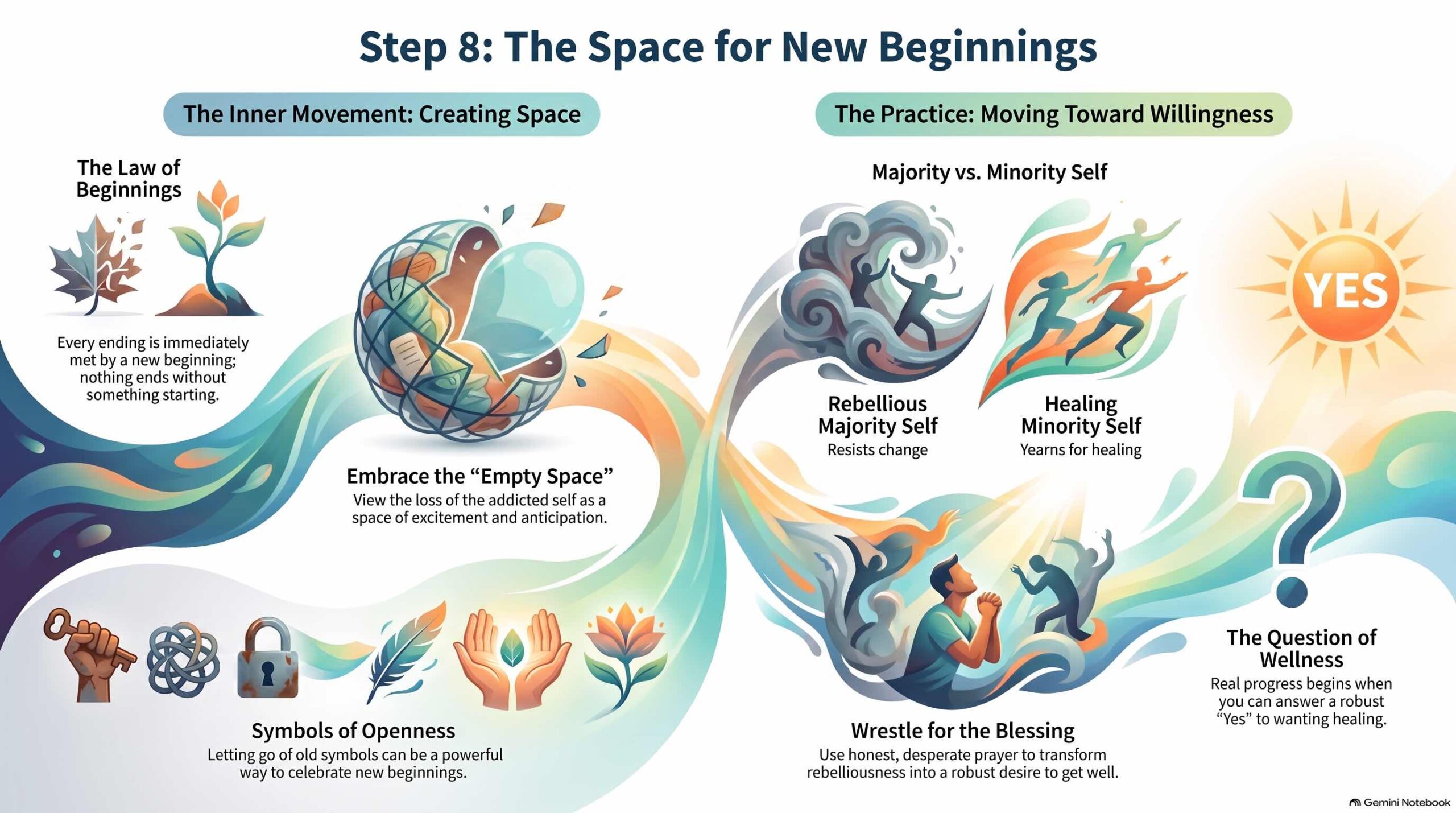
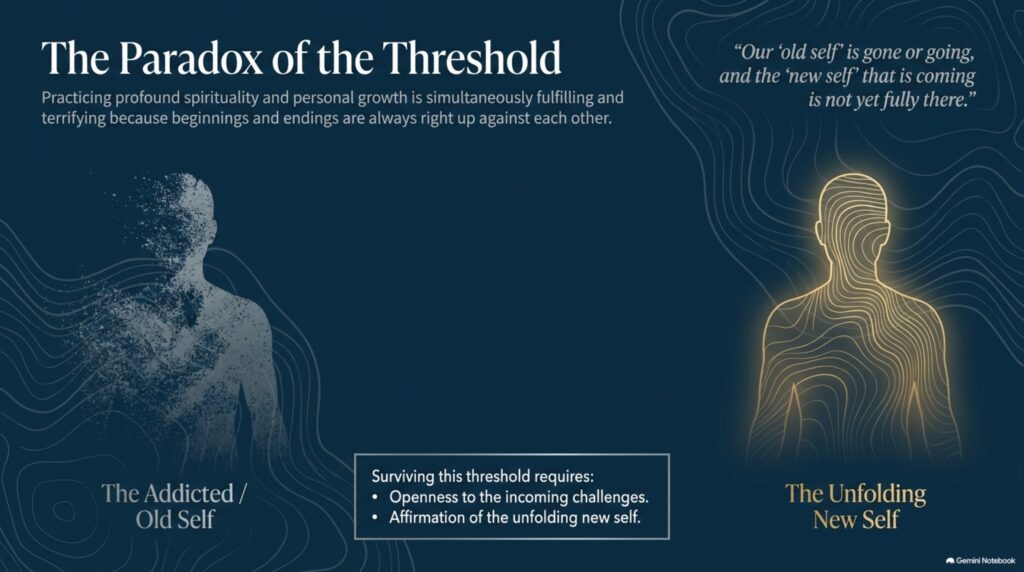
Actually practicing Twelve Step spirituality is at the same time fulfilling — and scary. Each of the steps marks a new beginning and opens up a new dimension of personal growth.
The loss of our addicted self — whether our addiction is to a substance or to an action — can be nothing less than overwhelming. Our “old self” is gone or going, and the “new self” that is coming is not yet fully there.
Throughout this whole process of becoming a new person through practicing the steps, it is vitally important to maintain an attitude of openness and affirmation — openness to whatever challenges and blessings the next step will bring, and affirmation of one’s new self as it unfolds.
Sometimes symbols can help us on our journey. I know persons who have chosen to wear a special symbol — such as a key or a cross or an infinity sign — to express their openness to the new beginnings taking place in their lives through the practice of Twelve Step spirituality.
And sometimes letting go of old symbols and not replacing them can be a striking way of celebrating one’s openness to new beginnings. Sometimes simply losing something “old” and choosing not to replace it can be a highly symbolic act, as it is in this story from Dr. Rachel Naomi Remen.
Please remember that these stories from the life of Dr. Remen are not intended to directly correlate with a particular step, but to describe an important inner movement that is helpful in approaching the steps as a whole.
Dr. Remen writes:
I was thirty-five years old before I understood that there is no ending without a beginning.
That beginnings and endings are always right up against each other. Nothing ever ends without something else beginning or begins without something else ending. . . .
For a long time I never noticed the beginnings. That was one of the first things that changed for me when I entered the Institute for the Study of Humanistic Medicine at Esalen.
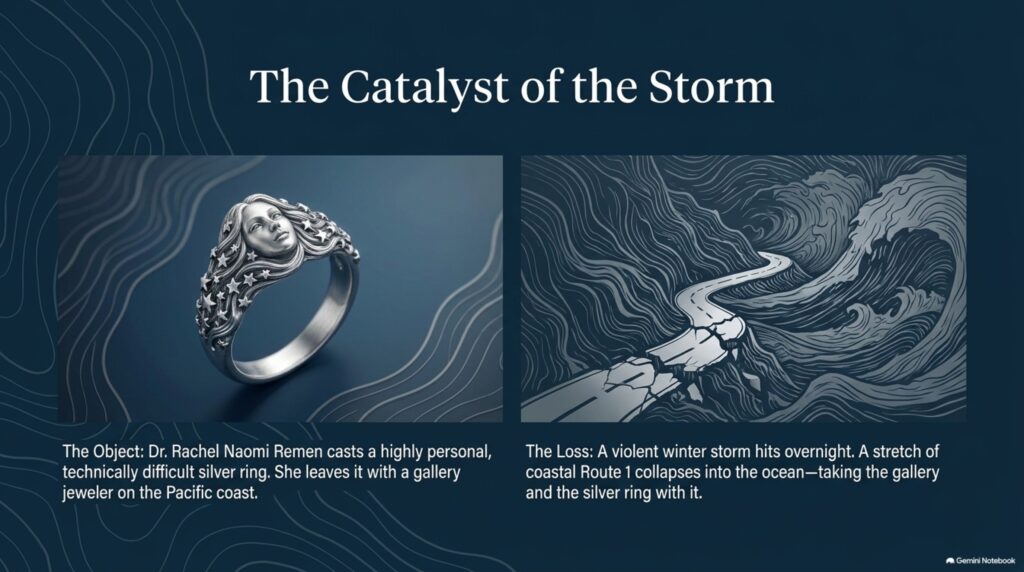
At that time I was just learning how to make jewelry and had cast a silver ring. The design was the head of a woman, whose long hair, entangled with stars, wound around your finger and formed the ring shank. Technically, it had been difficult to make, and I was proud of the design.
I finished it in time to wear to one of the first weekend sessions at Esalen. The ring attracted a great deal of attention.
At that time many craftsmen were in residence at Esalen, and several suggested that I drive back up the coast a few miles and show it to the jeweler at a gallery I had passed next to the road.
It was about to rain, but I made the trip anyway and had a wonderful afternoon. The jeweler, a gentle man and a gifted artist, had offered me tea, and we spent an hour or so talking about beauty and the ways in which art reminds people of the soul. Heady conversation for a young academic physician.
In the end, I left my ring with him so that he could recast it and sell it to others.
I drove down Route 1 with difficulty. Some serious rain had begun and the wind was strong enough to push my car a little on the road.
During the night, a wild and violent storm, the last of a long series of winter storms, hit the coast. At breakfast, without electricity and heat, I was shocked to hear that we were isolated. A stretch of Route 1 north of Esalen had fallen into the ocean. We would have to drive many miles south and go inland in order to go north and get back to San Francisco.
The gallery where I had left my ring had stood next to the stretch of road that had washed into the Pacific. [The owner had made it out just in time.] The building was gone and my ring with it.
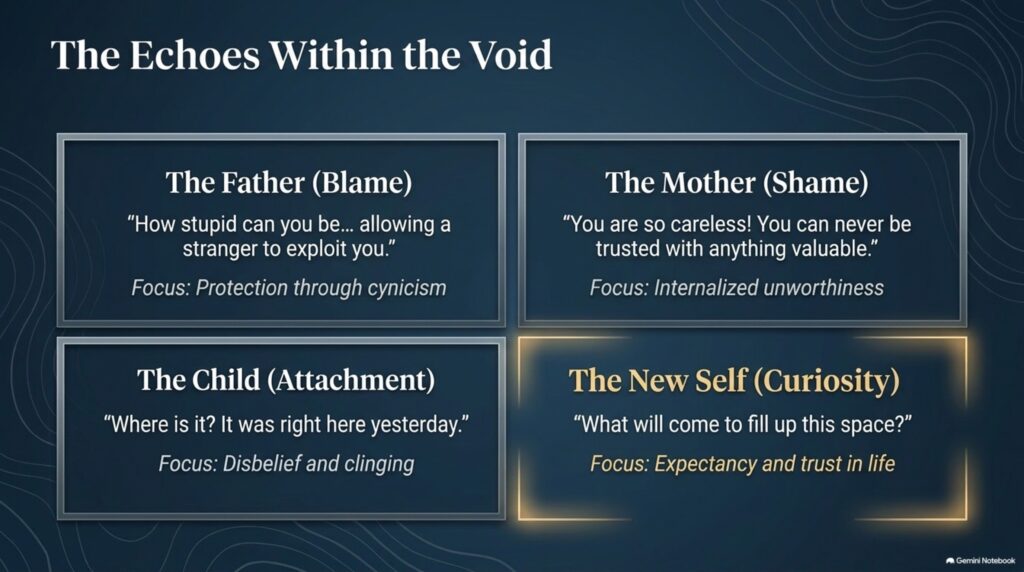
Through my numbness, I could hear several inner voices commenting on my loss. The loudest was my father’s, saying, “This would never have happened if you hadn’t allowed a total stranger to exploit you and make a profit from your design. How stupid can you be, and you a doctor.”
And my mother: “You are so careless! You can never be trusted with anything valuable. You always forget things and lose things.”
Mixed in was the voice of a very young part of myself that kept looking at the place on my hand where the ring had been yesterday and saying, “Where is it? It was right here.”
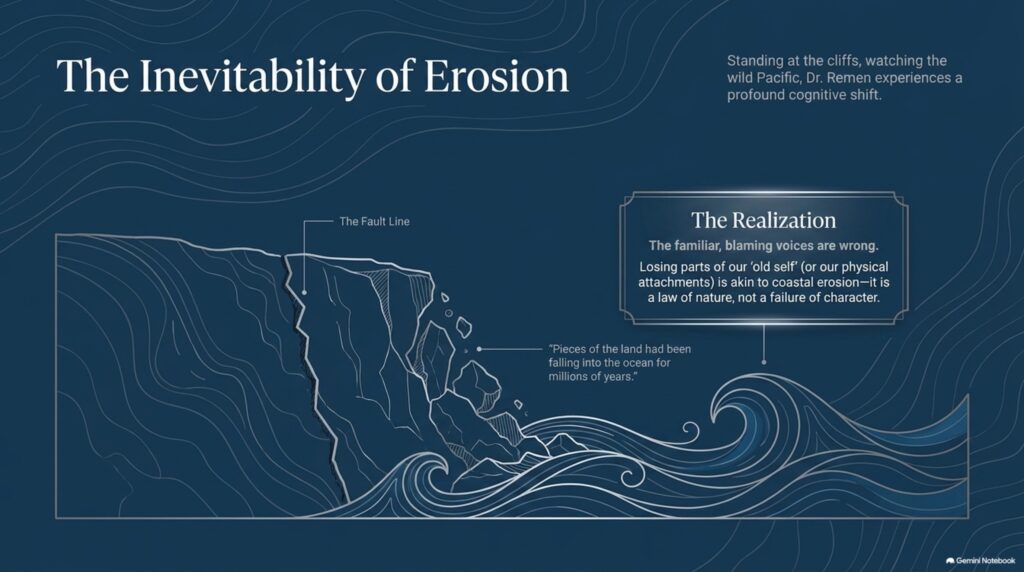
In anguish, I went to the edge of the cliffs and stood looking at the Pacific, still wild from yesterday’s storm. Down there somewhere was my ring.
As I watched the ocean hammer the cliffs, it began to occur to me that there was something rather natural, even inevitable, about what had happened. Pieces of the land had been falling into the ocean for millions of years. Perhaps all those familiar blaming voices were wrong. . . .
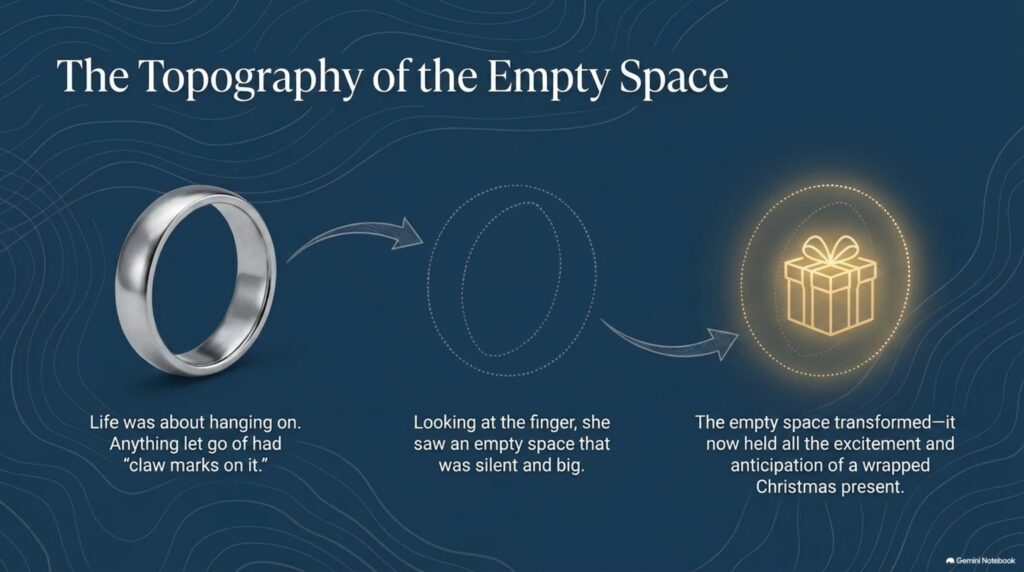
I looked at the place on my finger again. This time it really was an empty space. And silent. It was big. For the first time, I faced a loss with a sense of curiosity. What would come to fill up this space? . . .
I was thirty-five years old and I had never trusted life before. I had never allowed any empty spaces. Like my family, I had believed that empty spaces remained empty. Life had been about hanging on to what you had. . . . Anything I had ever let go of had claw marks on it.
Yet this empty space had become different. It held all the excitement and anticipation of a wrapped Christmas present. (End quote)
One of the things I most appreciate about Dr. Remen’s stories is how she is able to deeply listen to her own experience and learn from it. In the story that I just shared, what could have been chalked up as just another encounter with loss became a major event of learning. This was able to happen because Dr. Remen was finely attuned to her feelings, to all of her feelings, and because she was receptive to new insights and new realities unfolding in her life.
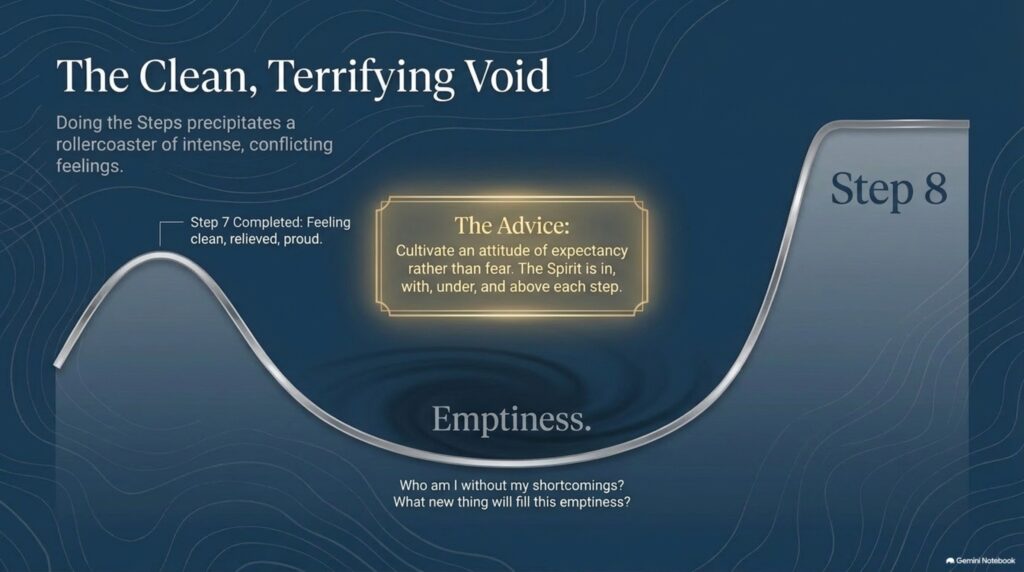
As many of us have found, actually doing the steps precipitates a rollercoaster of intense and often conflicting feelings. These feelings can scare us into trying to tightly bottle them up — or — we can choose to allow them to be our teachers. Instead of fleeing from the intensity and diversity of our feelings, we can celebrate them as manifestations of the new being we are becoming.
The first time I made it through Step Seven (notice that I said “first time,” implying a second and third time. I suspect that the steps are intended to be repeated — that they are a loop instead of a line) — the first time I made it through Step Seven, humbly ask God to remove my shortcomings, I felt clean, relieved, proud . . . and rather empty (after all, I did not yet know who I was without my shortcomings).
I also felt rather afraid of what new thing would come along to fill up my emptiness. I shared this concern with a gruff-and-tough Lutheran minister friend of mine, and he surprised me by saying that since God’s Spirit was “in, with, under, and above” each of the steps, I had nothing to be afraid of and instead should try to cultivate an attitude of expectancy and thankfulness.
This turned out to be very good advice as I approached the dreaded Eighth and Ninth Steps: made a list of all the persons I had harmed, and became willing to make amends to them all (Step 8), and then made amends to such people wherever possible (Step 9).
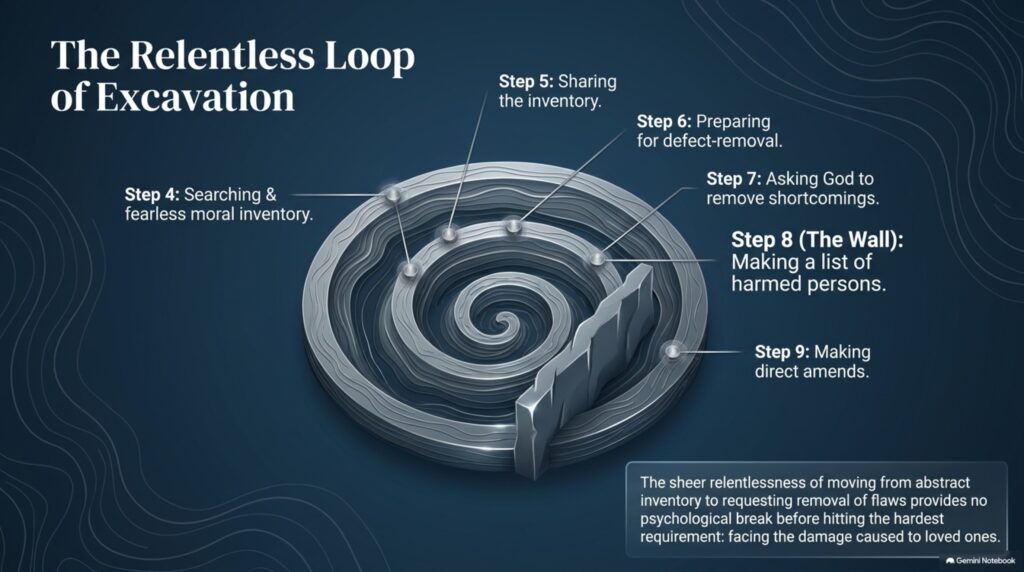
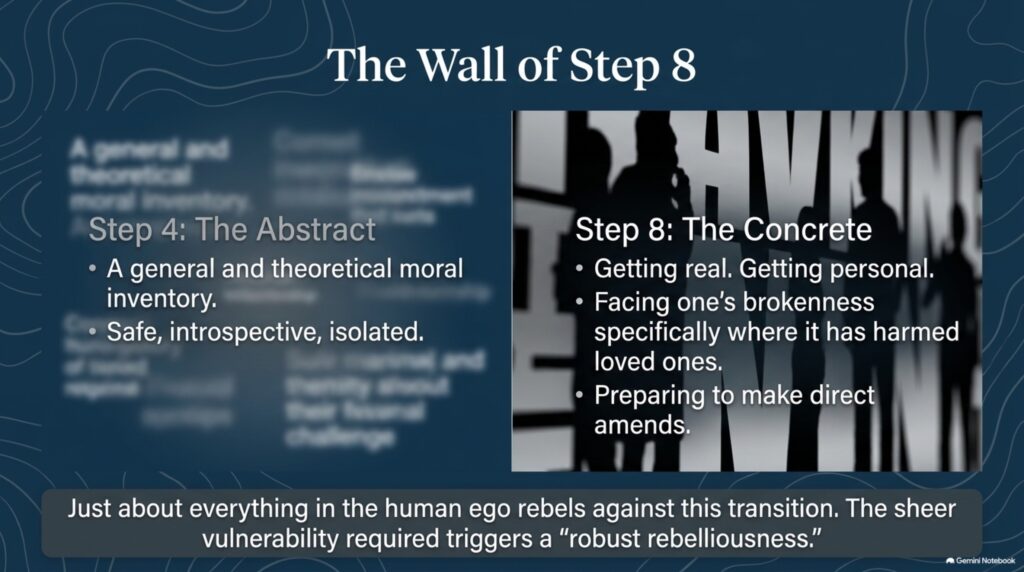
The relentlessness of the steps was getting to me. It seemed that there was no break between making a searching and fearless moral inventory (Step 4), sharing this inventory with God and another person (Step 5), preparing to ask for character-defect-removal (Step 6), actually asking God to remove my shortcomings (Step 7), and now being asked to make yet another list, this list being the hardest of them all: a list of all the persons I had harmed (Step 8), and somehow becoming willing to make amends to them all (Step 9).
Just about everything in me rebelled against taking Step 8. Unlike the rather general and abstract moral inventory I had made in Step Four, Step Eight required me to get real, to get personal. It required me to do some serious remembering, to actually face my own brokenness as it had harmed the lives of others — often the lives of those I loved the most. It required me to dare to make a list of these persons, and then to continue to dare by preparing to make amends.
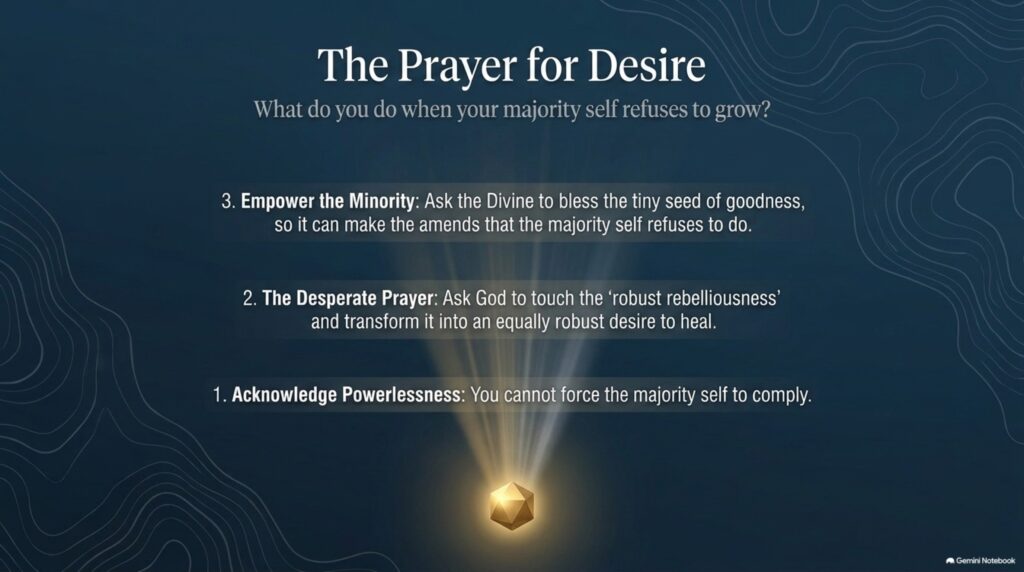
Since I had absolutely no desire to do Step Eight — yet was committed to the program — the only honest prayer that I could come up with was a simple, rather desperate prayer that God would touch my robust rebelliousness, and transform it into an equally robust desire to get well.
After this prayer of desperation — admittedly prayed more than once — perhaps for the first time in my life, I was able to face my rebellious feelings instead of running away from them.
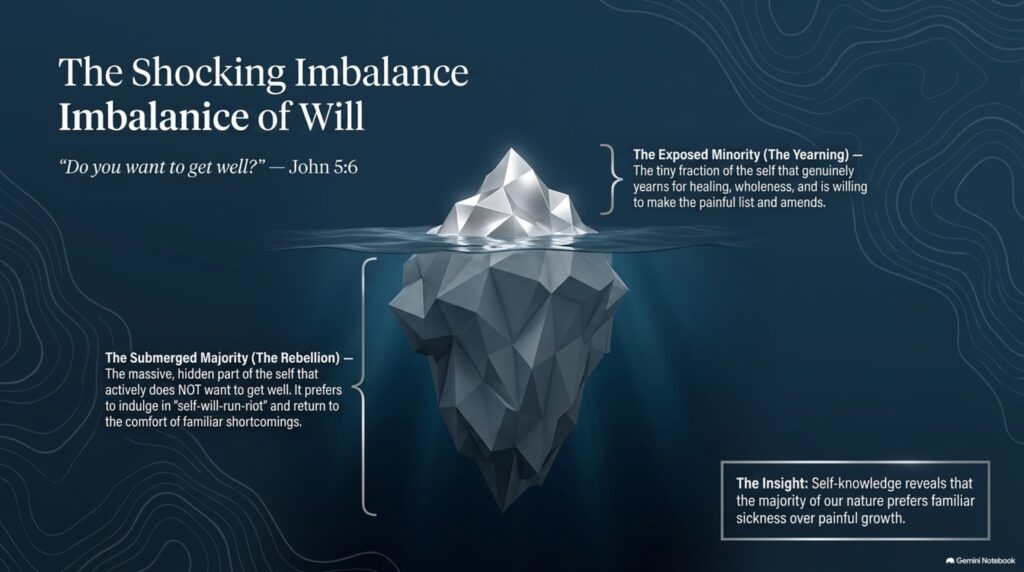
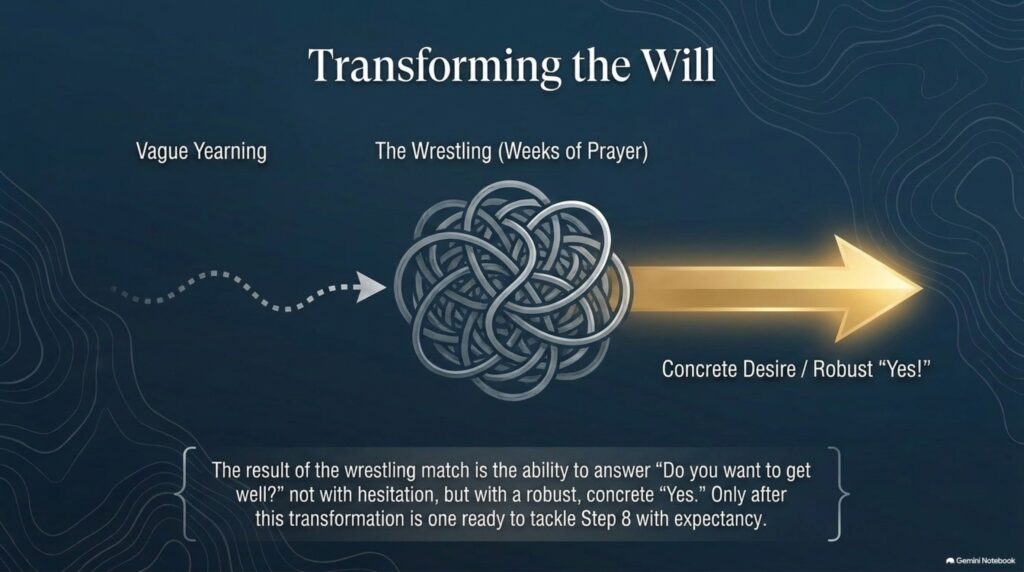
When I actually faced my feelings — allowed myself to really experience them — I was shocked and surprised to find Jesus asking me the same question that he posed to a paralyzed person at the pool of Bethesda: “Do you want to get well?” (John 5:6)
“Do you want to get well?” Still pushing myself to confront my feelings, pushing myself to be honest with them, I was dumbfounded to realize that the majority part of me did not want to get well, wanted nothing to do with being healed, and would rather continue to indulge in my self-will-run-riot, no matter how destructive to myself and to my most important relationships.
Self-knowledge is not only difficult to come by, but once found is often highly uncomfortable, and seems to leave one worse off than before.
But many months before I had made a serious decision to trust the process of the steps, no matter how difficult, no matter how uneasy they might make me feel at times.
What to do when the majority part of yourself wants to rebel against any further growth and return to the comfort of one’s shortcomings? What to do when the minority part of yourself yearns for healing and wholeness, even if that healing and wholeness is contingent on making a list and making amends? What to do?
Why, pray for the desire to have God’s Spirit empower one’s minority self to make the list and make the amends that one’s majority self cannot. Sometimes all we can do is to ask God to bless the seed of goodness in us, and, in spite of our rebellious, broken selves, grow it and us into the image of God that each of us is meant to be.
I seriously scared myself when I realized that a good part of me did not want to get well. In fact, this realization scared me so badly that I began praying in earnest for the desire to get well.
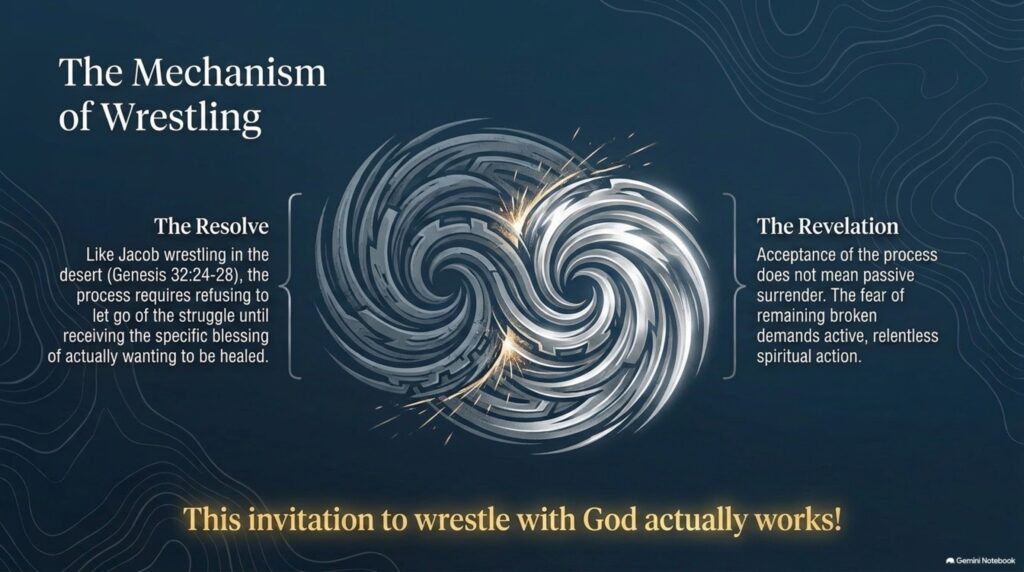
I was so afraid of being left in my brokenness that I resolved, like Jacob in his wrestling match with God in our reading from the Hebrew Scriptures, not to let God go until I received the blessing of actually wanting to be healed.
What I found was that this invitation to wrestle with God actually works! Let me repeat that: this invitation to wrestle with God actually works! Jacob’s story stands as an open-ended invite for each of us, for all of us.
After several weeks of praying that God would transform my vague yearning to be healed into a concrete desire for wellness in myself and in my relationships, I realized that I could answer a robust “Yes!” to Jesus’ question “Do you want to get well?”
Only then was I able to move on to complete Step Eight, made a list of all the persons I had harmed, and became willing to make amends to them all, with a sense of expectancy and thankfulness.
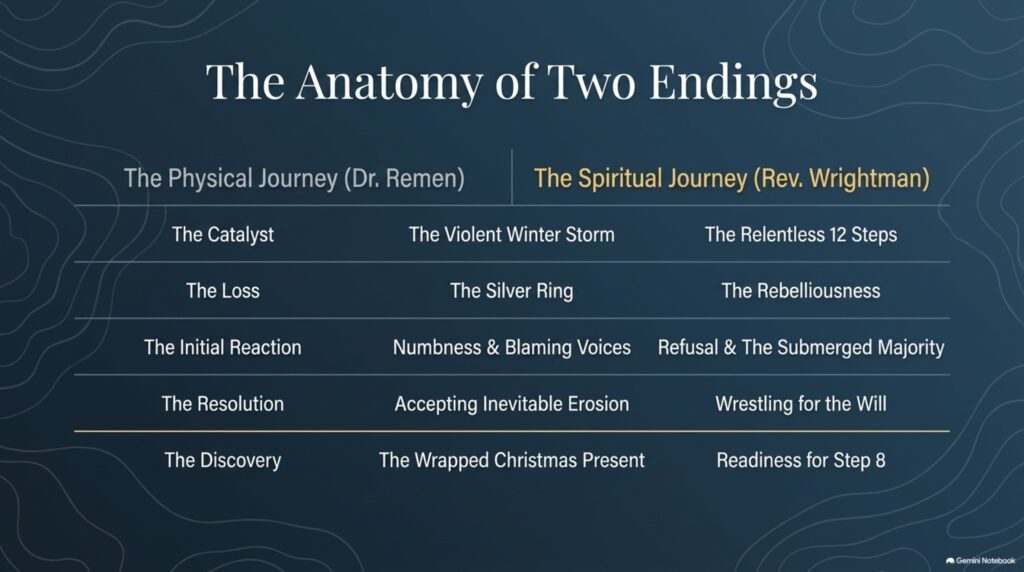
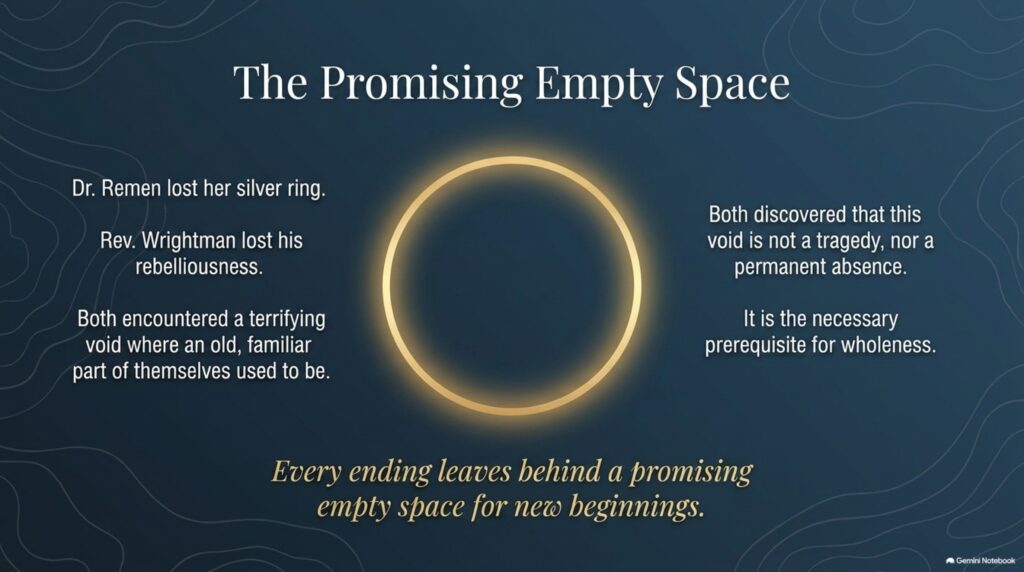
Parallel to Rachel Naomi Remen’s losing her ring, I lost my rebelliousness. And like her looking at that empty space on her finger, I found a promising empty space for new beginnings.
Amen.
Ai generated infographic, based on the Sermon
Paul Wrightman pastors at the Community Church of the Monterey Peninsula, California:
-
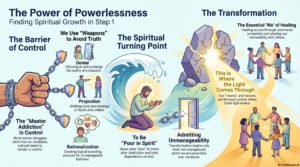
Pastor Paul: Step 1 – The Power Of Powerlessness
Sermon June 14, 2026 “The Spirituality Of The Twelve Steps”
-
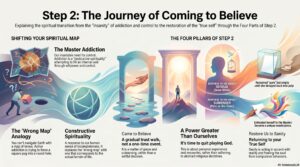
Pastor Paul: Step 2 – Came to Believe
Sermon June 21, 2026 “The Spirituality Of The Twelve Steps”
-
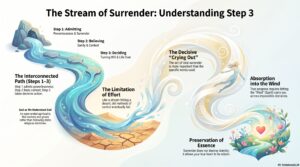
Pastor Paul: Step 3 – Choosing God
Sermon June 28, 2026 “The Spirituality Of The Twelve Steps”
-
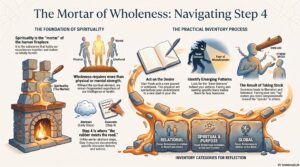
Pastor Paul: Step 4 – Taking Stock
Sermon July 5, 2026 “The Spirituality Of The Twelve Steps”
-
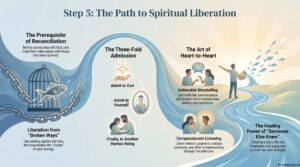
Pastor Paul: Step 5 – Heart-To-Heart
Sermon July 12, 2026 “The Spirituality Of The Twelve Steps”
-
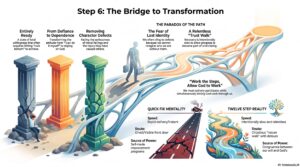
Pastor Paul: Step 6 – Becoming Ready
Sermon July 26, 2026 “The Spirituality Of The Twelve Steps”
-
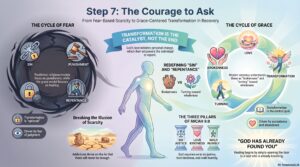
Pastor Paul: Step 7 – The Courage to Ask
Sermon August 2, 2026 “The Spirituality Of The Twelve Steps”
-
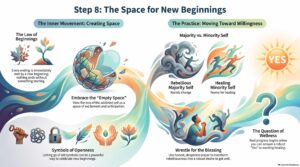
Pastor Paul: Step 8 — Making a List
Sermon August 9, 2026 “The Spirituality Of The Twelve Steps”
-
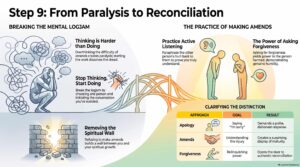
Pastor Paul: Step 9 – Embodied Reconciliation
Sermon August 16, 2026 “The Spirituality Of The Twelve Steps”
-
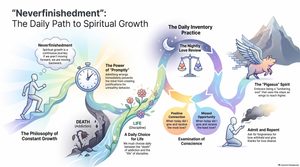
Pastor Paul: Step 10 – Neverfinishedment
Sermon August 23, 2026 “The Spirituality Of The Twelve Steps”
-
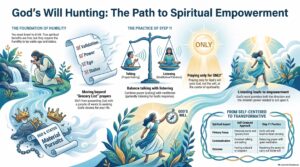
Pastor Paul: Step 11 – God’s Will Hunting
Sermon August 30, 2026 “The Spirituality Of The Twelve Steps”
-
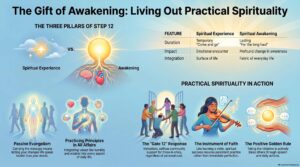
Pastor Paul: Step 12 – The Gift of Awakening
Sermon September 6, 2026 “The Spirituality Of The Twelve Steps”
-
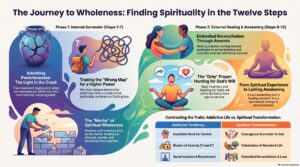
Ai’s take on Pastor Paul’s 12 Step Sermons
Sermon September 6, 2026 “The Spirituality Of The Twelve Steps”
Leave a Reply