Sermon by Pastor Paul Wrightman (July 12, 2026)
The Spirituality of the Twelve Steps:
Step 5: Heart-to-Heart
1 John 1:8-10; Matthew 5:23-24; Psalm 103:1-5, 8, 11-13, 22
As most of you know, we are in the middle of a sermon series on the spirituality of the Twelve Steps. If you are new to the series, or are missing one or more of the sermons, just let me know and I can get one to you by email, or give you a hard copy.
As many in our congregation already know, one does not have to be an active member of a Twelve Step group in order to benefit from the profound understanding of spiritual growth in the Steps. The fifth Step, which we are considering this morning, assumes that we know how to tell our own story, and listen to the stories of others.
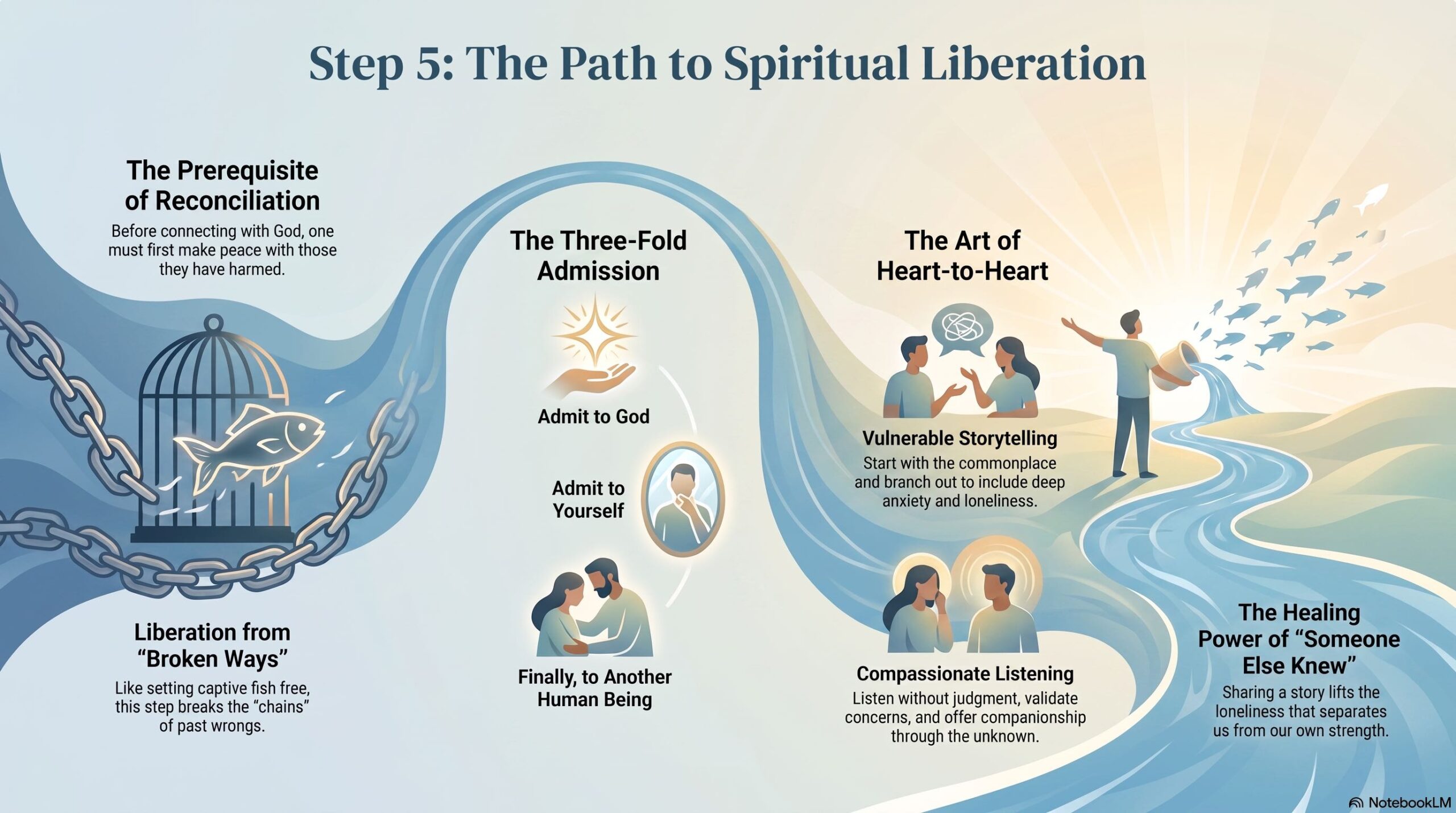
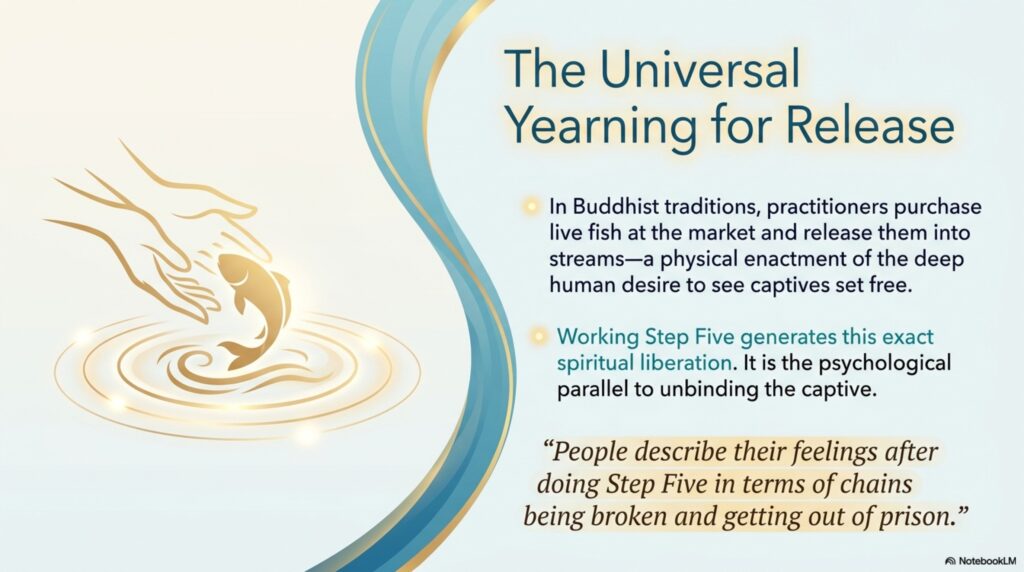
There is a beautiful practice that runs through all the branches of the Buddhist tradition, which celebrates the promise of freedom. Live fish are bought at the market, taken to a stream or to the sea, and set free. What was held captive is released; what was bound is given freedom. What a powerful, and powerfully moving, way to enact one’s yearning to be free.
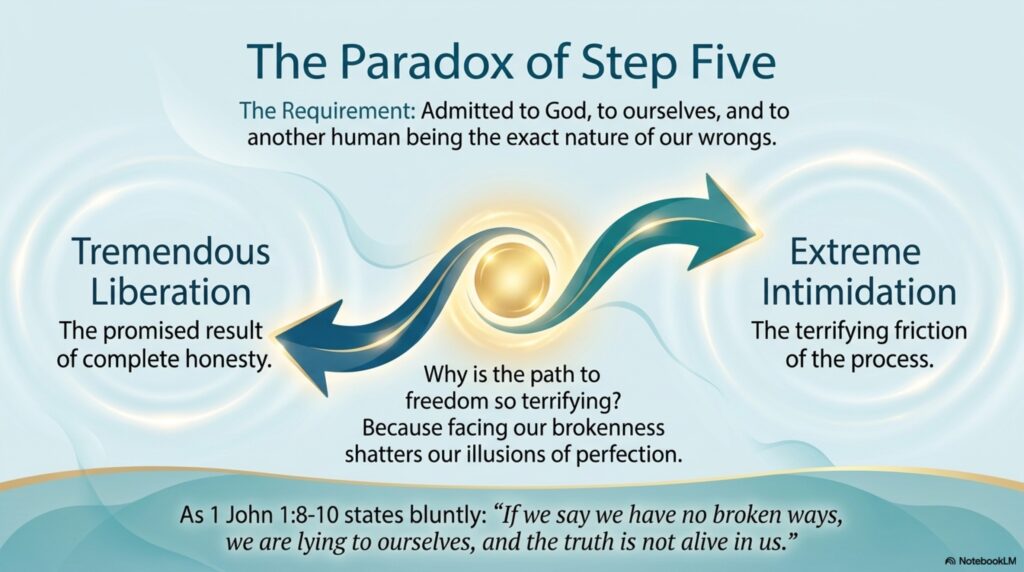
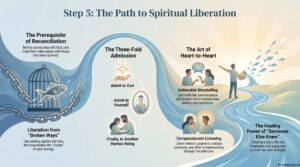
As literally millions of persons have experienced, actually working Step Five leads to a tremendous sense of liberation. Step Five reads: admitted to God, to ourselves, and to another human being the exact nature of our wrongs. People describe their feelings after doing Step Five in terms of chains being broken and getting out of prison.
Of course, to experience the liberation that Step Five brings involves actually doing Step Five, which many describe as being extremely intimidating to them. It is intimidating, first of all, because Step Five involves acknowledging the truth of what the apostle John says in his first letter, when he states bluntly that “if we say we have no broken ways, we are lying to ourselves, and the truth is not alive in us.”
Numerous people have stated that admitting one’s faults to God and to oneself was not all that difficult, but that admitting the exact nature of our wrongs to another human being was perhaps the scariest thing that they had ever done.
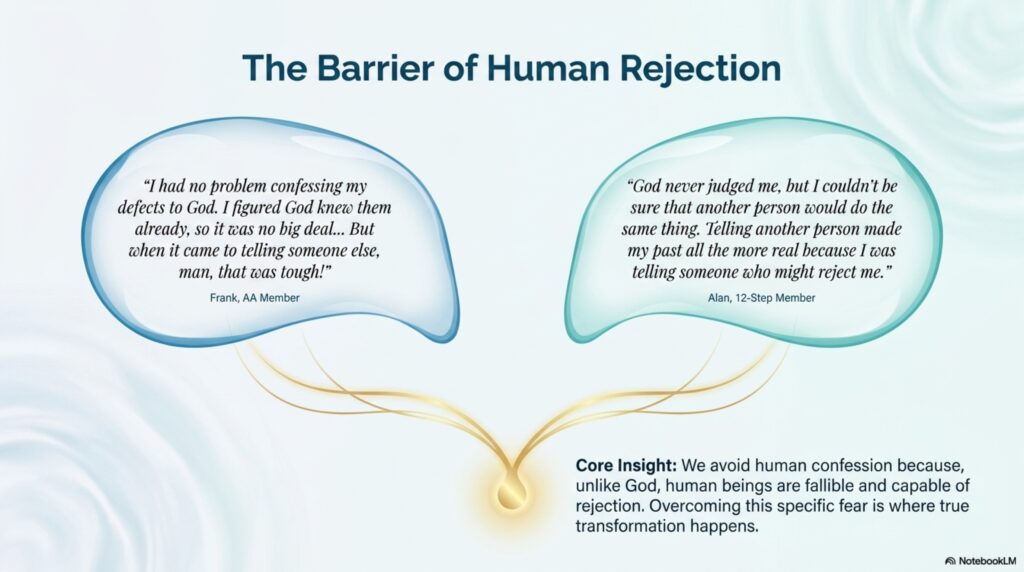
“I had no problem confessing my defects to God,” Frank, a middle-aged insurance salesman, said at an AA meeting. “I figured God knew them already, so it was no big deal. And it was easy to confess them to myself, because I knew them as well as God did. But when it came to telling someone else, man, that was tough!”
Alan, talking in a Twelve Step meeting about his difficulties with Step Five, said:
“I could tell God anything… and I was clear with myself, but admitting my faults to another human being was almost impossible for me. I avoided it for months. I think what frightened me was the reaction I might get. God never judged me, but I couldn’t be sure that another person, even my sponsor, would do the same thing. Telling another person made my past all the more real because I was telling someone who might reject me, and rejection is one of the things I fear the most.”
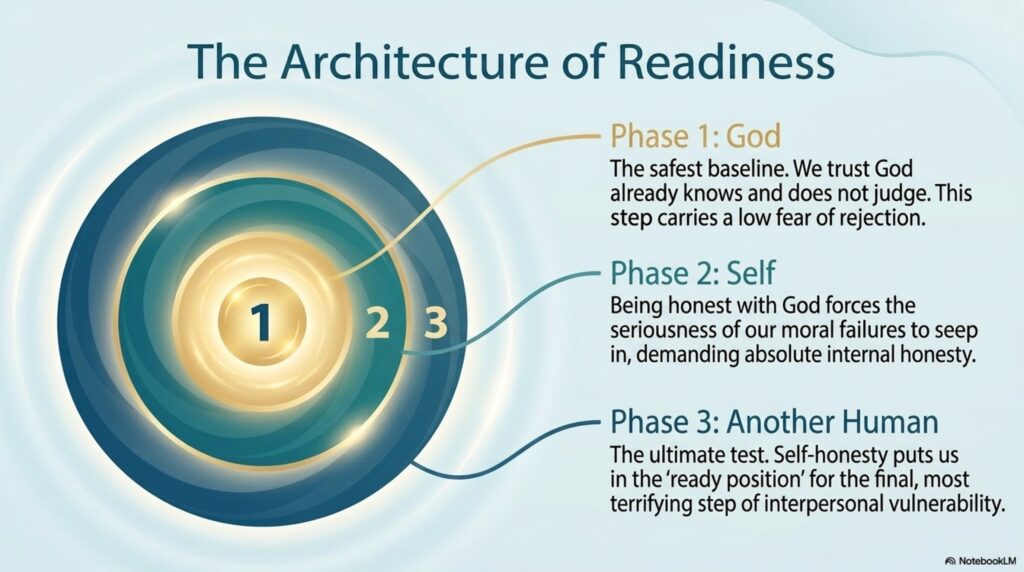
There is a deep wisdom in the progression of Step Five in first talking to God, then to oneself, and, finally, to another human being. Most of us trust God enough that we can acknowledge our flaws without too much fear. If we are really honest with God about our moral failures, however, the seriousness of what we are doing begins to seep in, and we are pushed to be honest with ourselves. Being honest with ourselves, in turn, puts us in the “ready” position for being honest with another human being.
There is something inherently healing when we share our story with another human being, and that other person actively listens and then responds with compassion.
Although not in itself a Twelve Step story, the following personal account from Dr. Rachel Naomi Remen captures the transformation that can happen in a mutual event of storytelling and storylistening.
For those of you not familiar with the work of Dr. Remen, she was a wonderful Jewish MD, early in her career a professor at Stanford, and in her prime a professor at UCSF — where our own Joe Owens now works. Rachel Naomi Remen was a pioneer in holistic and integrative medicine, and the author of two award-winning, nationally best-selling books exploring the interface between spirituality and medicine.
Dr. Remen writes:
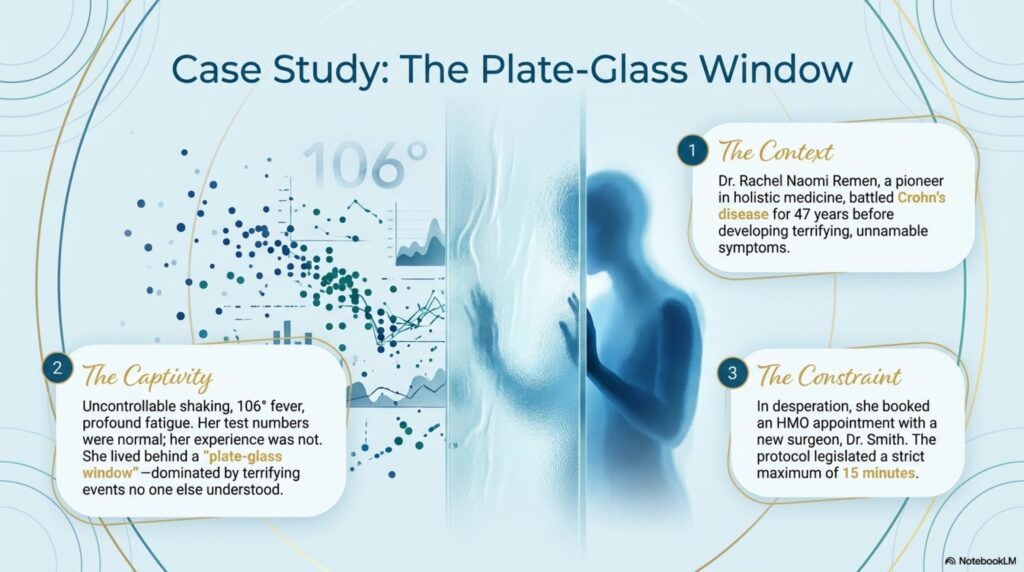
“I have had [a serious chronic illness, Crohn’s disease] for forty-seven years. In 1981, after feeling quite well for some time, I began to have mysterious and frightening symptoms. Sometimes, in the midst of some ordinary activity, I would begin to shake uncontrollably, and within minutes my temperature would rise to 106. Other times I would grow flushed and experience the acute onset of such profound fatigue that, if I were out, I would barely be able to get home. My physicians ordered progressively more sophisticated tests without finding any answers. My numbers were normal, but I, decidedly, was not.
Over a period of several months, these symptoms grew more frequent and severe. I continued to visit my doctors regularly, more because I did not know what else to do than because I thought they could offer an explanation or help. Eventually, I stopped telling them some of the more unusual things that I was experiencing. I felt they no longer wanted to hear.
As things became worse, I began to feel that something very dangerous was happening to me that no one could even name. The fear this caused me is impossible to describe. It seemed to me that I was looking at the world through a plate-glass window, caught up in a set of events that dominated my life, and that no one else experienced or understood.
In desperation, I made an appointment to see yet another doctor, a surgeon who had sat with me on the advisory board of a research project. Dr. Smith was the head of the department of surgery in a large HMO, a … health plan whose protocol legislated the length of time that a doctor could spend with a patient during any single visit. We would have fifteen minutes together.
Sitting in a tiny examining room waiting, I regretted making this appointment. It would probably be a waste of time. What could this man possibly do to be of help in fifteen minutes when several other physicians had not been able to offer much despite hours of their time?
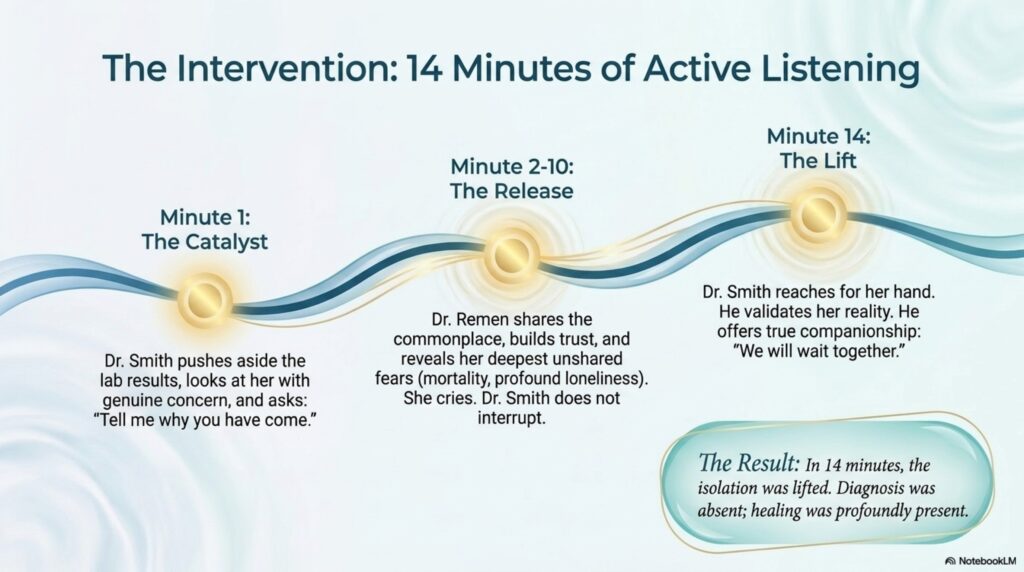
There was a soft knock on the door and Dr. Smith entered. He greeted me and then spent a few minutes sitting quietly and reading over the lab results and X-ray studies I had brought with me. Then he leaned toward me and said, “Tell me why you have come.”
I looked into his face and saw genuine concern. I began to tell him all the things I was experiencing, starting with the more commonplace and finally including such things as the strange taste that often awakened me from sleep, and the times when I suddenly lost all sense of direction and was unable to remember how to get home. My voice shook a little. He continued to listen.
Slowly I began to tell him other things, things I had not told anyone else. How the doctor who had first diagnosed my illness had told me I would die before I was forty, that my father had unexpectedly died a few months previously because of a medication error, and I had brought my mother, ill with severe heart disease, across the country to live with me. I shared my anxiety about being able to care adequately with her complex needs, the worry that my present health problems might cause me to let my own patients down, the loneliness I felt when friends went on without me because I could no longer keep up.
Eventually I said it all and then I just cried. It took no more than nine or ten minutes to tell my whole story. Dr. Smith said nothing to interrupt and just listened closely. When I had finished, he asked a few questions that showed me he had heard and fully understood.
Then he reached for my hand and told me he realized how hard things were. He validated my concerns. Despite the strangeness of these happenings, this was not all in my head. ‘There is no question that there is something going on that we do not yet understand,’ he told me. He reminded me that my lab studies had ruled out any truly life-threatening possibilities. He assured me that eventually whatever this was would declare itself more clearly, and when it did, if there was a surgical solution, he would be there.
He looked at me and smiled. ‘We will wait together,’ he told me. Like the others, he had no diagnosis. What he offered was his caring and companionship, his willingness to face the unknown with me. In fourteen minutes he had lifted the loneliness that had separated me from others and from my own strength.
In some way that I didn’t understand, this made all the difference. Someone else knew, someone else cared, and because of this I found I had the courage to deal with whatever was going to happen. Several months later, when the great abscess hidden deep in my abdomen finally appeared on an X-ray, it was he who did my surgery.”
This story from Dr. Remen is a moving example of the healing that can happen when we share our deepest self with another person.
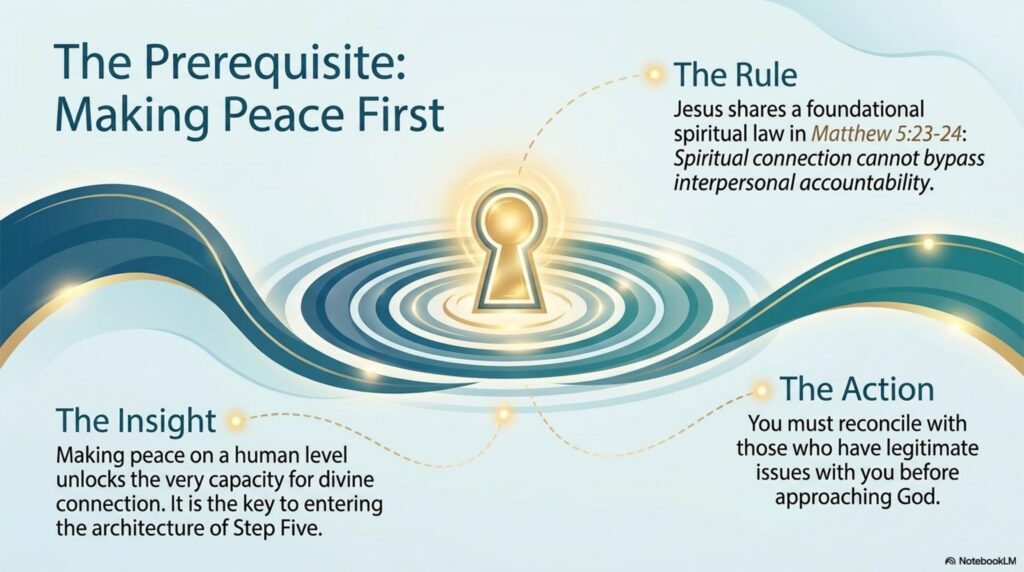
Before we can make a meaningful Step Five in terms of approaching God, we must first put into action what Jesus admonishes us to do in the Sermon on the Mount when he tells us unequivocally that before we can truly connect with God, we must first make peace with anyone who has anything against us. Jesus is sharing a foundational spiritual law here: before we can fully approach God, we must first be reconciled with those persons in our lives who have legitimate issues with us.
The next step in making a meaningful Step Five is to find a person who knows how to listen. Whether it is sharing health concerns, like Dr. Remen, or the exact nature of our wrongs, as in Step Five, the dynamics of good storytelling and good storyhearing are the same.
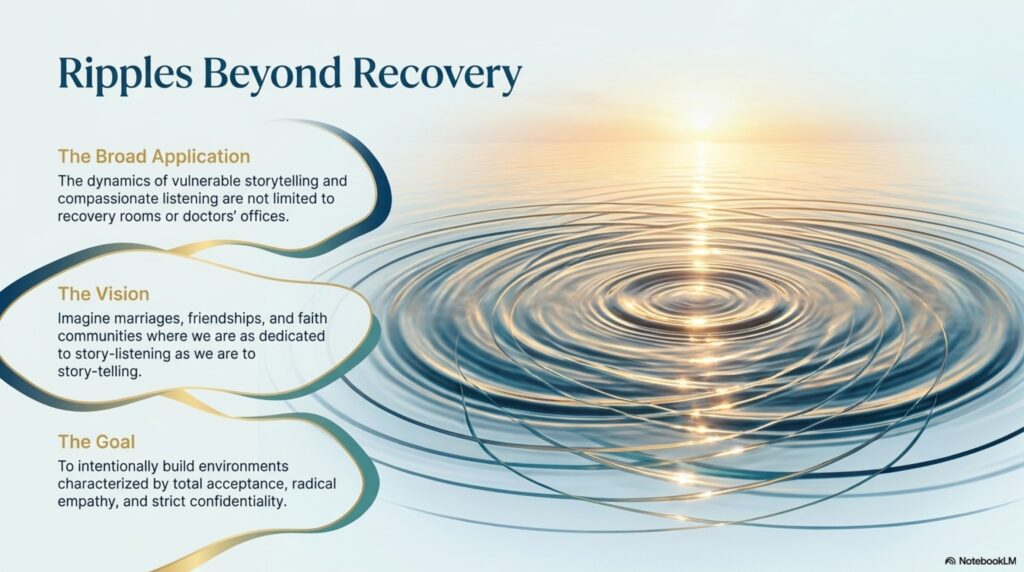
Let’s look closely at the account I just shared from Dr. Remen to see what we can learn from it in terms of how to share our own fifth Step story, and in terms of how we might best listen to another’s story. One of our heartfelt desires here at Community Church is to be a place where we can share our deepest stories — including fifth Step stories — with one another and find acceptance, empathy, care, and confidentiality.
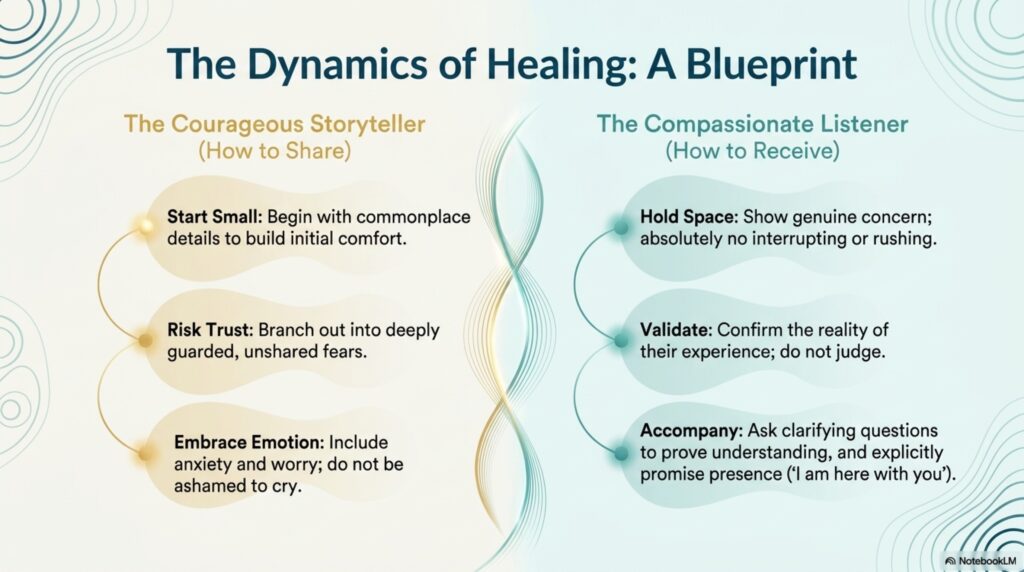
From Dr. Remen, we learn to begin at the beginning, and to begin with the commonplace, branching out from there. As we become more comfortable in the telling, we take the risk of trusting the person with whom we are sharing, trusting that person enough to share with him or her things we have never before shared with another human being. We include our anxiety and worry and loneliness and are not ashamed to cry.
We learn from Dr. Smith what it means to be a good confidante, a good listener. It means to show genuine concern, to listen, and to continue to listen. It means not interrupting, not judging, and at the end, asking a few questions to show the other person that not only have we heard, but that we have heard and understood. It means validating the storyteller’s concerns, reminding the other of their inherent goodness, assuring the other that we are there with them and for them.
Just think what marriage and friendship would be like if we practiced being good story listeners as well as being good story tellers.
If we choose to practice Twelve Step spirituality, just think of what a profound experience sharing our fifth Step story would be if we were able to share our searching and fearless moral inventory searchingly and fearlessly to God, to ourselves, and to another, trusting that other to hear it with grace, compassion, and confidentiality.
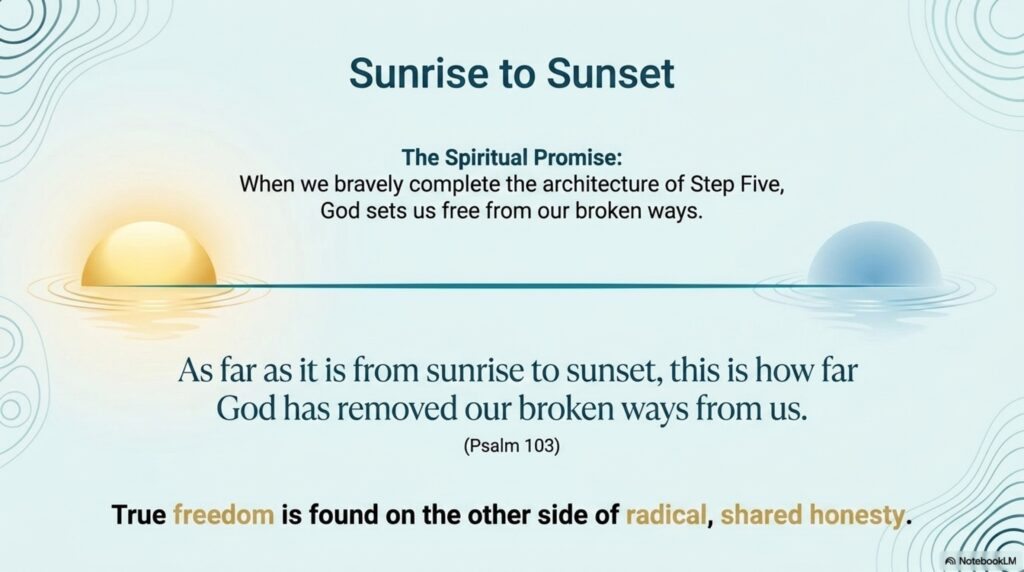
In terms of our relationship with God, we would be able to experience for ourselves, echoing the Psalmist, that God is the one who sets us free from all our broken ways. Again echoing the Psalmist, we would discover firsthand that God’s forgiveness means that as far as it is from sunrise to sunset, this is how far God has removed our broken ways from us.
Amen.
Ai generated infographic, based on the Sermon
Paul Wrightman pastors at the Community Church of the Monterey Peninsula, California:
-
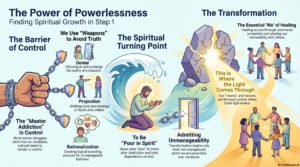
Pastor Paul: Step 1 – The Power Of Powerlessness
Sermon June 14, 2026 “The Spirituality Of The Twelve Steps”
-
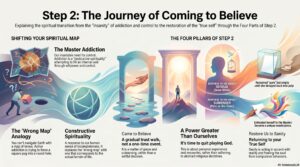
Pastor Paul: Step 2 – Came to Believe
Sermon June 21, 2026 “The Spirituality Of The Twelve Steps”
-
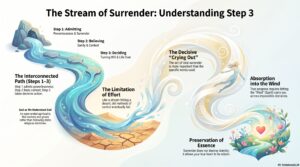
Pastor Paul: Step 3 – Choosing God
Sermon June 28, 2026 “The Spirituality Of The Twelve Steps”
-
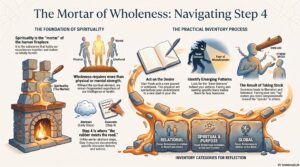
Pastor Paul: Step 4 – Taking Stock
Sermon July 5, 2026 “The Spirituality Of The Twelve Steps”
-
Pastor Paul: Step 5 – Heart-To-Heart
Sermon July 12, 2026 “The Spirituality Of The Twelve Steps”
-
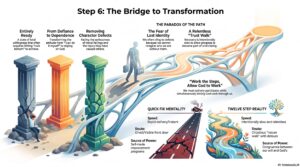
Pastor Paul: Step 6 – Becoming Ready
Sermon July 26, 2026 “The Spirituality Of The Twelve Steps”
-
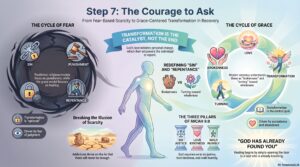
Pastor Paul: Step 7 – The Courage to Ask
Sermon August 2, 2026 “The Spirituality Of The Twelve Steps”
-
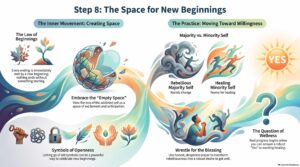
Pastor Paul: Step 8 — Making a List
Sermon August 9, 2026 “The Spirituality Of The Twelve Steps”
-
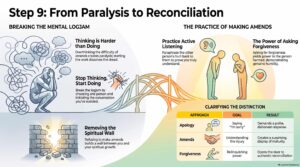
Pastor Paul: Step 9 – Embodied Reconciliation
Sermon August 16, 2026 “The Spirituality Of The Twelve Steps”
-
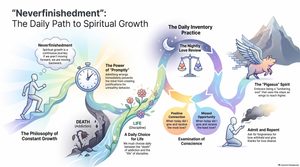
Pastor Paul: Step 10 – Neverfinishedment
Sermon August 23, 2026 “The Spirituality Of The Twelve Steps”
-
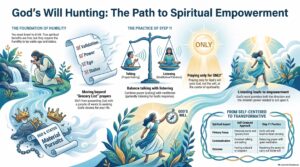
Pastor Paul: Step 11 – God’s Will Hunting
Sermon August 30, 2026 “The Spirituality Of The Twelve Steps”
-
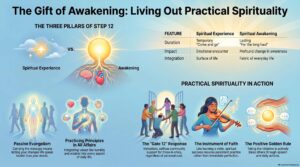
Pastor Paul: Step 12 – The Gift of Awakening
Sermon September 6, 2026 “The Spirituality Of The Twelve Steps”
-
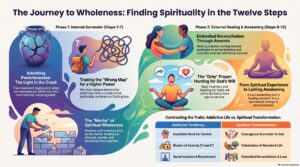
Ai’s take on Pastor Paul’s 12 Step Sermons
Sermon September 6, 2026 “The Spirituality Of The Twelve Steps”
Leave a Reply