Sermon by Pastor Paul Wrightman (August 16, 2026)
The Spirituality of the Twelve Steps:
Step 9 – Embodied Reconciliation
Matthew 5:23-24; James 1:23-24; Psalm 51:1-4, 9-12, 16-17
We continue our sermon series on the spirituality of the Twelve Steps. The last step we considered was Step 8: made a list of all the persons we had harmed, and became willing to make amends to them all.
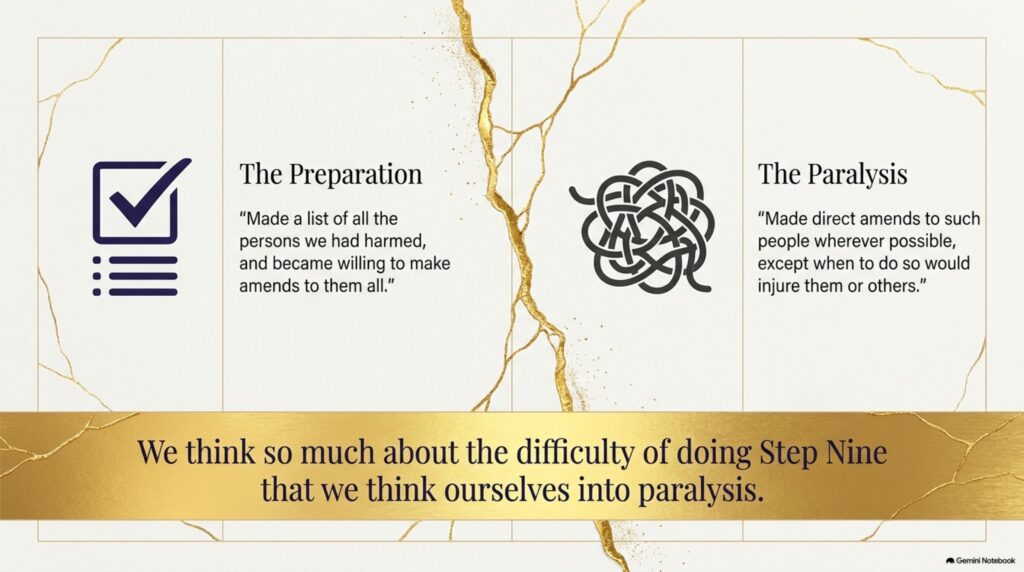
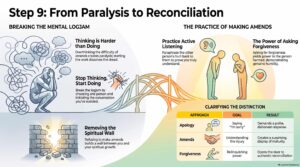
Many of us, myself included, after having made our list, get so caught up in dread at thinking about actually moving on to Step Nine, that we totally stall at this point. We think so much about the difficulty of doing Step Nine — made direct amends to the people we had harmed wherever possible, except when to do so would injure them or others — that we think ourselves into paralysis.
This reminds me of a story from Ajahn Brahm, a Buddhist monk from Australia, who shares his experience of life in a monastery in Thailand. Brahm calls his story Thinking About Washing:
One night each week… the monks would forego their sleep to meditate all night in the main hall. It was part of our forest monk’s tradition. It wasn’t too austere since we could always take a nap the following morning.
One morning, after the all-night meditation session, when we were about to go back to our huts to catch up on our sleep, the abbot beckoned a junior Australian-born monk. To the monk’s dismay, the abbot gave him a huge pile of robes to wash, ordering him to do it immediately…
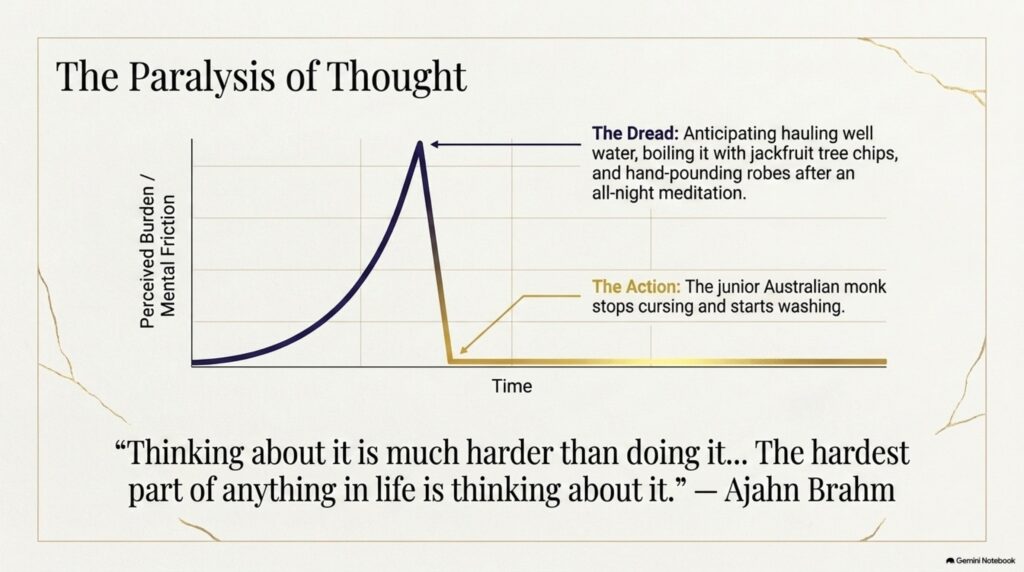
This was an enormous pile of washing. Moreover, all washing had to be done in the traditional way of the forest monks. Water had to be hauled from a well, a big fire made and the water boiled. A log from a jackfruit tree would be pared into chips with the monastery’s machete. The chips would be added to the boiling water to release their sap, which would act as a detergent. Then each robe would be placed singly in a long wooden trough, the brown boiling water poured over, and the robe would be pounded by hand until it was clean. The monk had then to dry the robes in the sun, turning them from time to time to ensure that the natural dye did not streak.
To wash even one robe was a long and burdensome process. To wash such a large number of robes would take many hours. The young Australian-born monk was tired from having not slept all night. I felt sorry for him. I went over to the washing shed to give him a hand.
When I got there, he was swearing and cursing, more in Australian tradition than Buddhist tradition. He was complaining how unfair and cruel it was. “Couldn’t that abbot have waited until tomorrow? Didn’t he realize that I haven’t slept all night? I didn’t become a monk for this!” That was not precisely what he said, but this is all that is printable.
When this occurred, I had been a monk for several years. I understood what he was experiencing and knew the way out of his problem. I told him, “Thinking about it is much harder than doing it!” He fell silent and stared at me. After a few moments of silence, he quietly went back to work…
Later that day, he came to see me to say thank you for helping with the washing. It was true, he discovered, that thinking about it was the hardest part. When he stopped complaining and just did the washing, there was no problem at all.
Brahm concludes: “The hardest part of anything in life is thinking about it.”
In a similar way to the junior monk’s thinking so much about the difficulty of doing the washing that he could not bring himself to begin the process, many of us think so much about the difficulty of actually doing Step Nine that we can’t even get started.
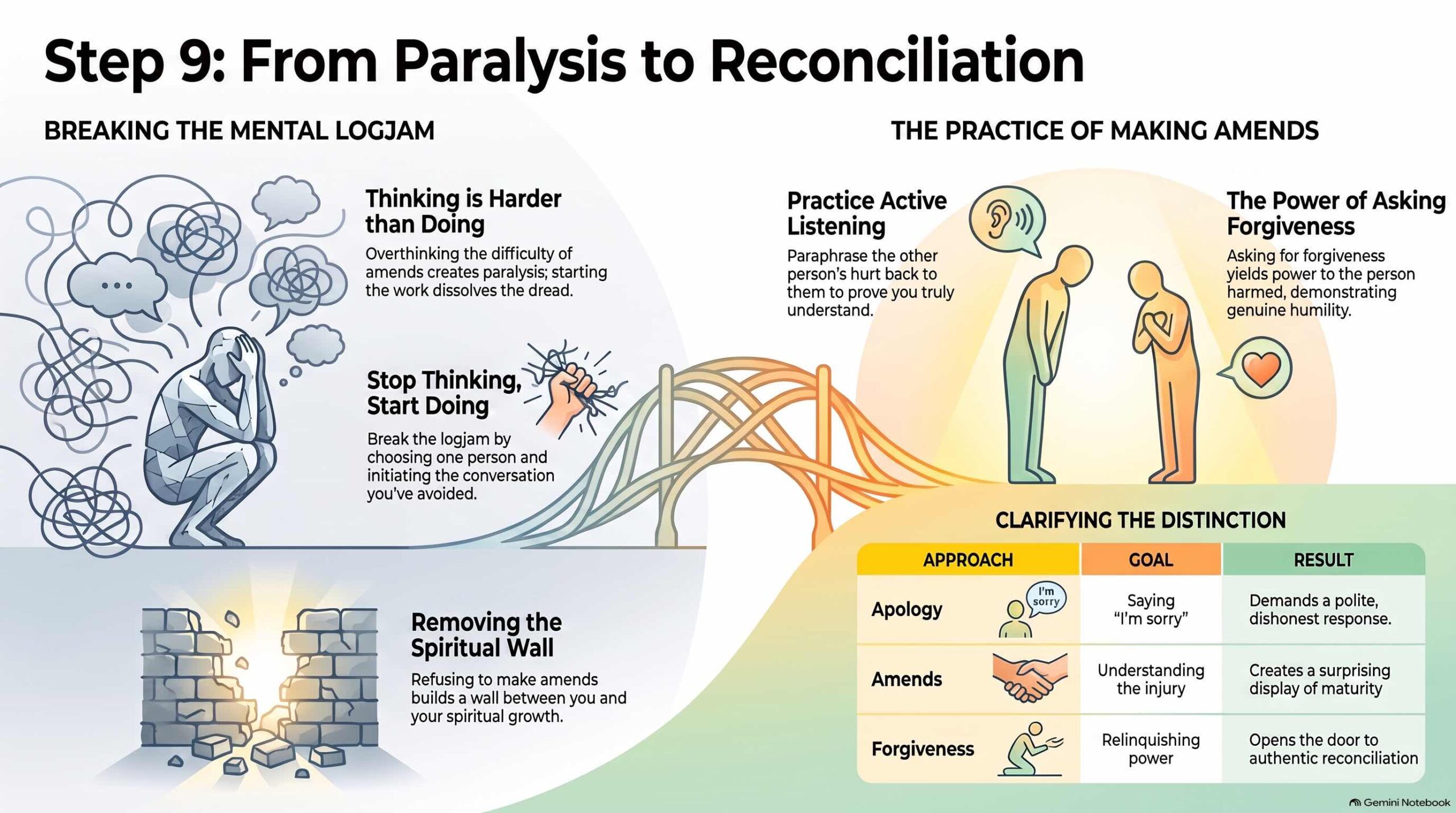
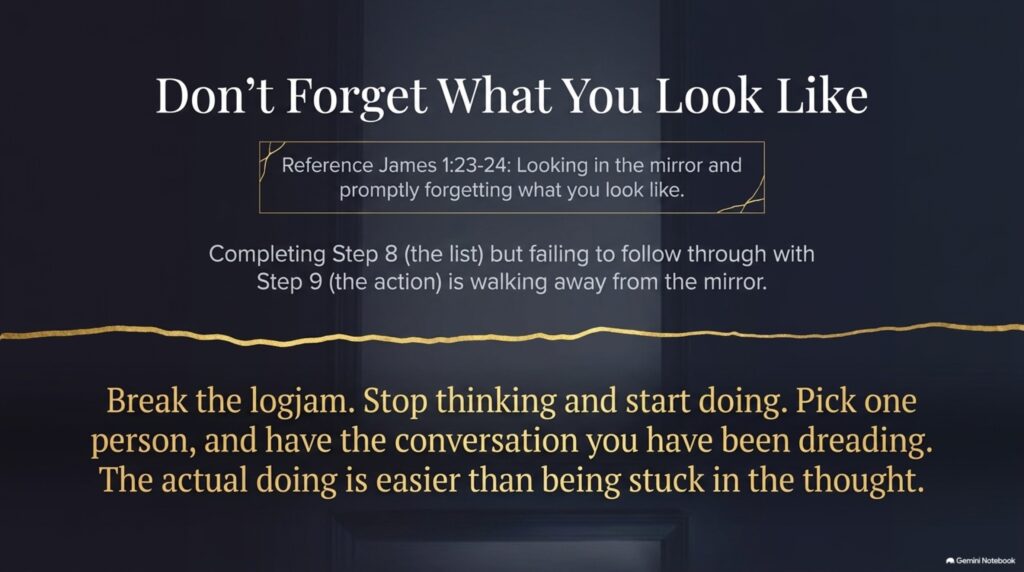
The best way to break this logjam is to stop thinking and start doing. Pick a person on your list with whom you think there is a relatively good chance of effecting a reconciliation by making amends — and just do the conversation that you’ve been dreading for so long.
As with all the Steps, Steps Eight and Nine are essential practices of any authentic spirituality. We may not all be addicts, but we have all harmed others. All of us need to make amends. Jesus says as much in his Sermon on the Mount when he states:
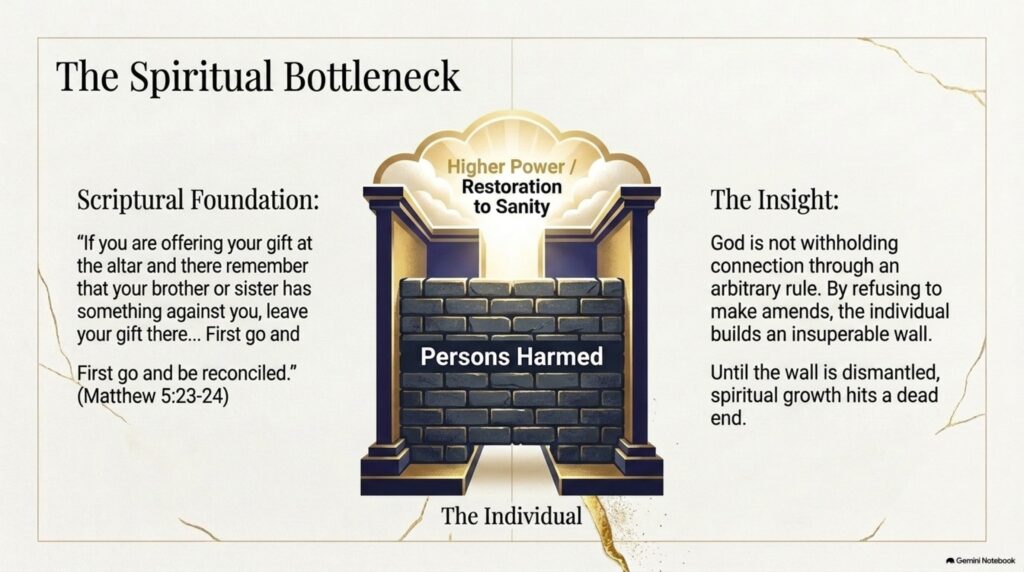
“If you are offering your gift at the altar and there remember that your brother or sister has something against you, leave your gift there in front of the altar. First go and be reconciled to that person; then come and offer your gift.” (Matthew 5:23-24)
Recall that in Step Two we came to believe that a power greater than ourselves could restore us to sanity, and then in Step Three we made a decision to turn our will and our lives over to the care of God as we understood God. All the major faith traditions on the planet are in agreement that a real relationship with God requires embodied reconciliation with those whom we have harmed.
It’s not that God refuses to have anything to do with us until we submit to this arbitrary rule. The reality is that in refusing to make amends we set up an insuperable wall between us and God on our end. God is waiting and wanting to connect with us in deeper and more fulfilling ways, but until we deal with the wall built of all those persons we have harmed, our spiritual growth will face a dead end.
That Buddhist abbot was obviously testing the junior monk with the order to wash all those robes after an all-night meditation session. He was testing the junior monk’s commitment to the program. In much the same way, Step Nine is a test, a test to see how real our commitment is to practicing the Twelve Step program. More people give up at this point in working the Steps than any other. All the more reason to stop thinking and start doing!
So… we’ve made our list of all the persons we have harmed, as mandated in Step Eight. What are the crucial things we need to keep in mind as we move on to Step Nine?
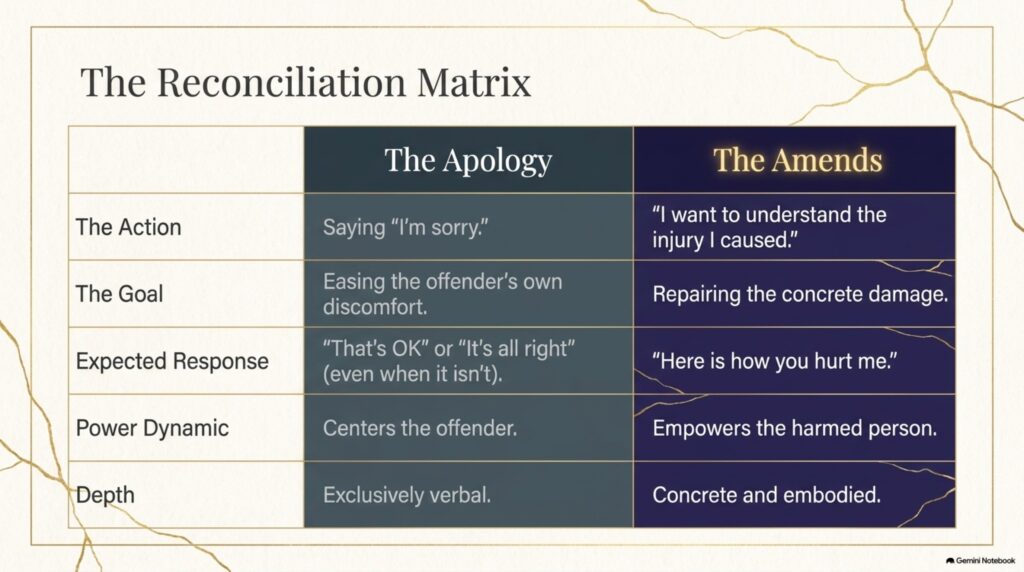
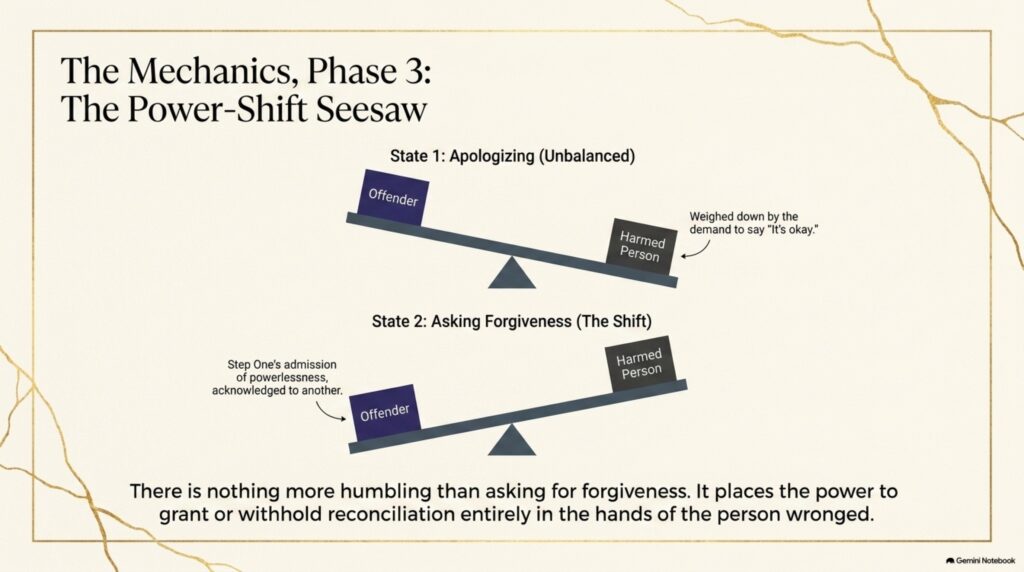
First, we need to distinguish between making apologies and making amends. In terms of working Step Nine, an apology, simply saying “I’m sorry,” is definitely not enough. A mere “I’m sorry” almost always demands from a person we have injured the response “That’s OK,” or “It’s all right,” when they know and we know that things are not OK, and things are not all right. Saying “I’m sorry” can fool us into thinking that we have made a real move toward reconciliation when all we have done is eased our own discomfort a bit.
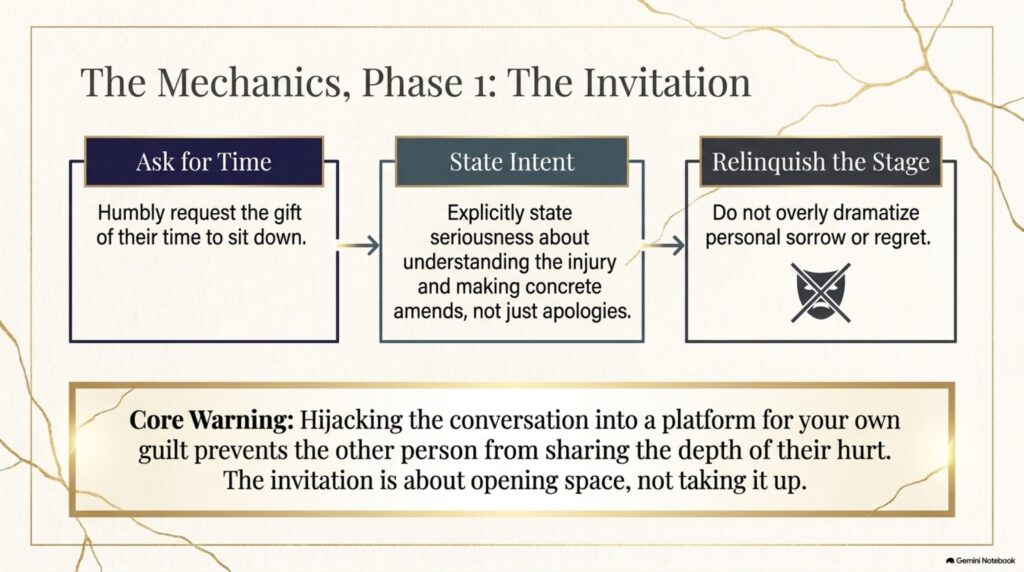
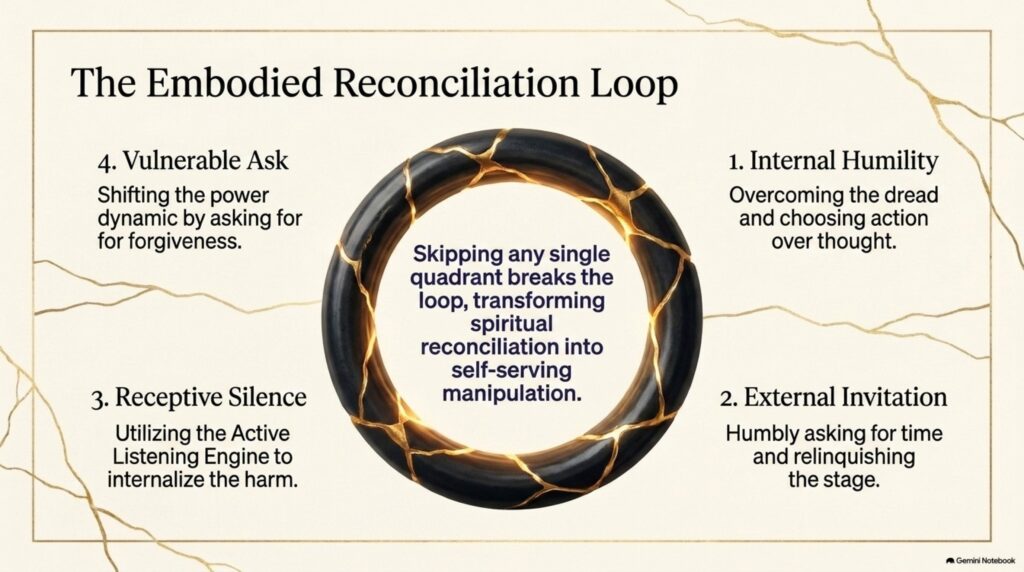
Rather than a quick apology, we need to tell a person we have harmed that we are serious about wanting to understand the injury we have caused them, and that we are serious about making concrete amends, not just verbal apologies. We need to humbly ask them for the gift of their time. We need to humbly ask them to sit down with us and help us to understand the depth of their hurt. Most, if not all, the persons we have harmed will be so taken aback by this surprising display of maturity on our part that they will consent to talk with us.
When face-to-face with the person, or, if distance requires, over the phone, it is crucial that we not overly dramatize our sorrow and regret over what we have done. To do this is to hijack the conversation into a platform for ourselves, rather than as a time for the other person to share the depth of their hurt. So we ask them to share with us all the ways in which we have caused harm. And then we listen. Chances are they will need some proof that we really are listening, that we really are taking them seriously.
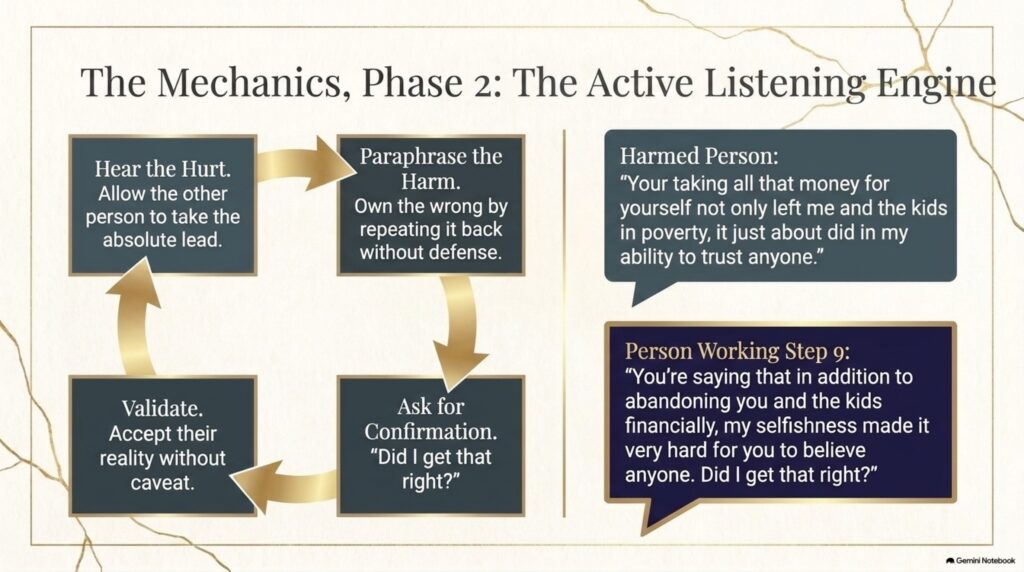
Perhaps the best way to offer proof is to practice what is known as active listening. Active listening allows the other to take the lead in the conversation. After they have expressed something which is of concern, we paraphrase what they have said, and then ask if we have heard them correctly. Let me give you an example:
Person we have harmed: “Your taking all that money for yourself not only left me and the kids in poverty, it just about did in my ability to trust anyone.”
Person working Step Nine, and practicing active listening: “You’re saying that in addition to abandoning you and the kids financially, my selfishness made it very hard for you to believe anyone. Did I get that right?”
I think you get the picture. You can see how biting the bullet and humbling ourselves to the point of owning our wrongs by paraphrasing them back to the person we have harmed could go a long way to convince them that we are serious about making amends.
There is probably nothing more humbling than asking for forgiveness. And asking for forgiveness is precisely what we must do after actively acknowledging the hurt we have caused another. Asking for forgiveness gives the person we have wronged the position of power. It is a continuation of Step One, where we finally admitted our powerlessness — only in this case, in the context of Step Nine, we are not only admitting our powerlessness to ourselves, but acknowledging it to the person we have harmed.
Rabbi Rami Shapiro writes that the difference between apologizing and asking for forgiveness was made clear to him by an addict named Phil, who shared with him the following experience with his wife:
“I kept telling her I was sorry for this and sorry for that, but she kept on being [angry] at me. And that was making me angry as well. Here I am apologizing and she just doesn’t seem to care. In fact, the more I said I was sorry the more angry she got. So I kept asking her what she wanted and she kept saying she wanted me to apologize and I kept apologizing — you know, saying I’m sorry — and we got nowhere.
And then it happened: instead of saying I’m sorry during one of these attempts at amends, I asked her to forgive me. [I really got in touch with the extent of the harm that I had done to her and finally asked for her forgiveness.]”
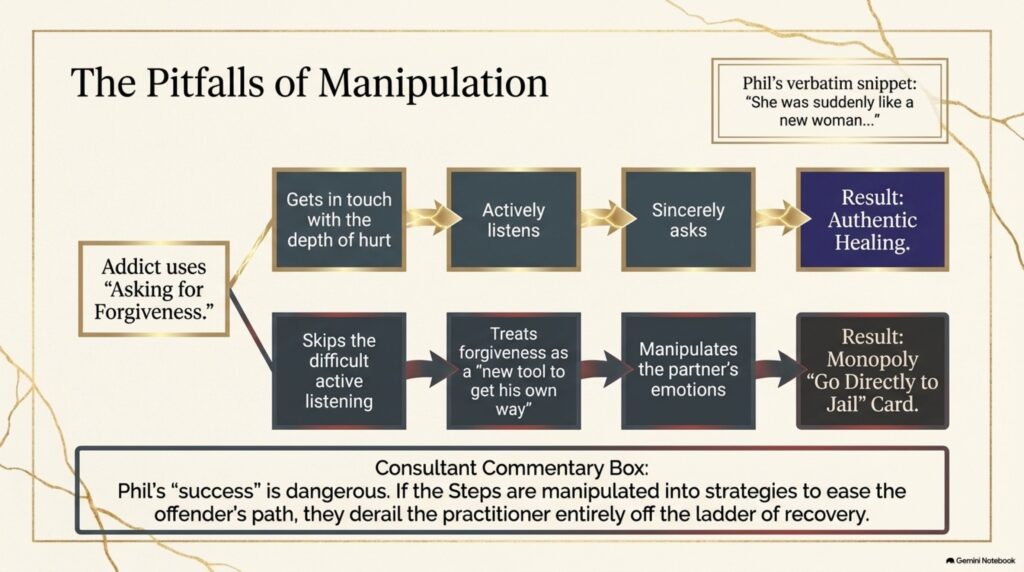
Phil continues: “She was suddenly like a new woman. She started crying and saying how much she wanted to forgive me, and how much she still loved me, and that it would take time, but she thought that my behavior was better and that she could and would forgive me.”
This verbatim from an actual Twelve Step meeting reveals not only the difference between making an apology and asking for forgiveness, it also reveals the fact that Phil comes very close to stumbling upon asking for forgiveness as a new tool to put in his toolbox of strategies for getting his own way.
It seems that with his wife, probably the first person on his list of people to make amends to, Phil was able to honestly get in touch with the depth of the hurt he had caused her, and was able to sincerely ask for her forgiveness. But his statement “she was suddenly like a new woman” strikes me as dangerous. Even in this brief verbatim, Phil comes across as something of a manipulator.
I can see him using asking for forgiveness with the rest of the people on his list, skipping over the difficult active listening part, and using asking for forgiveness as a way to make it easier on himself. Of course if he does this, he is not making a genuine Ninth Step. If he were playing Monopoly, he would get one of those “Go directly to jail, do not pass ‘Go,’ do not collect $200” cards.
In working the Steps, Phil will soon find that if he tries to manipulate them — if they become just one more expression of his “self will run riot” — he will soon find himself off the ladder of the Steps altogether. The endless possibilities we have for self-deception! Hopefully, Phil will finally get it right. Hopefully, we will finally get it right.
Until then, better to stop thinking about taking the dreaded Ninth Step and just do it — do it with humility and sincerity, do it with active listening, do it with a genuine ask for forgiveness. And in the doing, it may just happen that we discover — like the junior monk stuck with all that laundry — the surprising fact that the actual doing is easier than being stuck in all the thinking and worrying about doing it.
We don’t want to be like the person in today’s scripture reading from James, who looks at their face in the mirror and then promptly forgets what they look like. That would be like completing Step Eight — made a list of all the persons we had harmed, and became willing to make amends to them all — and then failing to follow through with Step Nine: made direct amends to such people wherever possible, except when to do so would injure them or others.
Amen.
Ai generated infographic, based on the Sermon
Paul Wrightman pastors at the Community Church of the Monterey Peninsula, California:
-
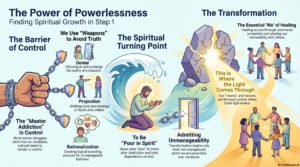
Pastor Paul: Step 1 – The Power Of Powerlessness
Sermon June 14, 2026 “The Spirituality Of The Twelve Steps”
-

Pastor Paul: Step 2 – Came to Believe
Sermon June 21, 2026 “The Spirituality Of The Twelve Steps”
-
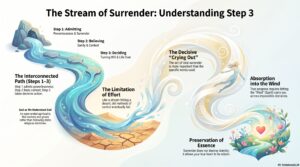
Pastor Paul: Step 3 – Choosing God
Sermon June 28, 2026 “The Spirituality Of The Twelve Steps”
-

Pastor Paul: Step 4 – Taking Stock
Sermon July 5, 2026 “The Spirituality Of The Twelve Steps”
-
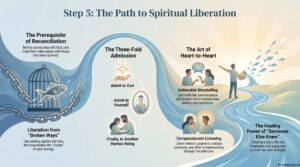
Pastor Paul: Step 5 – Heart-To-Heart
Sermon July 12, 2026 “The Spirituality Of The Twelve Steps”
-

Pastor Paul: Step 6 – Becoming Ready
Sermon July 26, 2026 “The Spirituality Of The Twelve Steps”
-
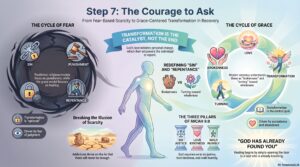
Pastor Paul: Step 7 – The Courage to Ask
Sermon August 2, 2026 “The Spirituality Of The Twelve Steps”
-

Pastor Paul: Step 8 — Making a List
Sermon August 9, 2026 “The Spirituality Of The Twelve Steps”
-
Pastor Paul: Step 9 – Embodied Reconciliation
Sermon August 16, 2026 “The Spirituality Of The Twelve Steps”
-

Pastor Paul: Step 10 – Neverfinishedment
Sermon August 23, 2026 “The Spirituality Of The Twelve Steps”
-

Pastor Paul: Step 11 – God’s Will Hunting
Sermon August 30, 2026 “The Spirituality Of The Twelve Steps”
-

Pastor Paul: Step 12 – The Gift of Awakening
Sermon September 6, 2026 “The Spirituality Of The Twelve Steps”
-
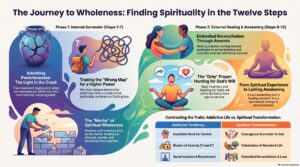
Ai’s take on Pastor Paul’s 12 Step Sermons
Sermon September 6, 2026 “The Spirituality Of The Twelve Steps”
Leave a Reply