Sermon by Pastor Paul Wrightman (August 23, 2026)
The Spirituality of the Twelve Steps:
Step 10 – Neverfinishedment
Deuteronomy 30:19; Colossians 3:12-15; Galatians 5:22
Before moving on specifically to Step Ten, I would like to briefly look back to Steps Eight and Nine, which together provide the all-important foundation for the continuing spiritual growth we want to welcome in Step Ten.
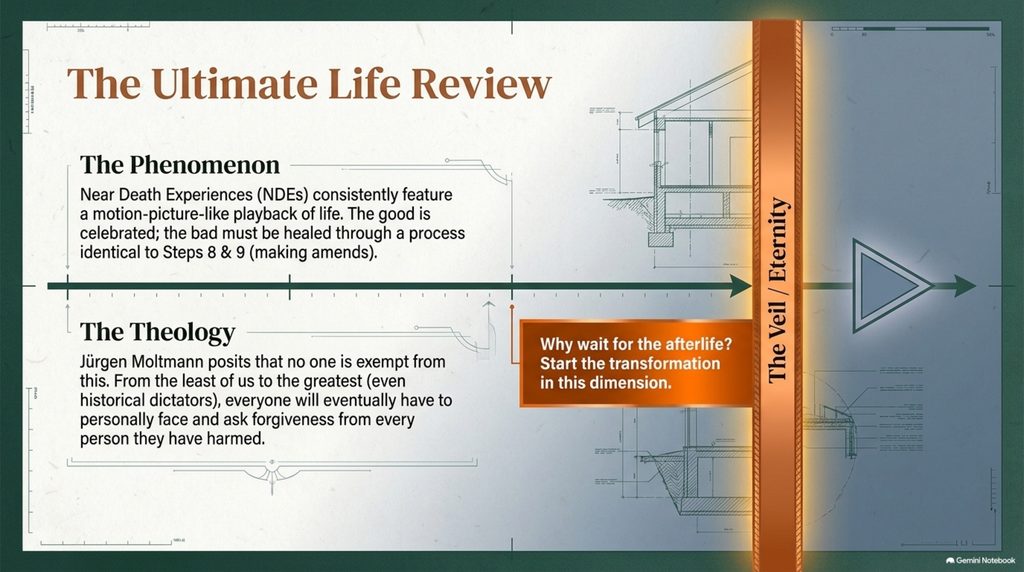
Making a list of all the persons we have harmed, becoming willing to make amends to them all, and then actually making those amends is something we best do now, in this dimension of our lives.
Near death experiences are events which I, and many theologians, take very seriously. Most near death experiences have certain characteristics in common, and one of these common traits is a life review. The life review part of a near death experience is described as a motion-picture-like play-back of everything good and bad that we have done in our lives here. The good is celebrated, the bad has to be healed through a process akin to Steps Eight and Nine combined. In other words, before moving on to heaven, one needs to ask for and receive forgiveness from all those we have harmed in this dimension.
Jürgen Moltmann, one of the most important theologians of the twentieth century, when asked about the afterlife, theorizes that all of us, from the least of us to the greatest, will have to personally face those we have harmed, admit our guilt, and ask their forgiveness. Moltmann maintains that no one is exempt from this process, not even politicians. He posits that Adolf Hitler and the rest of his crew will have to personally face and ask forgiveness from each of the millions of persons they have murdered and otherwise harmed.
While all this remains in the realm of theory, there are strong biblical and theological precedents for it. In my book, better to start this process now, and get a headstart on a transformation that we’re all going to undergo anyway.
“Neverfinishedment.”
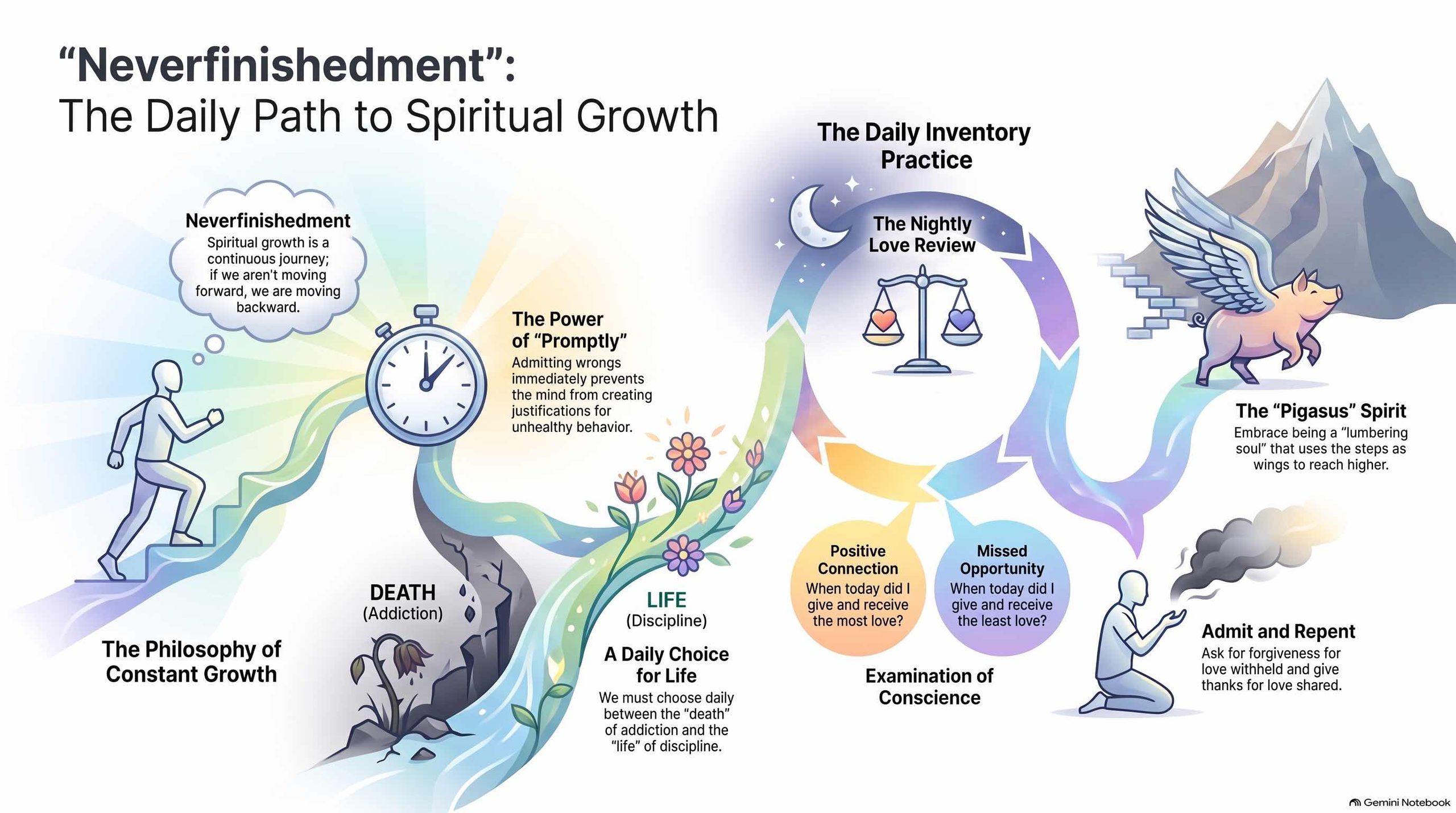
I’ve taken the liberty of making up a compound word which, I think, captures something of the spirit of Step Ten: continued to take personal inventory and when we were wrong promptly admitted it.
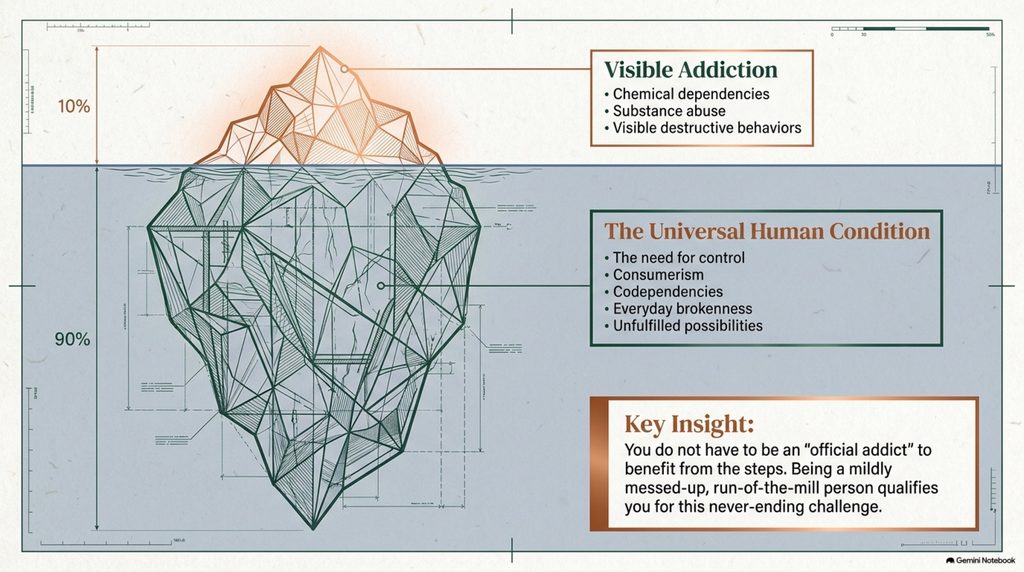
Much like an iceberg, nine-tenths of which lies underwater, there is a great deal of wisdom and experience in the steps which is not immediately visible. All major contemporary authors on Christian spirituality, both Protestant and Catholic, are in agreement that one does not have to be an official “addict” in order to hugely benefit from working the steps. Just being a run-of-the-mill, mildly messed-up person qualifies one just fine to work the steps as an expression of one’s never-ending challenge to become a better human being!
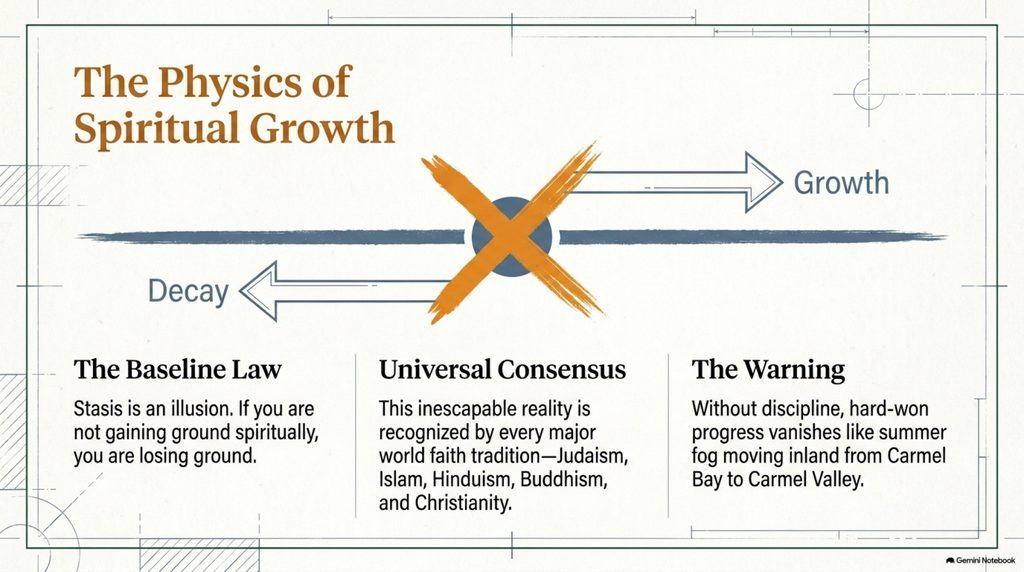
All of us have had the experience of having made significant progress in some area of our lives that needed work, only to let go of our discipline and find our hard-won progress vanish like summer fog moving inland from Carmel Bay to Carmel Valley.
All the great spiritual masters from all the world’s great faith traditions – Judaism, Islam, Hinduism, Buddhism, and Christianity – talk about the fact that if one is not gaining ground spiritually, one is losing ground spiritually. Spiritual growth is a process, a journey, that is either moving forward or backward; stasis, remaining indefinitely at the same place, is impossible. Thus, each major spiritual tradition has built into it disciplines that, if followed, make it possible to continue one’s forward movement.
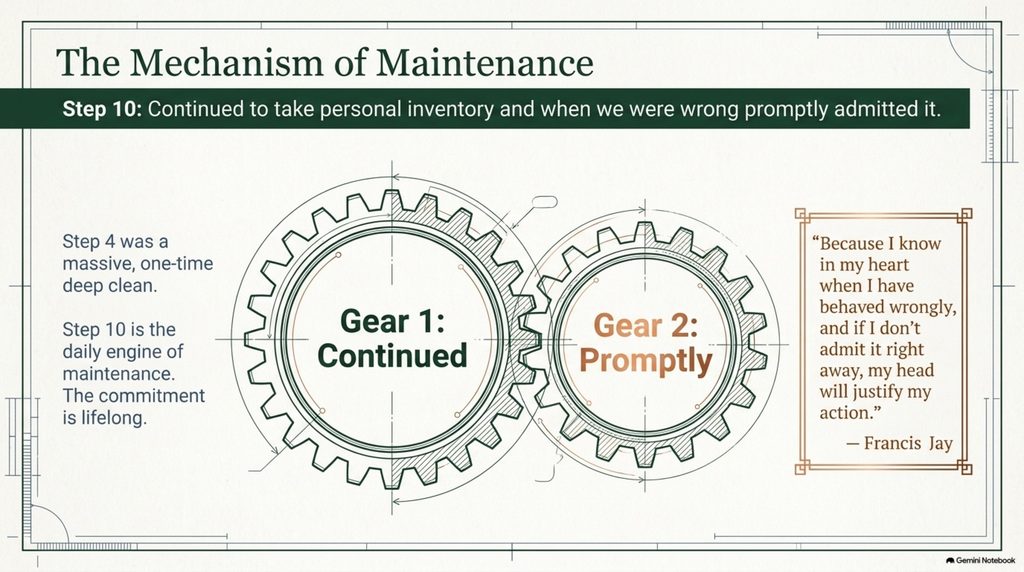
In terms of Twelve Step spirituality, Steps Ten, Eleven, and Twelve are there to empower us to keep on growing. Step Ten, continued to take personal inventory and when we were wrong promptly admitted it, assumes a lifelong commitment to spiritual growth. The key words in this step are continued and promptly.
The searching and fearless moral inventory of ourselves that we made in Step Four was, admittedly, a big deal, a very big deal, covering as it did such a huge chunk of our lives. But taking moral inventory, if it is to have lasting benefit, cannot be a one-time event; it has to become a continuing process, preferably a daily process.
Francis Jay, in her book Walking with God through the Twelve Steps: What I Learned about Honesty, Healing, Reconciliation, and Wholeness, writes:
The tenth step says I must promptly admit it. Why promptly? Because I know in my heart when I have behaved wrongly, and if I don’t admit it right away, my head will justify my action.
Each of the steps presents us – each in its own unique way – with reasons to become discouraged with the whole Twelve Step process and want to give up. With Step Ten it is easy to feel sorry for oneself and the never-ending challenge to become healed and whole.
But those of us who have become enslaved to certain substances or actions have merely to recall what it was like to be a raging alcoholic or workaholic – or whatever – to reembrace the process of the steps. It is a process, a spirituality, which has empowered us to find an honesty, healing, reconciliation, and wholeness in our lives that we never thought possible.
I’ve had people working the steps tell me that they never thought their lives would be “saddled” with such a strict discipline. But usually they pause at this point and go on to say something along the following lines: “But all I have to do is remember what I was like before to become thankful that the steps are there for me to follow.”
The key, I think, is not to allow oneself to become bitter over unfulfilled possibilities in our lives, but to celebrate the fact that there are surprisingly good options still available for us.
In a very different context, Dr. Rachel Naomi Remen reflects on the dynamics of having disappointment surprisingly turn into joy, and on the importance of continuing to choose those things that lead to joy. She writes:
My backyard on the slopes of Mt. Tamalpais is actually a very small meadow.
In the summer and fall of every year a stag visits at dawn and at twilight.
This is quite a thing for someone who grew up in Manhattan.
This year he has six points on his antlers…
He is heart-stopping.
Dr. Remen continues:
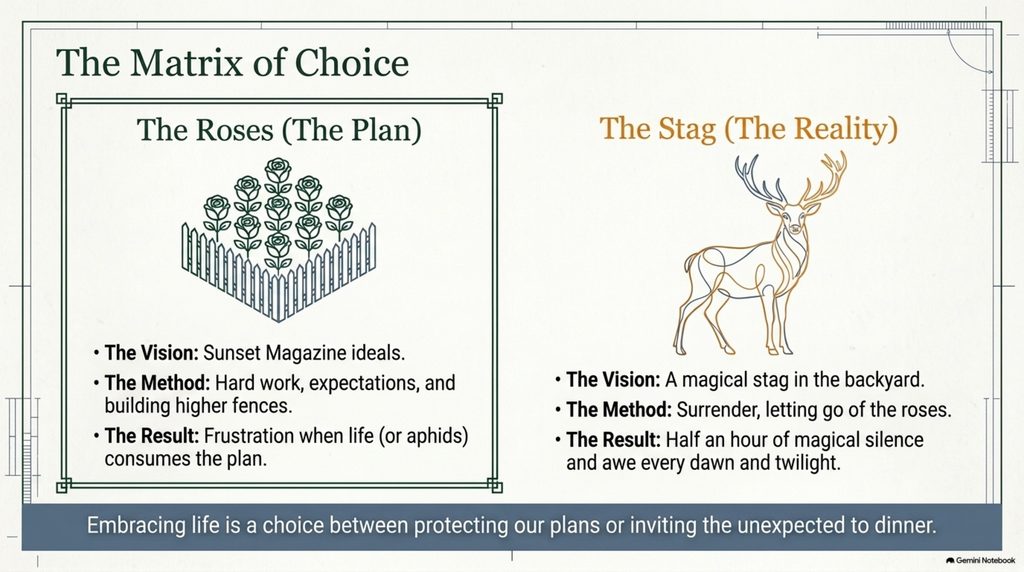
Actually, I did not plan to have a stag. I planned to have a rose garden.
The year after I moved here, I planted fifteen rosebushes… It was a lot of hard work, but I could see it in my mind’s eye. Just like in Sunset Magazine.
The roses bloomed in the late spring and for a month the garden was glorious. Then the roses started disappearing.
Puzzled, I eventually realized that something larger than aphids was eating them and became determined to catch it in the act.
Getting up one dawn and glancing out the window, I was transfixed by seeing the stag for the first time. He looked like an illustration from one of my childhood books.
As I watched in awe he unhurriedly crossed the yard, browsed for a while among the roses, and then delicately ate one of my Queen Elizabeths.
Every year since then I have to make a… choice. Am I going to put up higher fences and have roses, or am I going to have a stag ten feet from my back door? Every year so far, I have chosen the stag.
After two years of watching each other through a pane of glass, I can now sit outside as he dines. If I tell people this, some say in disbelief, “You mean you are letting this deer eat your roses?” Sometimes I will invite someone like this over to watch [and they are always won over].
Dr. Remen concludes:
I had thought I was planting rosebushes in order to have roses. It now seems I was actually planting rosebushes in order to have half an hour of silence with this magical animal every morning and every evening.
Dr. Remen goes on to reflect:
Embracing life is actually a choice.
Dr. Remen stands in good company when she emphasizes the necessity of choice, especially in the context of choosing life.
In his concluding address to the assembled Hebrews – people who were formerly slaves in Egypt and now at the point of getting ready to cross the River Jordan to enter the Promised Land – Moses graphically portrays two alternative realities:
“I call heaven and earth to witness for you today that I have set before you life and death, blessings and curses. Choose life so that you and your descendants may live…” (Deuteronomy 30:19)
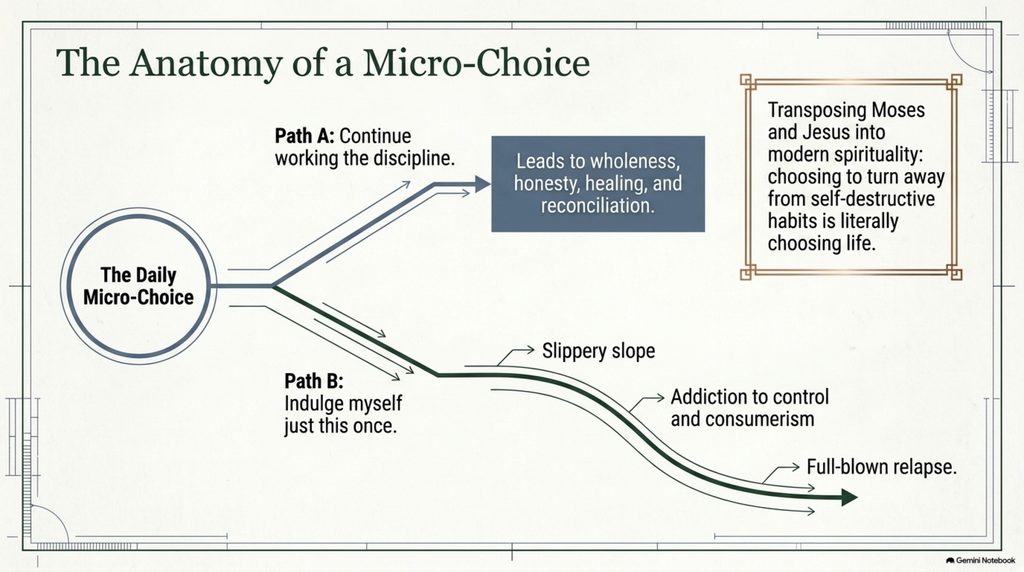
It’s not too much of a stretch, I think, to transpose Moses’ words into the key of Twelve Step spirituality, to describe as death our addiction, or near-addiction, to control, to consumerism, or to a thousand and one other possibilities, and to confront this self-imposed death sentence with the reality of the new life made possible by following the spiritual discipline of the steps.
Dr. Remen, in the context of roses versus stag, writes of having to make a choice every year. Those of us seeking to recover from addictions, dependencies, and codependencies get to make a choice every day, perhaps several times a day, and that choice is: shall I continue working the steps, or shall I take a break and “indulge” myself just this once? As many of us know from experience, choosing to “indulge myself just this once” is all too often the first step on a slippery slope that leads to full-blown relapse.
Jesus, like Moses, challenges us to choose life. His way of putting it is to “repent,” to turn away from our self-destructive habits and to turn toward those positive realities that lead to life. The greatest of these realities, according to Jesus, is to “love the Lord your God with all your heart, and with all your soul, and with all your mind; and to love your neighbor as yourself.” (Matthew 22:37,39)
Loving God and neighbor in this way – with all one’s heart, and soul, and mind – empowers us to live as St. Paul challenges us to live in this morning’s scripture reading from his letter to the Colossians. As I reshare this text with you, imagine what your life, your family, your country, and your world would look like and be like if you and everyone else lived this way:
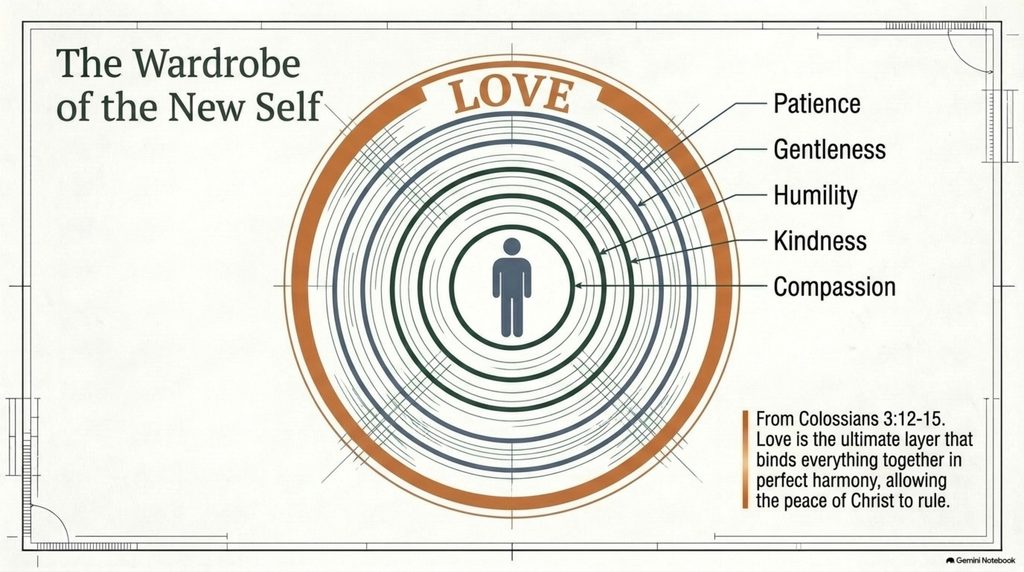
As God’s chosen ones, holy and beloved, clothe yourselves with compassion, kindness, humility, gentleness, and patience.
Bear with one another and, if anyone has a complaint against another, forgive each other; just as the Lord has forgiven you, so you also must forgive.
Above all, clothe yourselves with love, which binds everything in perfect harmony.
And let the peace of Christ rule in your hearts, to which indeed you were called… and be thankful. (Colossians 3:12-15)
I imagine that if I were to ask how many of us have had relapses, or, to put it more generally, if I were to ask how many of us have had experiences of backsliding on resolutions and promises – both to ourselves and to others – everyone in this sanctuary would have to raise his or her hand.
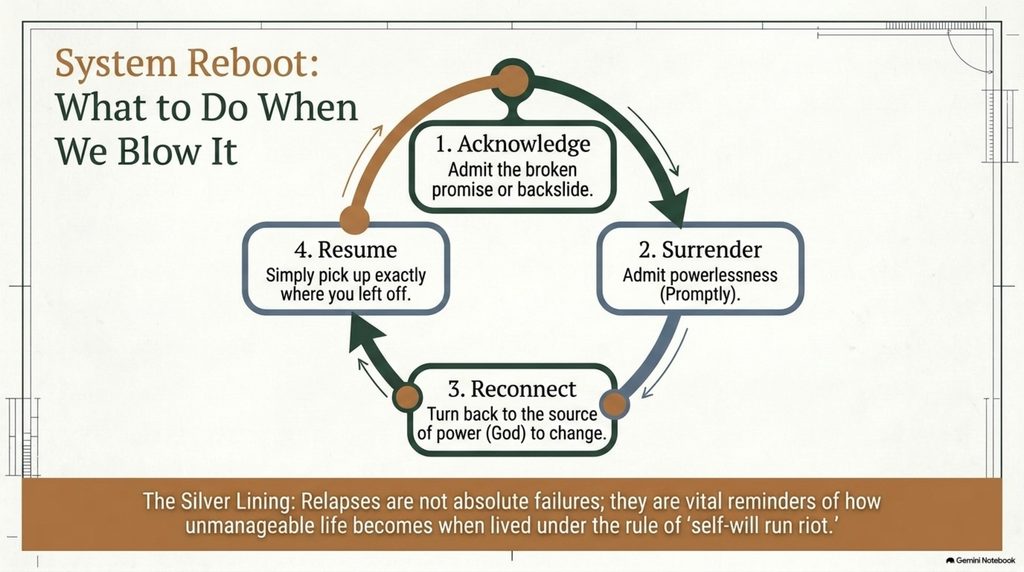
What to do when we’ve blown it? As the second half of Step Ten so succinctly puts it: when we were wrong promptly admitted it.
What to do when we’ve blown it? Admit our powerlessness yet again, turn back to God as the source of our power to change, and then simply choose to pick up where we left off. Even a relapse has a silver lining to it, and that silver lining is the reminder of how truly impossible and unmanageable our lives are when lived under the rule of “self-will run riot.”
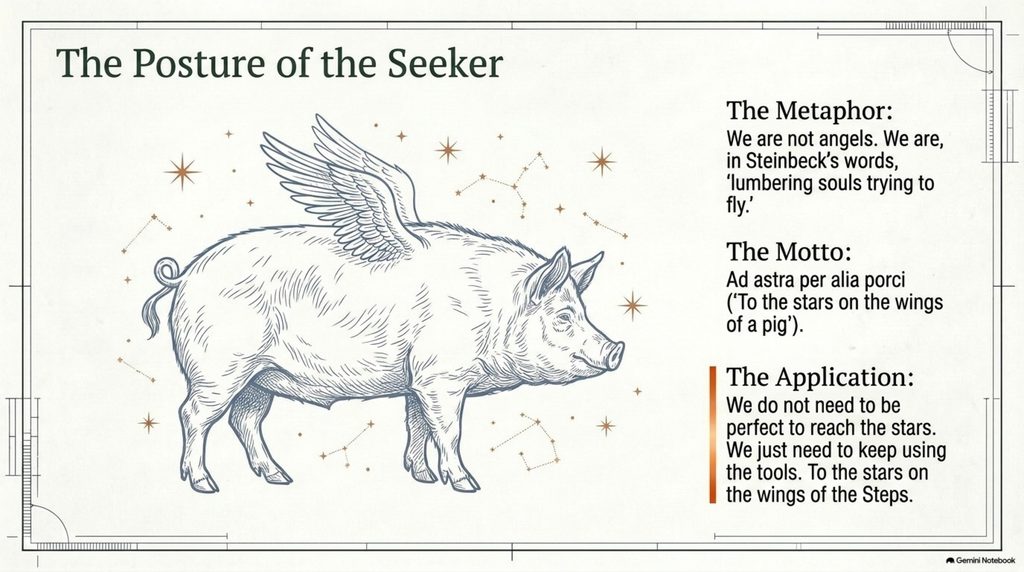
We are, all of us, like our local Nobel Prize winner John Steinbeck, who included with his signature a rough drawing of a pig with wings. Making an intellectual pun, he called this his “Pigasus” logo, illustrating his picture of himself as “a lumbering soul but trying to fly.” Above the flying pig he wrote the Latin words Ad astra per alia porci, which translates as “to the stars on the wings of a pig.” In the context of the spirituality of the Twelve Steps, we could say “to the stars on the wings of the steps.”
Step Ten reads: continued to take personal inventory and when we were wrong promptly admitted it.
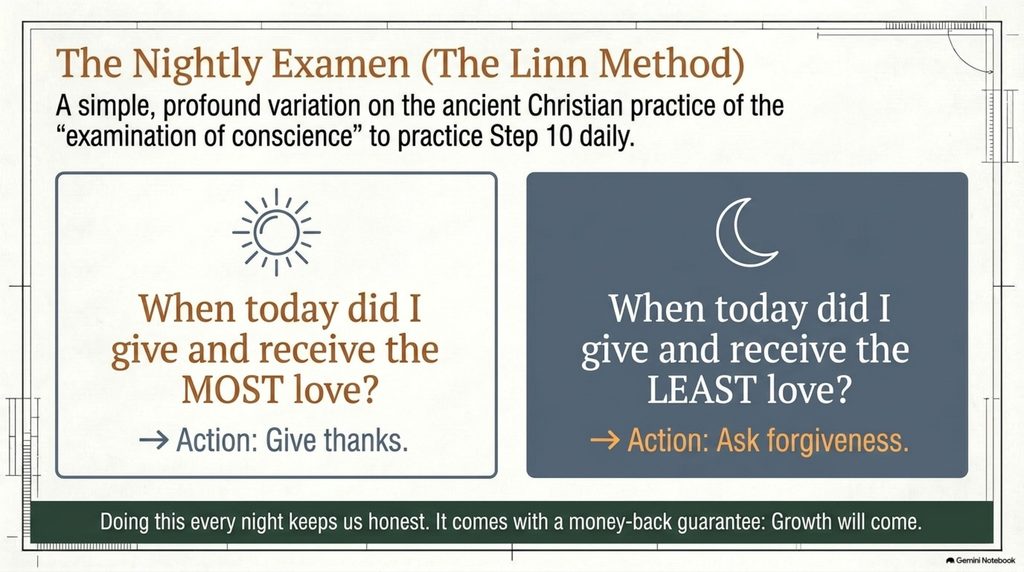
Matthew Linn, Sheila Fabricant Linn, and Dennis Linn, leading lights in bringing the practice of healing prayer as practiced by the early Church back into the life of the contemporary Church, offer a simple yet profound way to practice Step Ten on a daily basis.
Every night before going to sleep, ask yourself two questions:
When today did I give and receive the most love?
When today did I give and receive the least love?
After answering these questions, give thanks to God for the love you gave and received, and ask God’s forgiveness for the love you withheld. This is a variation on the ancient Christian practice known as “examination of conscience.”
Doing this every night will keep us honest, and empower us to keep growing spiritually. This practice comes with a money-back guarantee that if you do it, growth will come.
Amen.
Ai generated infographic, based on the Sermon
Paul Wrightman pastors at the Community Church of the Monterey Peninsula, California:
-
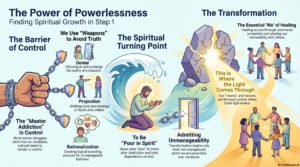
Pastor Paul: Step 1 – The Power Of Powerlessness
Sermon June 14, 2026 “The Spirituality Of The Twelve Steps”
-
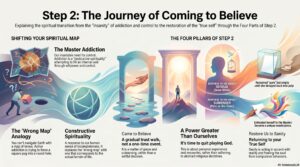
Pastor Paul: Step 2 – Came to Believe
Sermon June 21, 2026 “The Spirituality Of The Twelve Steps”
-
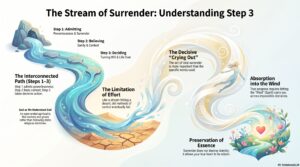
Pastor Paul: Step 3 – Choosing God
Sermon June 28, 2026 “The Spirituality Of The Twelve Steps”
-
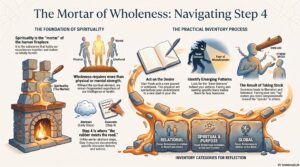
Pastor Paul: Step 4 – Taking Stock
Sermon July 5, 2026 “The Spirituality Of The Twelve Steps”
-
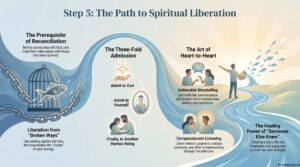
Pastor Paul: Step 5 – Heart-To-Heart
Sermon July 12, 2026 “The Spirituality Of The Twelve Steps”
-
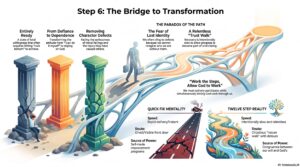
Pastor Paul: Step 6 – Becoming Ready
Sermon July 26, 2026 “The Spirituality Of The Twelve Steps”
-
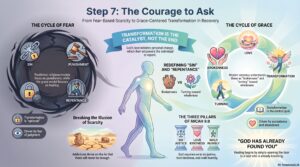
Pastor Paul: Step 7 – The Courage to Ask
Sermon August 2, 2026 “The Spirituality Of The Twelve Steps”
-
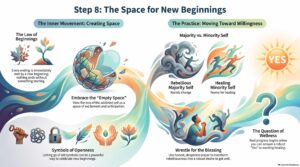
Pastor Paul: Step 8 — Making a List
Sermon August 9, 2026 “The Spirituality Of The Twelve Steps”
-
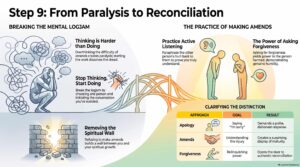
Pastor Paul: Step 9 – Embodied Reconciliation
Sermon August 16, 2026 “The Spirituality Of The Twelve Steps”
-
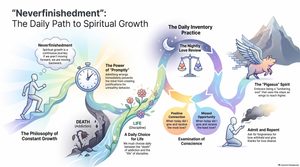
Pastor Paul: Step 10 – Neverfinishedment
Sermon August 23, 2026 “The Spirituality Of The Twelve Steps”
-
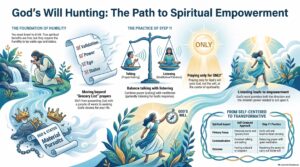
Pastor Paul: Step 11 – God’s Will Hunting
Sermon August 30, 2026 “The Spirituality Of The Twelve Steps”
-
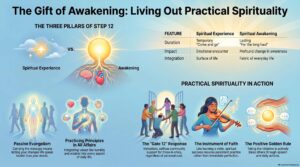
Pastor Paul: Step 12 – The Gift of Awakening
Sermon September 6, 2026 “The Spirituality Of The Twelve Steps”
-
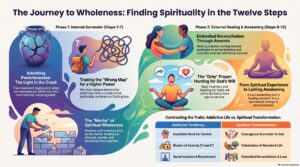
Ai’s take on Pastor Paul’s 12 Step Sermons
Sermon September 6, 2026 “The Spirituality Of The Twelve Steps”
Leave a Reply