
SOURCE
Perplexity.ai:
Yes—this is from A Course in Miracles (ACIM), specifically Workbook Lesson 8, titled “My mind is preoccupied with past thoughts.”[acimlife][youtube]
Where it appears
The passage you quoted matches the opening explanatory section of Lesson 8 in the Workbook for Students:
“This idea is, of course, the reason why you see only the past. No one really sees anything. He sees only his thoughts projected outward. The mind’s preoccupation with the past is the cause of the total misconception about time from which your seeing suffers…”[miraculousliving]
Different editions vary slightly in wording (e.g., “total misconception” vs. “misconception”), but the core text is the same.[acimlife]
Core ideas in this lesson
Lesson 8 develops several key ACIM themes:
- Projection: “He sees only his thoughts projected outward.” What you perceive is not an objective world “out there,” but a reflection of your mind’s contents.[acimlife]
- Seeing only the past: Because your mind is filled with past thoughts, your perception is of the past, not the present.[miraculousliving]
- Time misconception: The mind’s fixation on past thoughts creates a false sense of time, blocking true understanding.[miraculousliving]
- Present as the only time: “Your mind cannot grasp the present, which is the only time there is.” The Course points to the present as the only reality; past and future are mental constructs.[acimlife]
The workbook then guides you through exercises (with eyes closed) to notice your thoughts and conclude: “But my mind is preoccupied with past thoughts.”[youtube][miraculousliving]
If you’d like, I can walk you through the practical exercises from Lesson 8 in a way that fits your daily markdown journaling habit.
My mind is preoccupied with past thoughts.
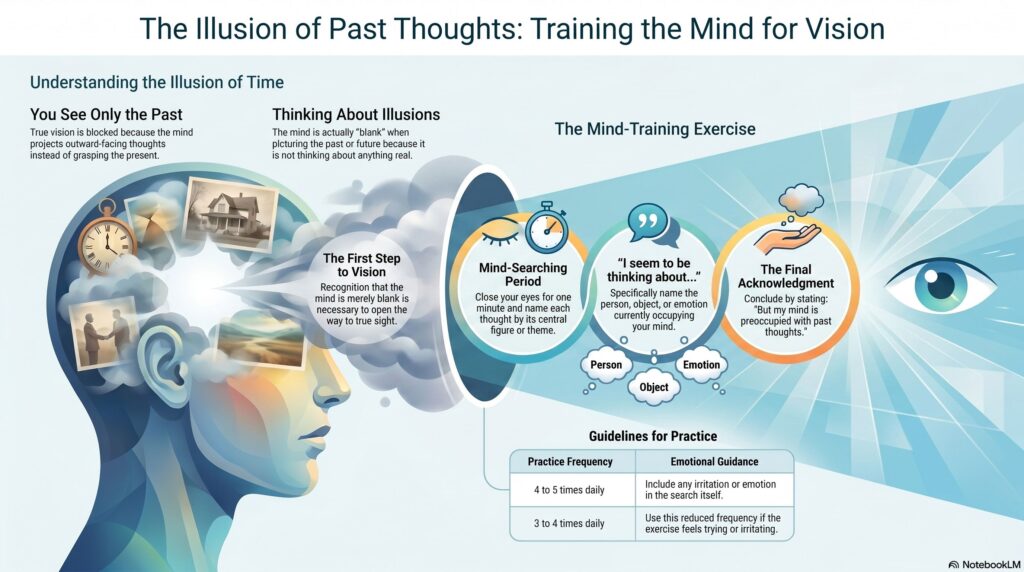
1. This idea is, of course, the reason why you see only the past. No one really sees anything. He sees only his thoughts projected outward. The mind’s preoccupation with the past is the cause of the misconception about time from which your seeing suffers. Your mind cannot grasp the present, which is the only time there is. It therefore cannot understand time, and cannot, in fact, understand anything.
2. The one wholly true thought one can hold about the past is that it is not here. To think about it at all is therefore to think about illusions. Very few have realized what is actually entailed in picturing the past or in anticipating the future. The mind is actually blank when it does this, because it is not really thinking about anything.
3. The purpose of the exercises for today is to begin to train your mind to recognize when it is not really thinking at all. While thoughtless ideas preoccupy your mind, the truth is blocked. Recognizing that your mind has been merely blank, rather than believing that it is filled with real ideas, is the first step to opening the way to vision.
4. The exercises for today should be done with eyes closed This is because you actually cannot see anything, and it is easier to recognize that no matter how vividly you may picture a thought, you are not seeing anything. ³With as little investment as possible, search your mind for the usual minute or so, merely noting the thoughts you find there. Name each one by the central figure or theme it contains, and pass on to the next. ⁵Introduce the practice period by saying:
I seem to be thinking about ___.
5. Then name each of your thoughts specifically, for example:
seem to be thinking about [name of a person], about [name of an object], about [name of an emotion],
and so on, concluding at the end of the mind-searching period with:
But my mind is preoccupied with past thoughts.
6. This can be done four or five times during the day, unless you find it irritates you. If you find it trying, three or four times is sufficient. You might find it helpful, however, to include your irritation, or any emotion that the idea for today may induce, in the mind searching itself.
Leave a Reply