Sermon by Pastor Paul Wrightman (August 3, 2026)
The Spirituality of the Twelve Steps:
God’s Will Hunting
Matthew 7:7-8; Luke 10:38-42; Psalm 130:5-7
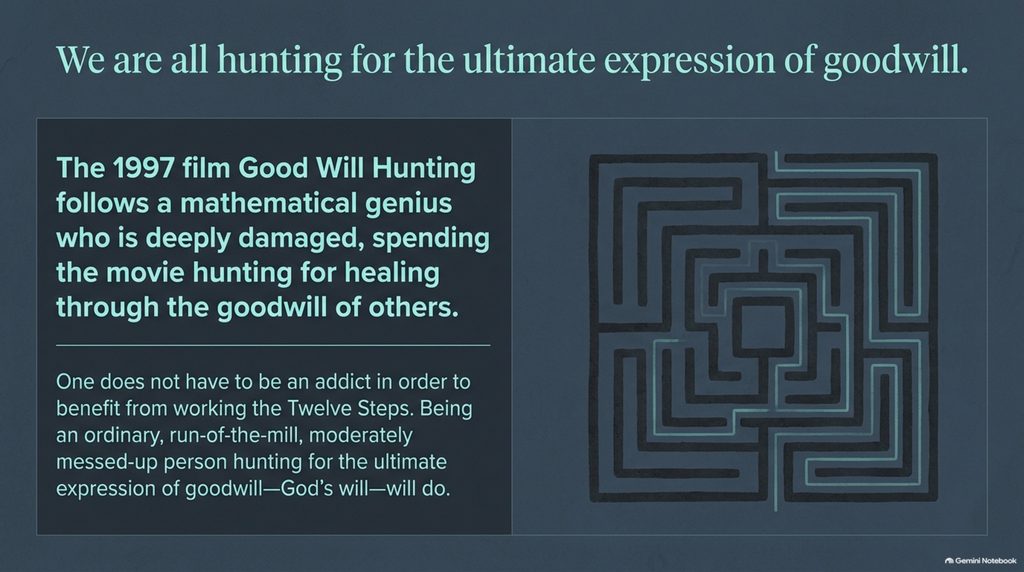
All the major contemporary writers on spirituality are unanimous in saying that the Twelve Steps are the greatest contribution that the United States has made to world spirituality. They all acknowledge the fact that one does not have to be an actual addict in order to benefit from working the steps, and that just being an ordinary, run-of-the-mill, moderately messed-up person will do. I know that I definitely fit into that category — and then some! Working the steps as my own major spiritual discipline has been of immense value to me personally.
Our sermon title this morning, God’s Will Hunting, is a take-off on the popular 1997 movie, Good Will Hunting, sadly, the only movie for which Robin Williams received an Academy Award. In that movie, the main character, a janitor working at MIT, is discovered to be a mathematical genius. He may be a genius, but he is also a deeply damaged person who spends the bulk of the movie hunting for healing in the form of good will from others. Many of us spend our lives hunting for the ultimate expression of good will, which we believe to be God’s will.
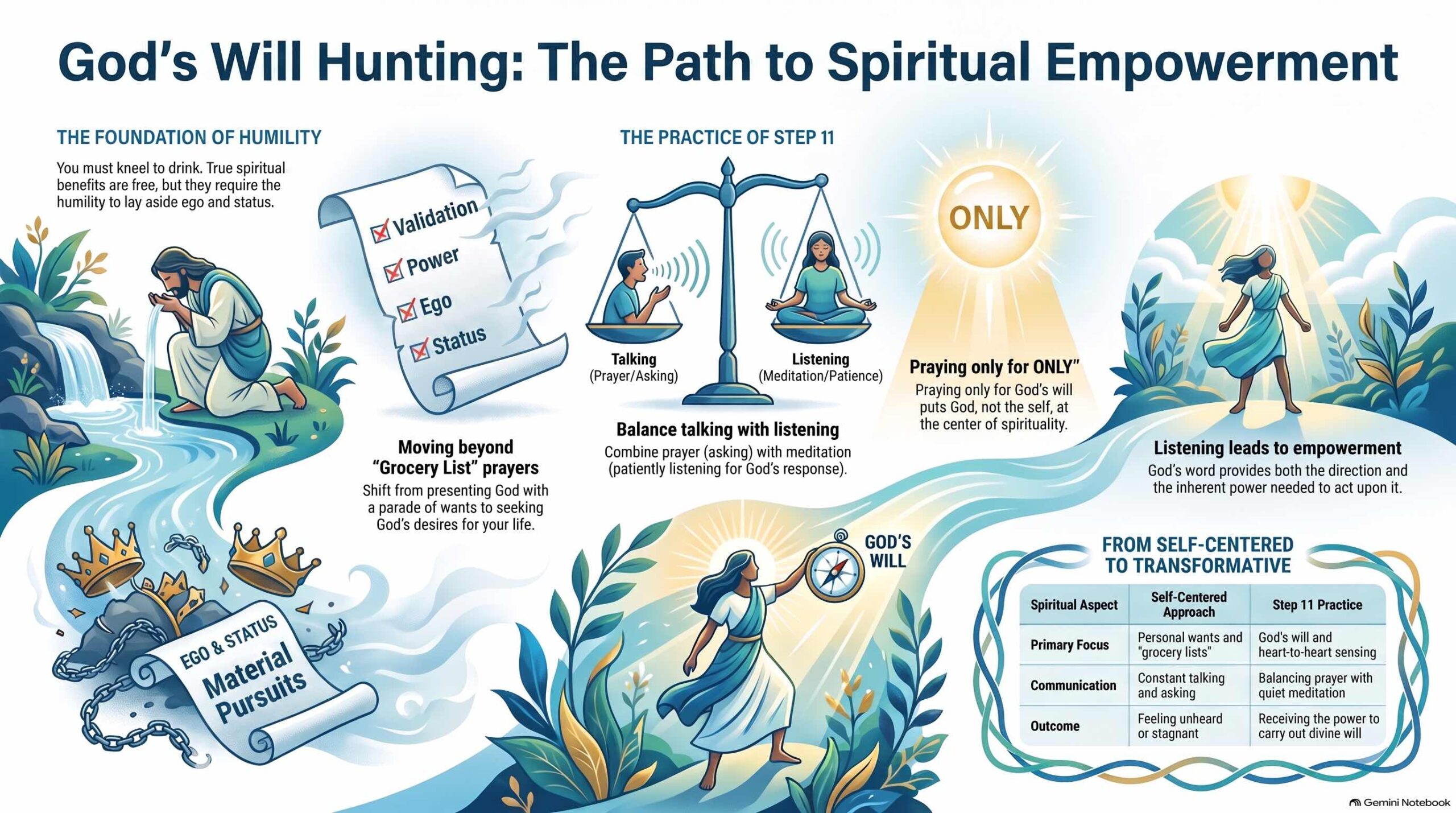
Each of the steps assumes a basic attitude of humility. Without a foundational character strength of humility on our part, it is impossible to work the steps. One of the finest stories about humility is this one by Kate Compston: it is called The Water of Life.
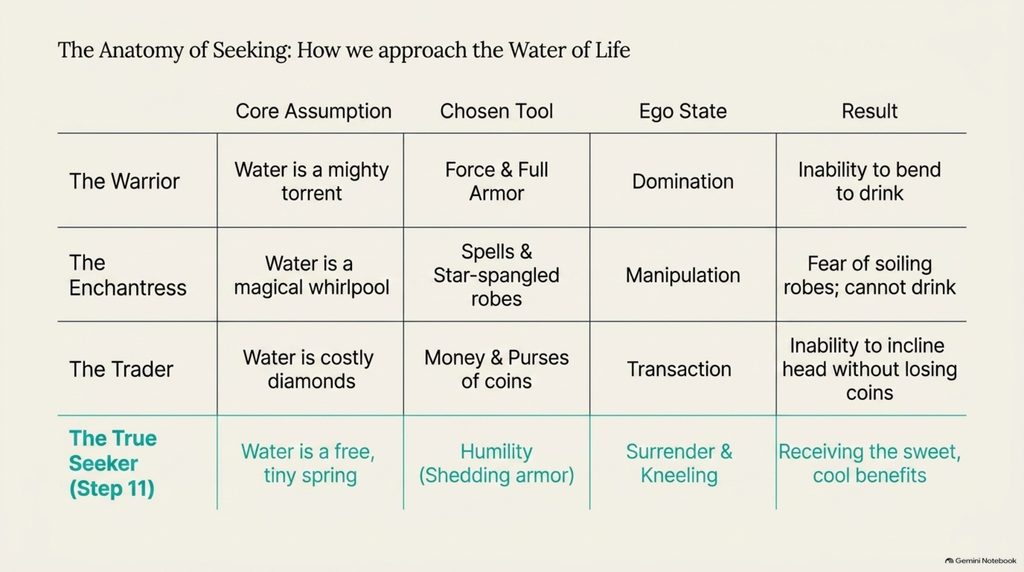
Three people were searching for the water of life, hoping to drink from it and live forever.
The first was a warrior: he reckoned the water of life would be very mighty — a torrent or a rapid — so he went in full armor, with all his weapons, believing he could force the water to yield to him.
The second was an enchantress: she reckoned the water of life would be very magical — perhaps a whirlpool or a geyser, something she would need to manipulate with spells — so she went in her long star-spangled robe, hoping to outwit the water.
The third was a trader: he reckoned the water of life would be very costly — a fountain of pearl-drops or diamonds, perhaps — so he loaded his clothes with purses and money, hoping to be able to buy the water.
When the travellers reached their destination, they found they had all been quite wrong about the water of life. It wasn’t a torrent to be intimidated by force. It wasn’t a whirlpool to be charmed by spells. And it wasn’t a fountain of pearl-drops or diamonds to be bought for money. It was just a tiny, sparkling spring; its benefits were absolutely free — but of course, you had to kneel to drink from it.
This caused the seekers great consternation. The warrior was in full armor and couldn’t bend. The enchantress had on her long magic robe, and if that became soiled, it would lose its power. The trader was so loaded with money that if he did no more than incline his head, coins would start rolling away into corners and crevices. All dressed up, the three could not lower themselves to drink from the spring of the water of life.
There was only one solution. So the warrior laid aside his armor. The enchantress laid aside her magic robe. And the trader laid aside the clothes he had stuffed with money. And then each of them — naked — could kneel to drink from the water of life and receive its sweet, cool, startling benefits.
Step Eleven deals directly with our search for God. It reads:
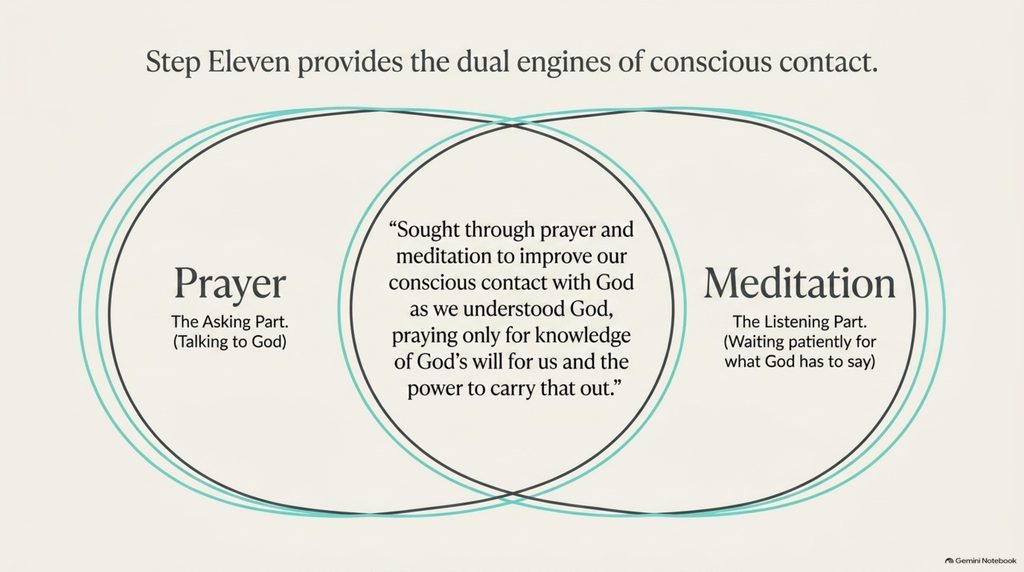
“Sought through prayer and meditation to improve our conscious contact with God as we understood God, praying only for knowledge of God’s will for us and the power to carry that out.”
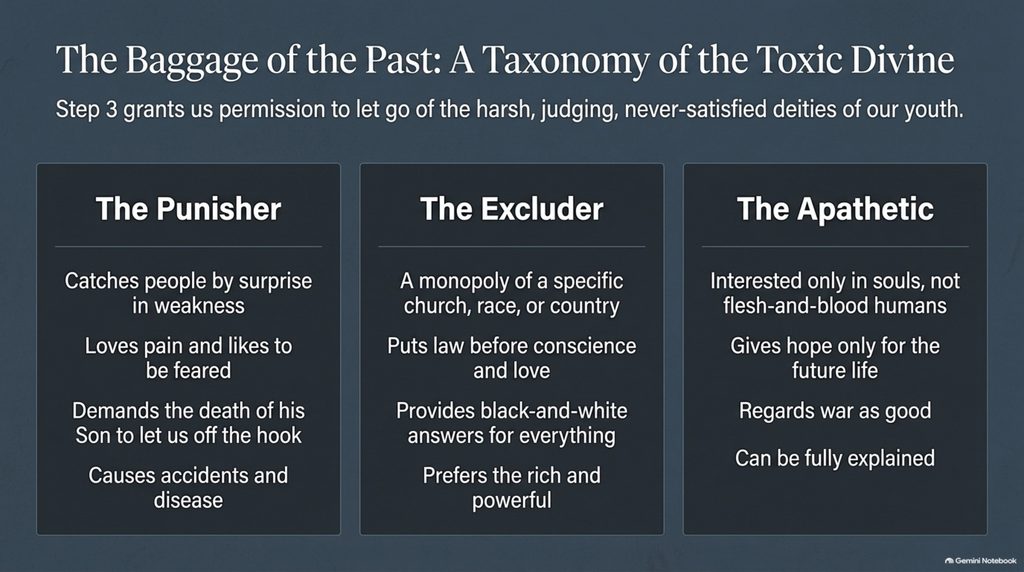
Persons too numerous to count have reported experiencing a great sense of liberation when they embraced and put into practice Step Three: “Made a decision to turn our will and our lives over to the care of God as we understood God.” The liberation came from the final four words of this step: as we understood God.
For many of us, these words gave us permission to finally let go of the harsh, judging, mean-tempered and mean-spirited, never-satisfied God that we had met in the Sunday School and church of our childhood and youth. For many of us, working Step Three gave us the courage to finally say, no, I shall never believe in:
- The God who catches people by surprise in a sin of weakness
- The God who loves pain
- The God who likes to be feared
- The God who is a monopoly of a church, a race, a culture, a country
- The God who says, “You will pay for that!”
- The God who demands the death of his Son in order to let us off the hook
- The God who is not interested in this world and gives hope only for the future life
- The God who puts law before conscience
- The God who puts law before love
- The God of those who have black-and-white answers for everything
- The God who prefers the rich and the powerful
- The God who causes accidents and disease
- The God who is interested only in souls, and not flesh-and-blood human beings
- The God who regards war as good
- The God who says, feels, and does nothing about the agonizing problems of suffering humanity
- The God who can be fully explained
Our list, of course, could go on and on. Many of us here at Community Church are refugees from downright abusive understandings of God. We know what it’s like to be liberated from having to believe all sorts of harmful things about a God who is supposed to be loving.
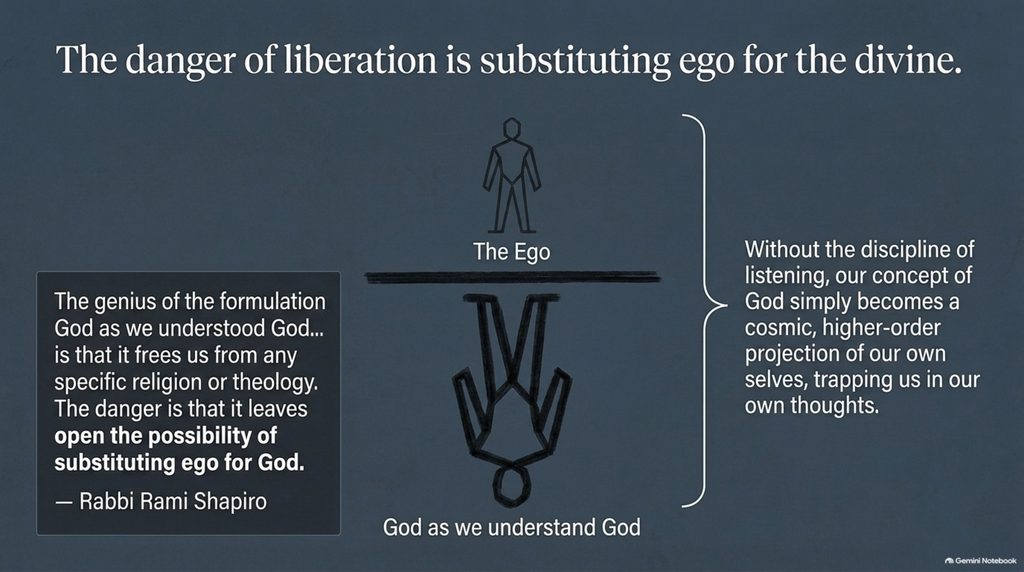
But just as there are significant dangers with the vengeful God featured in many of our childhoods, there can also be real dangers with the God of our dreams. Rabbi Rami Shapiro captures the hazards involved:
The genius of the formulation God as we understood God, found in Steps Three and Eleven, is that it frees us from any specific religion or theology. The danger is that it leaves open the possibility of substituting ego for God: God as we understood God can become a cosmic projection of our own selves.
Similarly, the genius of Step Eleven is that it frees us from any specific spiritual or religious practice. The danger is that this leaves open the possibility of becoming trapped in our thoughts, rather than freed from them, and hence mistake our own will for God’s will.
How, then, do we avoid making our God a higher-order projection of ourselves?
Once again, the wisdom of the steps is phenomenal. Notice how Step Eleven begins by mentioning both prayer and meditation. Prayer represents our talking to God, much as we do in the call to worship and the unison prayers we do as a community. Meditation represents our patient listening for what God has to say to us.
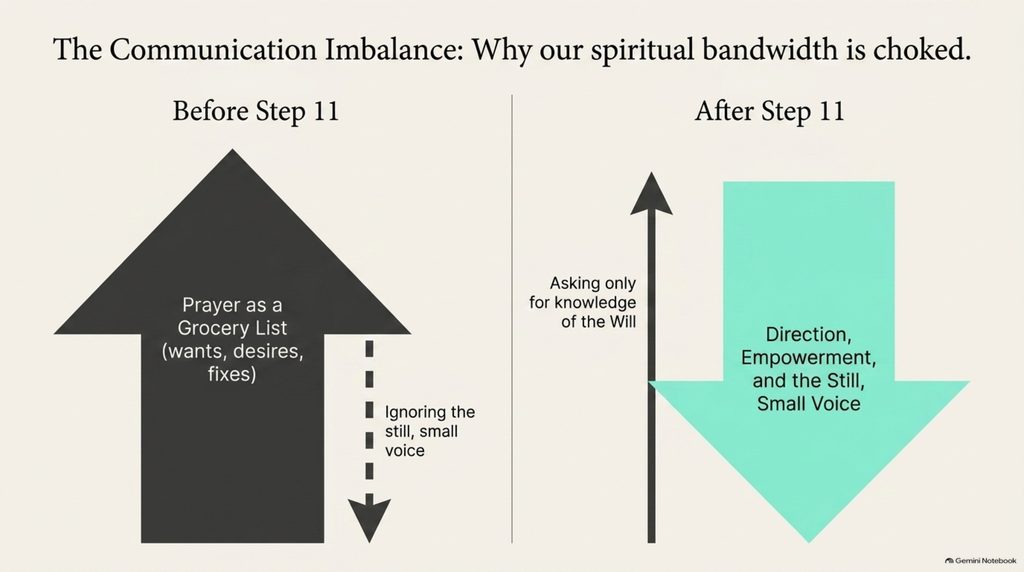
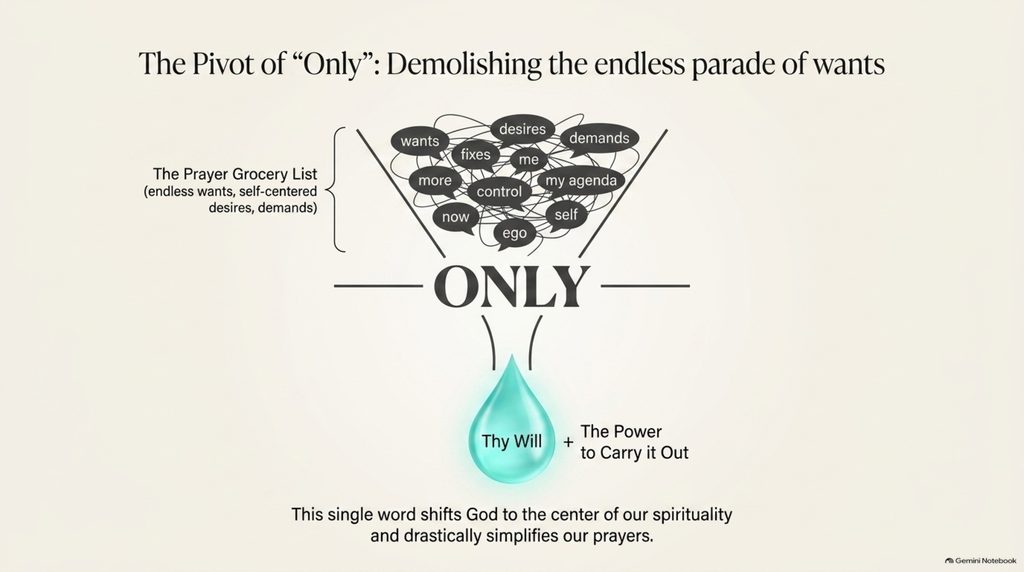
For many of us, myself very much included, prayer has often been a kind of grocery list of things we want. I’ve noticed in my own prayer life that after I’ve presented God with a list of my desires, I hardly ever stop to listen for God’s list of desires concerning me. So I would have to say that Bill Wilson was nothing less than inspired when he put prayer — the asking part — together with meditation — the listening part.
But there’s more. This is not all that Step Eleven has to offer. Notice the little word only in this step, as in praying only for the knowledge of God’s will and the power to carry that out.
For many years in my own practice of the steps, I overlooked the only in the Eleventh Step. As a result, I continued to rattle off my lengthy grocery list of desires and wants. To be sure, I would tack on a minute or two of perfunctory silence after sharing my list with God, figuring that that fulfilled the meditation part of Step Eleven. Interestingly enough, God never seemed to have anything to say to me in the brief time that I gave God.
It was about twenty-five years ago that I not only saw but actually paid attention to the little but crucial word only. This little word revolutionized my prayer life. In a nutshell, being limited to praying only for knowledge of God’s will for my life and the power to carry that out put God rather than myself at the center of my spirituality. It completely demolished my list-making tendencies, with my endless parade of wants and desires.
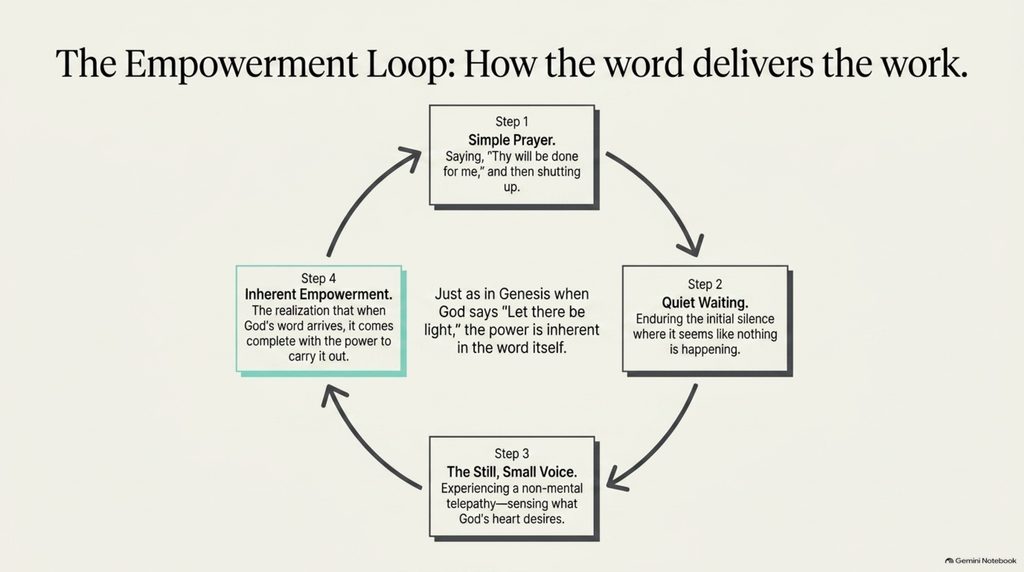
And focusing on the only drastically simplified my prayers. Since back then I was rather clueless about what God’s will was for my life, it put me in the position of saying to God, “Thy will be done for me,” then shutting up and having to really wait and listen in case God might actually have something to say in response.
I must admit that this was no easy process. It’s a big change from me being the one doing the talking and expecting God to listen and respond, to becoming the listening one myself and being willing to respond once God had done the talking.
At first, as with so many things spiritual, it seemed like nothing was happening. But after a few weeks of this simple prayer, “Thy will be done in my life,” and waiting in quiet meditation for an answer, I began to sense God’s “still, small voice.” I say sense instead of hear, because I heard no audible words, but began to have a definite sense of God’s will for my life. It was like what we mean by “mental telepathy,” except that it wasn’t mental. It was more like heart-to-heart, my heart sensing what God’s heart desired for me and from me.
Once again, there’s more. I was flat-out surprised to discover that the more I waited and learned to listen, when God’s word and God’s will finally did come to me, it came with the power to carry it out. On a very small scale, it was something like the first chapter of Genesis, when God says “Let there be light,” and through the power inherent in God’s word, there was light. I was actually getting a personal taste of the power of God’s word and God’s will.
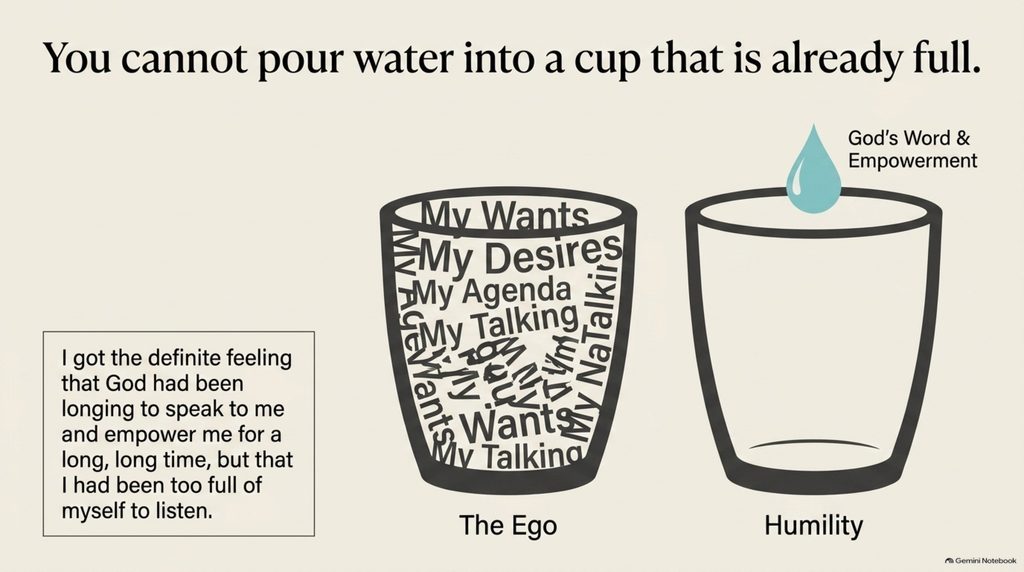
When I finally stopped talking and waited on and listened for what God had to say to me, when God’s word finally came, it came complete with the empowerment to carry it out. I got the definite feeling that God had been longing to speak to me and to empower me for a long, long time, but that I had been too full of myself to listen. There’s an old saying, “You can’t pour water into a cup that’s already full,” and I found that saying to be a good description of myself.
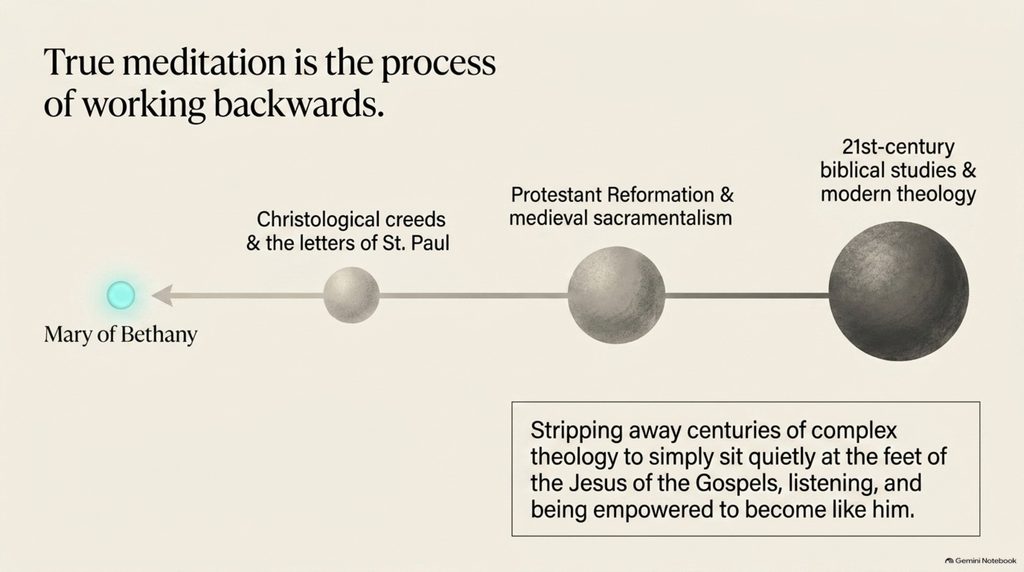
In addition to discovering what God would like for your life in terms of God’s will, working the Eleventh Step can lead, I think, into a much deeper and much simpler understanding of who God is and what God really cares about. For me, it’s been a process of working backwards: working backwards from the complexities of twentieth and twenty-first century biblical studies and theology, past the Protestant Reformation, through the sacramentalism of medieval Catholicism, beyond the Christological definitions of the creeds, sifting through the letters of St. Paul, and winding up, like Mary of Bethany, sitting at the feet of the Jesus of the Gospels, listening to him, and in the process of listening, in my own small way, being empowered to become more and more like him.
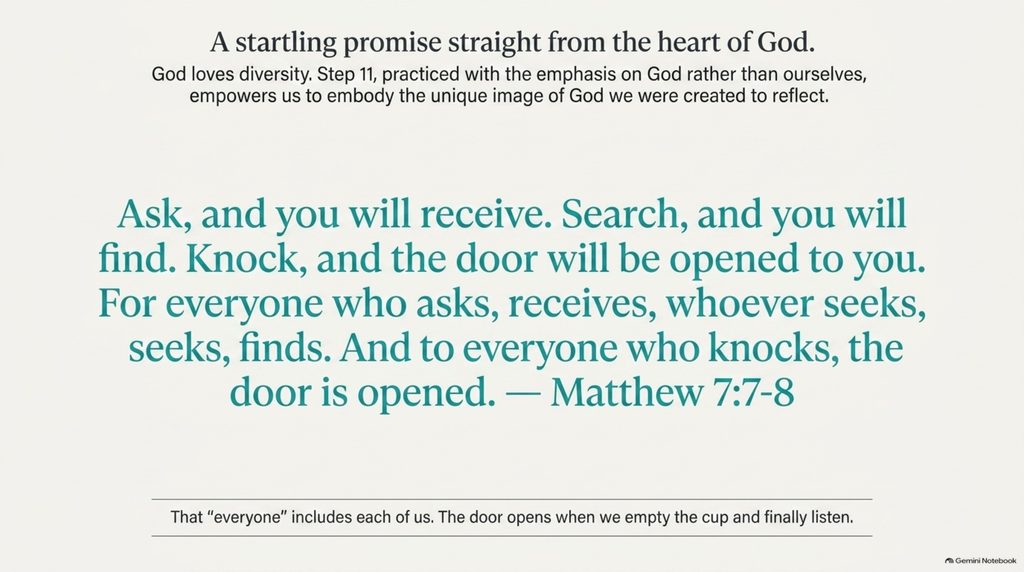
Of course, not all of our faith journeys will be the same. God loves diversity! And if the ancient story is to be believed, each of us is called to reflect the image of God in our own unique way. Step Eleven, if practiced the way it was intended to be practiced — with the emphasis on God, not on ourselves — will enable us to find that image and empower us to embody that image in ourselves. What could possibly be more fulfilling?
Jesus, in the Sermon on the Mount, gives us a startling promise straight from the heart of God:
“Ask, and you will receive. Search, and you will find. Knock, and the door will be opened to you. For everyone who asks, receives, whoever seeks, finds. And to everyone who knocks, the door is opened.” (Matthew 7:7-8)
That “everyone” includes each of us.
May God bless our God’s Will Hunting.
Amen.
Ai generated infographic, based on the Sermon
Paul Wrightman pastors at the Community Church of the Monterey Peninsula, California:
-
Pastor Paul: Step 1 – The Power Of Powerlessness
Sermon June 14, 2026 “The Spirituality Of The Twelve Steps”
-
Pastor Paul: Step 2 – Came to Believe
Sermon June 21, 2026 “The Spirituality Of The Twelve Steps”
-
Pastor Paul: Step 3 – Choosing God
Sermon June 28, 2026 “The Spirituality Of The Twelve Steps”
-
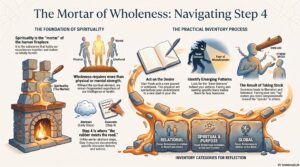
Pastor Paul: Step 4 – Taking Stock
Sermon July 5, 2026 “The Spirituality Of The Twelve Steps”
-
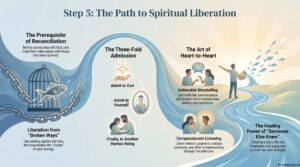
Pastor Paul: Step 5 – Heart-To-Heart
Sermon July 12, 2026 “The Spirituality Of The Twelve Steps”
-
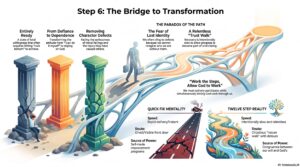
Pastor Paul: Step 6 – Becoming Ready
Sermon July 26, 2026 “The Spirituality Of The Twelve Steps”
-
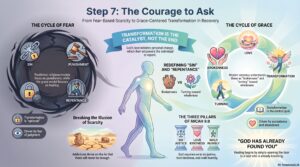
Pastor Paul: Step 7 – The Courage to Ask
Sermon August 2, 2026 “The Spirituality Of The Twelve Steps”
-
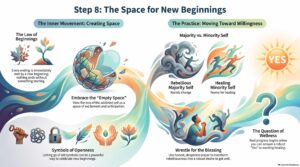
Pastor Paul: Step 8 — Making a List
Sermon August 9, 2026 “The Spirituality Of The Twelve Steps”
-
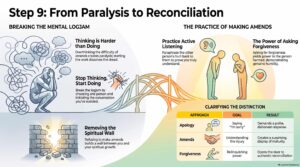
Pastor Paul: Step 9 – Embodied Reconciliation
Sermon August 16, 2026 “The Spirituality Of The Twelve Steps”
-
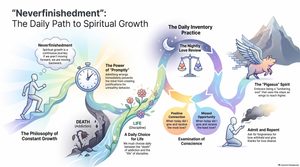
Pastor Paul: Step 10 – Neverfinishedment
Sermon August 23, 2026 “The Spirituality Of The Twelve Steps”
Leave a Reply