Sermon by Pastor Paul Wrightman (July 26, 2026)
The Spirituality of the Twelve Steps:
Step 6: Becoming Ready
Matthew 6:9-10; Psalm 8:1, 3-9
We continue our sermon series on the spirituality of the Twelve Steps. Remember that we can all benefit from the life-changing and life-enhancing nature of the Steps, even if we are not formally in a Twelve Step program. Today we look at Step 6.
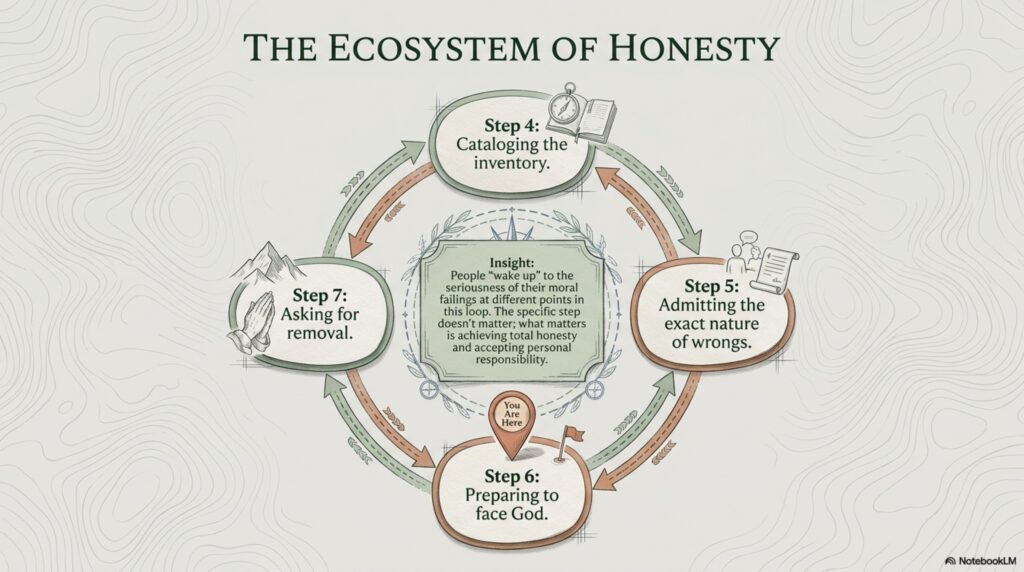
Steps 4, 5, 6, and 7 are closely connected. Step 4, making a moral inventory; Step 5, admitting the exact nature of our wrongs; Step 6, were entirely ready to have God remove all these defects of character; and Step 7, humbly asked God to remove our shortcomings — all demand that we face the seriousness of what we have done or left undone in terms of our own personal morality.
But I can attest, on the basis of numerous conversations with persons in Twelve Step programs, that different people come to realize the seriousness of their moral failings while working any of these steps. For some it comes with making the inventory of Step 4. For others it comes while admitting, or confronting, one’s moral failures in Step 5. For some it comes from getting ready to face God, as in Step 6. For others it comes from actually asking God to remove our shortcomings, as in Step 7. It doesn’t matter which step it takes for us to realize the seriousness of our moral failings. What’s important is that we’re totally honest, and that somewhere along the line we accept personal responsibility for the injury we have caused.
Before we look at Step Six, it is appropriate to pause for a moment to consider the loving nature of the God who reaches out to us. Psalm 8 is a wonderful celebration of God’s loving care:
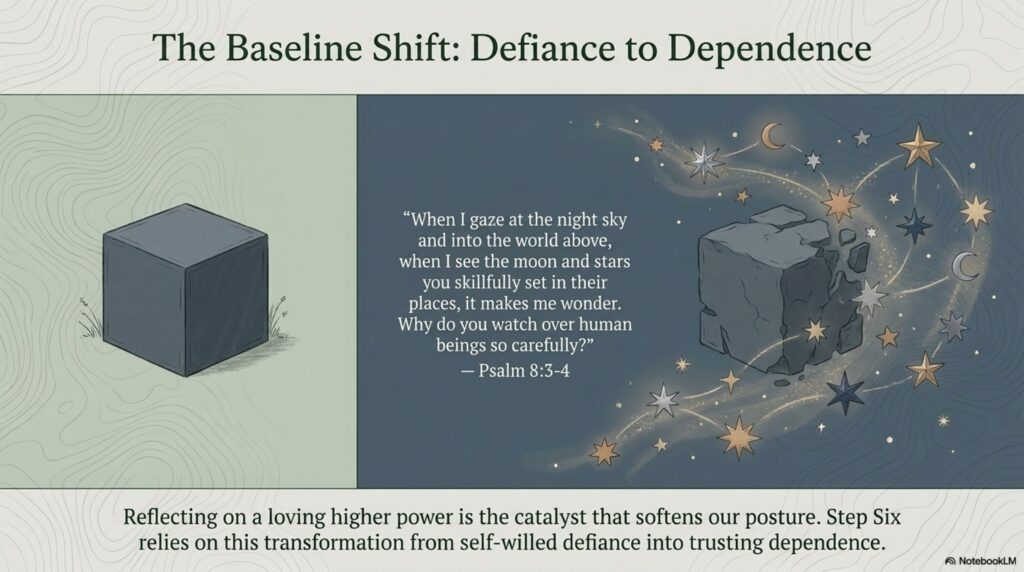
When I meditate on what your hands have made, when I gaze at the night sky and into the world above, when I see the moon and stars you skillfully set in their places, it makes me wonder. Why do you think so much of humanity? Why do you watch over human beings so carefully? (Psalm 8:3-4)
Such loving concern for us should evoke a response from us. And this is precisely what Step Six does — it enables us to transform our attitude toward God from one of defiance, to one of dependence.
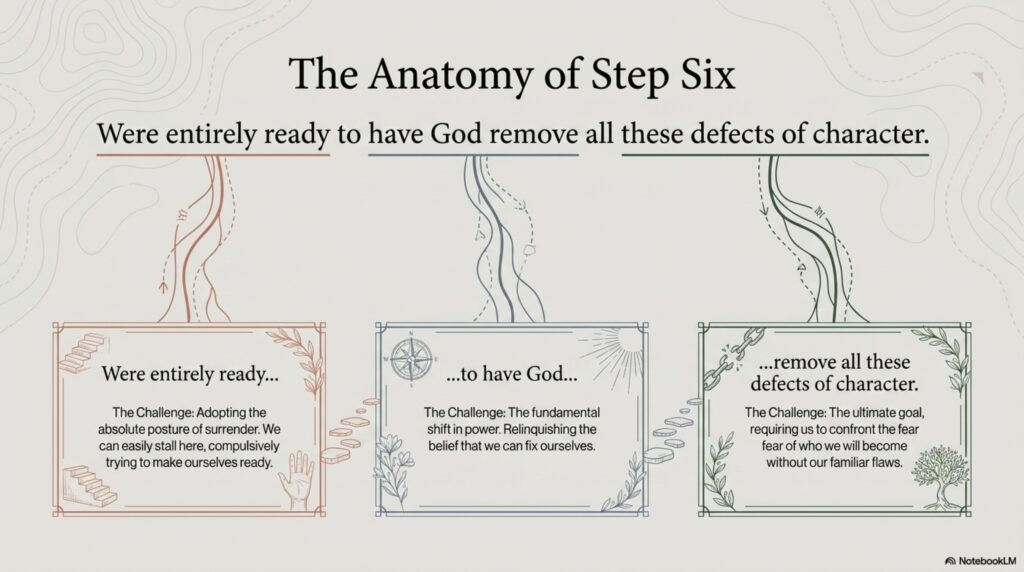
Taking a close look at Step Six, we can see that it has three distinct parts:
- Were entirely ready,
- To have God,
- Remove all these defects of character.
Each of these parts contains its own unique challenge.
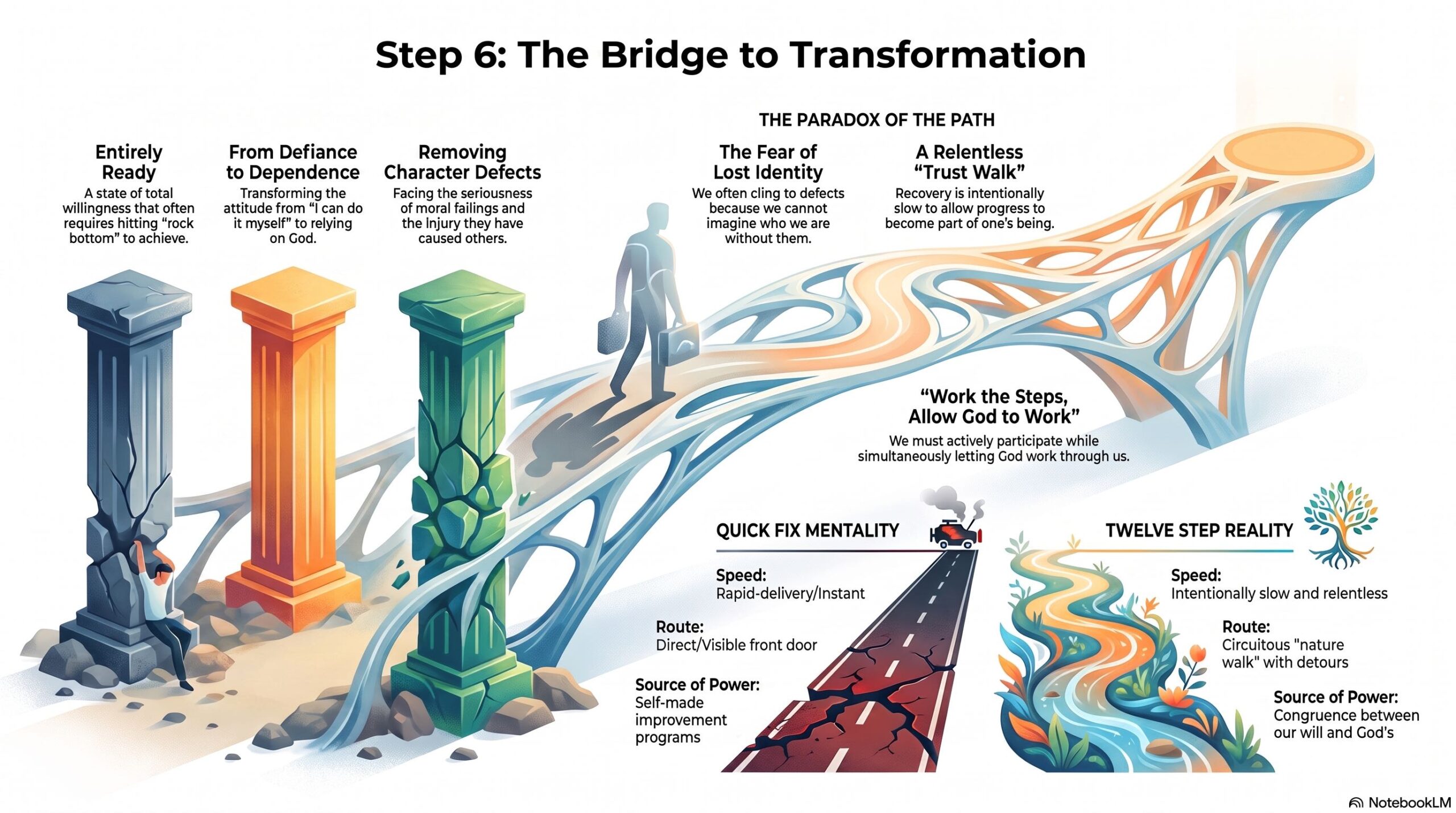
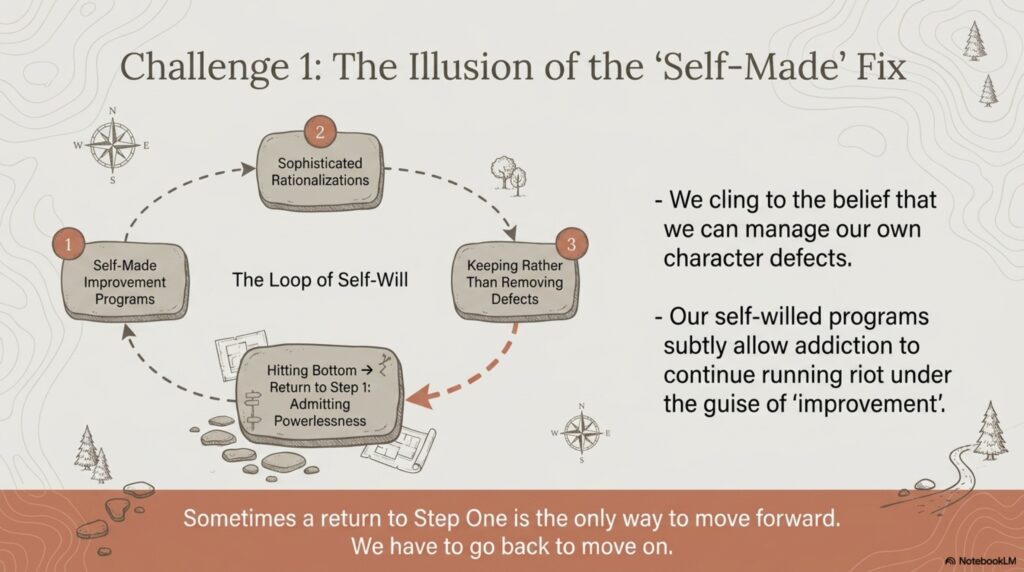
In facing Step Six, most of us, if we are honest, have to admit that we are not entirely ready to have all our character defects removed. There is a part of us that still clings to the belief that we can take care of our character defects ourselves. Many of us, myself very much included, can attest to the fact of having come up with our own self-made character improvement programs — programs that subtly allowed our self-will to continue to run riot, programs that turned out to be sophisticated rationalizations for keeping rather than removing our character defects.
This is a place where many of us have to hit bottom yet again, limp back to the First Step — admitted that we were powerless over ourselves and that our lives had become unmanageable — and re-affirm our powerlessness. Sometimes a return to Step One is a necessary condition for continuing to move forward. Sometimes we have to go back to move on.
I doubt if any of us are ever entirely ready to have all our character defects removed, and we can easily stall on this step, compulsively trying to make ourselves ready. The best thing we can do to keep ourselves from stalling is to ask God to give us the desire for character defect removal.
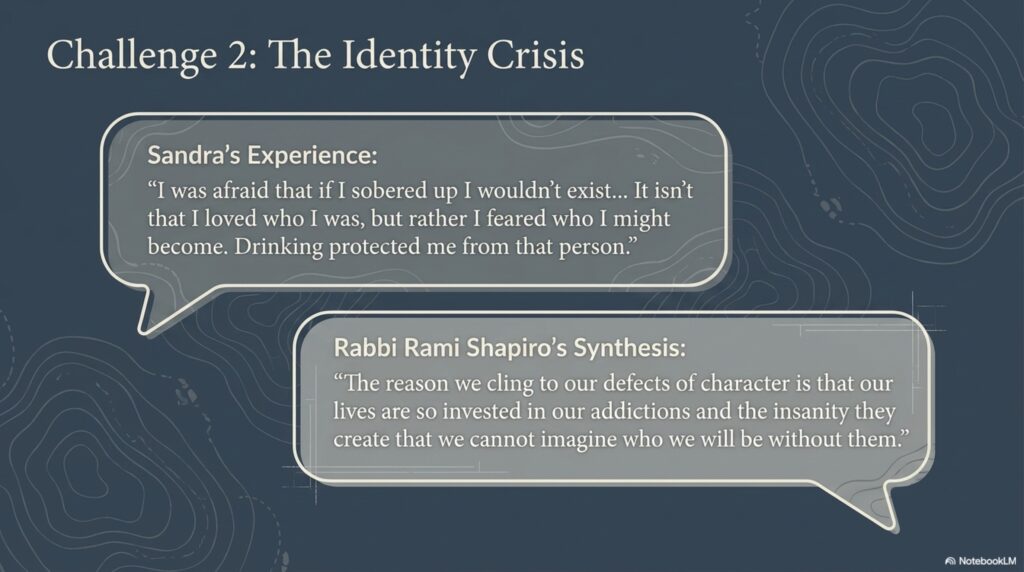
A second challenge which most of us preparing to practice Step Six are faced with is the fear that we will lose our identity along with our character defects.
“I thought Step Six would be a snap,” Sandra said at one AA meeting.
“I hated the person I’d become. I was ashamed of the way I was living my life — the lying, the secrets, the double life of a successful administrator and a drunk. I thought I’d jump at the chance to have all my defects lifted from me. But the truth is I wasn’t ready. I was afraid that if I sobered up I wouldn’t exist, or the me that would exist would be worse off than the me I was. It isn’t that I loved who I was, but rather I feared who I might become. Drinking protected me from that person, and I was afraid that I needed to be protected from her. What finally pushed me to Step Six was once again hitting rock bottom.”
Rabbi Rami Shapiro summarizes this dynamic well:
“The reason we cling to our defects of character is that our lives are so invested in our addictions [and our addictive tendencies] and the insanity they create that we cannot imagine who we will be without them. And because we cannot know who we will be, we are afraid to let go of who we have been.”
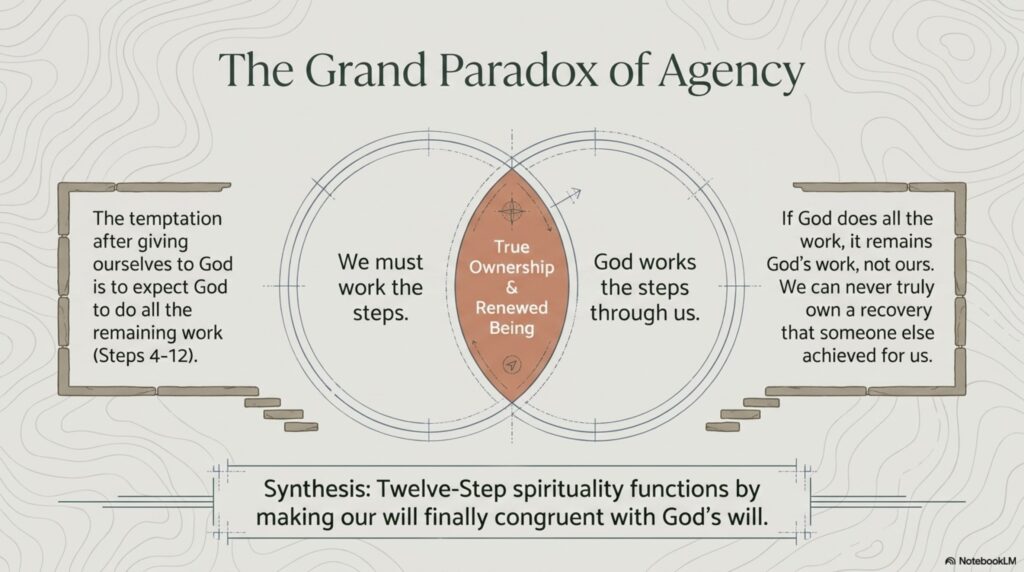
This is a real dilemma, and we cannot get beyond it unless we submit to the paradox of the Twelve Steps and of Twelve Step spirituality: at the same time, we have to work the Steps, and allow God to work the Steps through us.
Let me say that one more time: at the same time, we have to work the Steps, and allow God to work the Steps through us.
A person who regularly attends AA meetings shared with me that some in the group have voiced the frustration that after completing Steps One through Three — admitting that our lives had become unmanageable, coming to believe that a power greater than ourselves could restore us to sanity, and making a decision to turn our will and our lives over to God — that after all that, there was still the burden of having to complete Steps Four through Twelve. They felt that since they had already given themselves to God, that God should do all the rest of the work for them.
Do you see the problem here? If God does all the work for us, it becomes God’s work and not ours. The work never becomes something we ourselves can truly own, because someone else has done it.
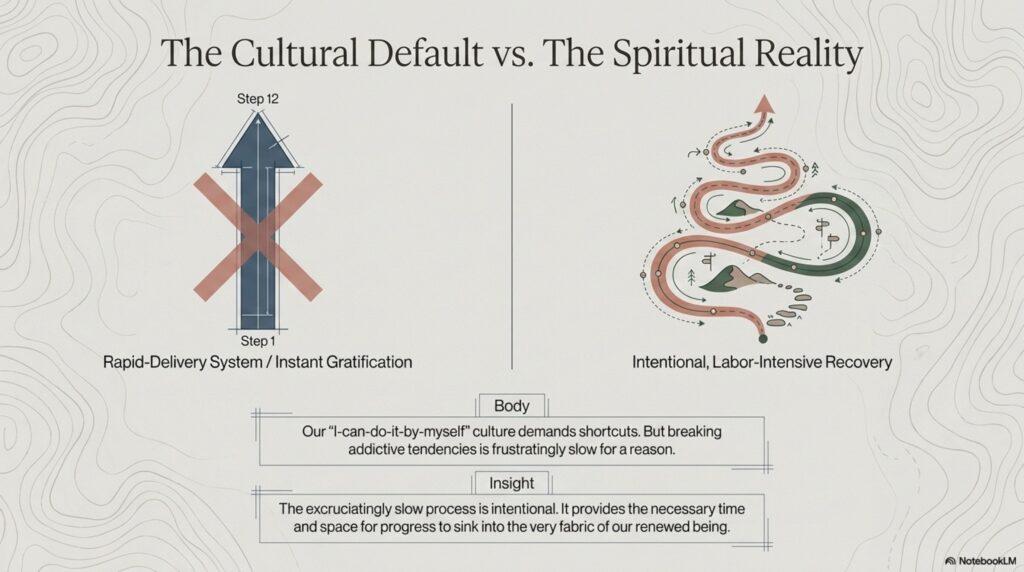
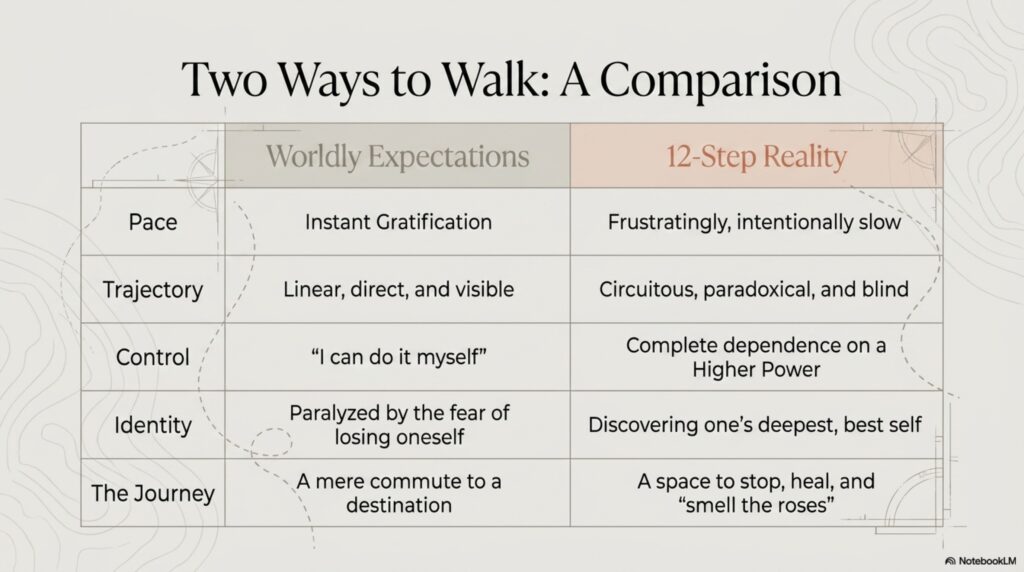
Yes, actually working the Twelve Steps is frustratingly slow and labor intensive. But they are slow and labor intensive for a reason. And that reason is that it takes a tremendous amount of time and effort to break an addiction or addictive tendency. The excruciatingly slow process of working the Steps is intentional. Each “baby” step is designed to get us to the goal of recovering slowly but surely, giving us the time and the space that we need to have our progress really sink in, to become part of the very fabric of our renewed being.
Practicing the spirituality of the Twelve Steps is one of the best ways on the planet for enabling God’s will to actually get done, as it says in the Lord’s Prayer, “on earth as it is in heaven.” And this happens because in Twelve Step spirituality our will finally becomes congruent with God’s will.
I’d like to dwell a while on the paradoxical, drawn-out, excruciatingly slow, and relentless nature of the Twelve Steps. The best way I can think of for doing this is to share with you another illustration from the writings of Dr. Rachel Naomi Remen.
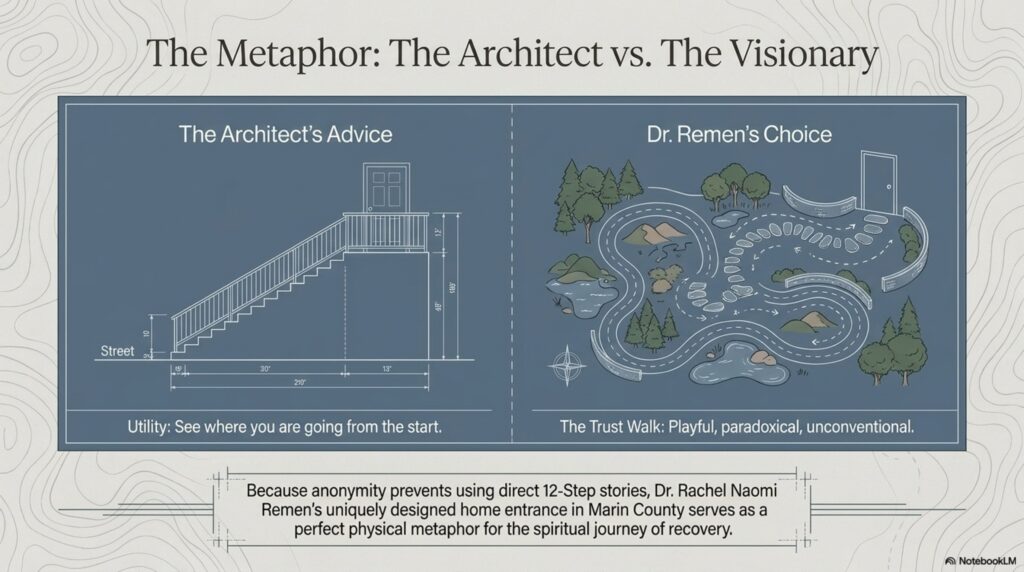
This story is not a direct illustration for the Twelve Steps. I repeat: this story is not a direct illustration for the Twelve Steps. It is difficult, if not impossible, to come up with direct illustrations for the Steps because of the anonymous nature of the sharing involved in Twelve Step meetings. But the way in which Dr. Remen created nothing less than a trust walk to get to the front door of her house in Marin County can serve as a metaphor echoing the paradoxical, slow, and trust-walk nature of the Steps themselves.
Any “normal” person would simply have had a flight of steps built from street level to connect to a short path that led directly to her front door. The utility of using this approach is that from the moment you started ascending the steps, you could actually see where you were going. In fact, Dr. Remen’s architect advised her to do this — one of the basic principles of the architecture of front entrances being that people need to see where they are going from the start.
Dr. Remen, however, being the playful, paradoxical, and unconventional person that she is — and also a person deeply in love with beauty and its unfolding — chose a totally different approach. Basically, she created a circuitous nature walk that had nothing to do with getting to her front door directly.
I’m now going to describe Dr. Remen’s path for you. This is going to be a complicated description that asks that you actively participate with your imagination. I invite you to close your eyes and visualize each part of the path as it unfolds. Here we go:
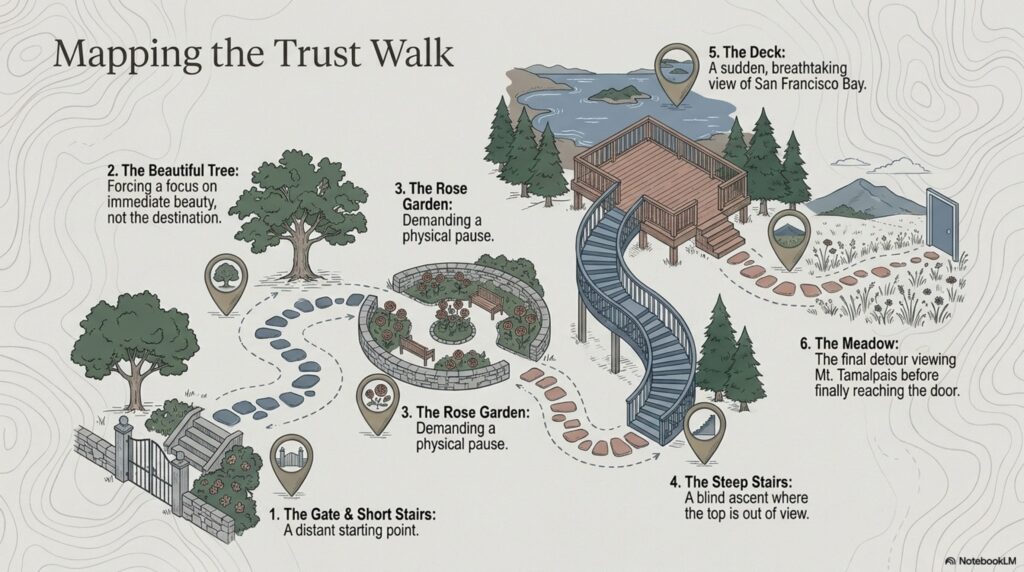
First, you come through a gate much further down the street from the house and climb a short series of steps to a small landing. Just beyond this landing is a tree of great beauty, and this beautiful tree is all you can see as you climb the steps.
Next, when you reach the landing, you discover that it joins a small deck bordered by a rose garden. You must walk through the rose garden to get to another flight of stairs, this one quite steep, leading off to the right. The top step is well above eye level, so you can see nothing but the steps until you reach the deck at the top, where suddenly and surprisingly you are faced with a breathtaking view of San Francisco Bay.
Crossing this deck, you find three more steps leading off to the left, which takes you to a small meadow — which is Dr. Remen’s backyard — and which offers a stunning view of Mt. Tamalpais. Only then, after this long series of beautiful detours, do you get to the front door!
What Dr. Remen has done for herself is to create a nature trail of great beauty which literally forces her to “stop and smell the roses” on her way home from work. What she has constructed for family and friends is the equivalent of a trust walk, a slow route with plenty of stops for beauty along the way — a path that they have to trust will eventually get them to her front door.
I hope that you’re able to see the metaphor here between Dr. Remen’s paradoxical, intentionally slow way to her front door, and the paradoxical, intentionally slow nature of the Twelve Steps to get one to the goal of recovering.
The Twelve Steps are a lot like this paradoxical, intentionally slow, trust-walk type path that Dr. Remen designed to get to her front door. They go counter to the accepted “wisdom,” the so-called “common sense” of our “I-can-do-it-by-myself-thank-you-very-much” culture. Like Dr. Remen’s path, and contrary to the instant gratification emphasis of our society, they take a long time getting us to where we want to go.
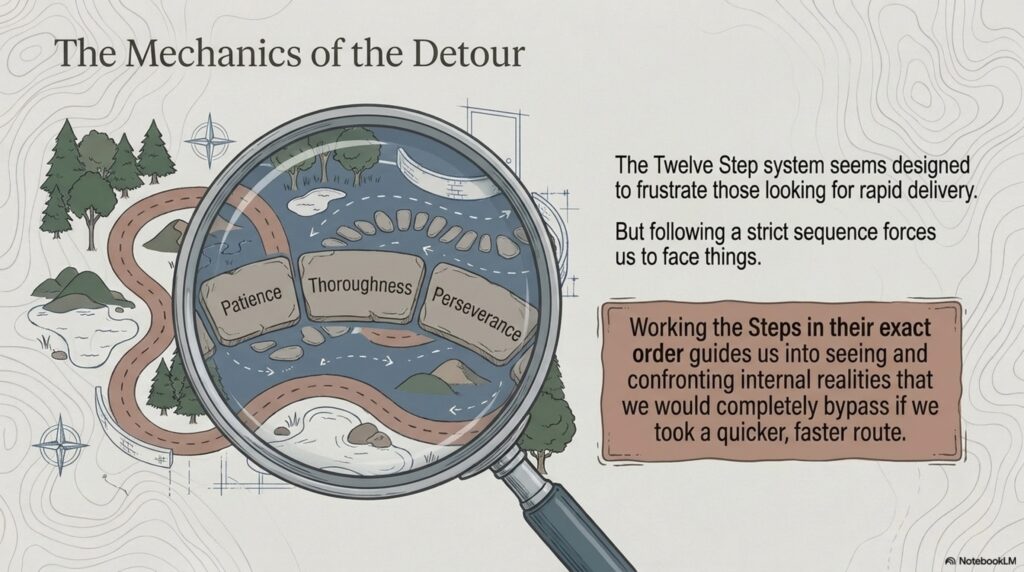
For those of us focused on rapid-delivery systems, the Twelve Step system seems designed to frustrate us, to push us into patience, thoroughness, and perseverance. Many who begin the Steps would like to go straight from Step One, admitting that we were powerless, non-stop to Step Twelve, having a spiritual awakening. Working all the Steps in the order in which they are given guides us into seeing and facing things along the way that we would never have seen and faced if we follow a quicker, faster route.
A spirituality that is not afraid of paradox tells us that often the only way to our goal is by a way that is intentionally slow, complicated, and relentless. The Twelve Steps are the result of a great deal of reflection, experience, and reflection on experience. There is a method to their madness. They are designed to move us from point A, the unmanageability and insanity of addiction or addictive tendencies, to point B, the serenity of mature spirituality — but only if we relinquish our haste and embrace the path.
Each step along the way gives us the time we need for our slow but sure progress to become part of the very fabric of our being. Like getting to Dr. Remen’s front door, anyone who actually works the Steps will discover many unexpected encounters with beauty. With regard to the Steps, this would be the beauty of coming to know and to welcome one’s deepest, best self, which would also include the beauty of being surprised by and growing into a heart-to-heart and face-to-face relationship with God.
Amen.
Ai generated infographic, based on the Sermon

Paul Wrightman pastors at the Community Church of the Monterey Peninsula, California:
-
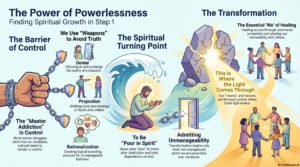
Pastor Paul: Step 1 – The Power Of Powerlessness
Sermon June 14, 2026 “The Spirituality Of The Twelve Steps”
-
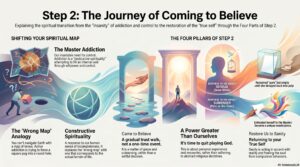
Pastor Paul: Step 2 – Came to Believe
Sermon June 21, 2026 “The Spirituality Of The Twelve Steps”
-
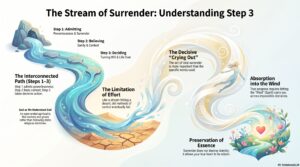
Pastor Paul: Step 3 – Choosing God
Sermon June 28, 2026 “The Spirituality Of The Twelve Steps”
-
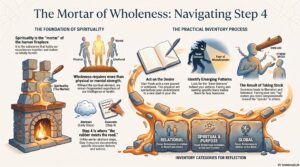
Pastor Paul: Step 4 – Taking Stock
Sermon July 5, 2026 “The Spirituality Of The Twelve Steps”
-
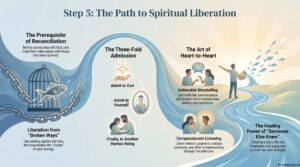
Pastor Paul: Step 5 – Heart-To-Heart
Sermon July 12, 2026 “The Spirituality Of The Twelve Steps”
-
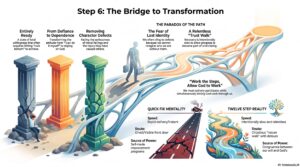
Pastor Paul: Step 6 – Becoming Ready
Sermon July 26, 2026 “The Spirituality Of The Twelve Steps”
-
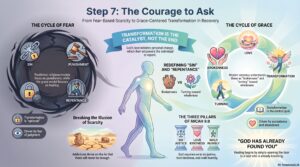
Pastor Paul: Step 7 – The Courage to Ask
Sermon August 2, 2026 “The Spirituality Of The Twelve Steps”
-
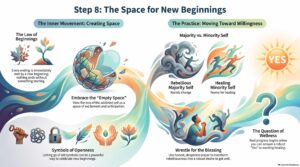
Pastor Paul: Step 8 — Making a List
Sermon August 9, 2026 “The Spirituality Of The Twelve Steps”
-
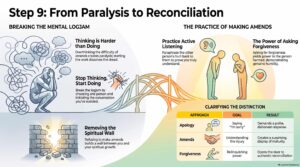
Pastor Paul: Step 9 – Embodied Reconciliation
Sermon August 16, 2026 “The Spirituality Of The Twelve Steps”
-
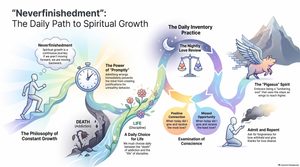
Pastor Paul: Step 10 – Neverfinishedment
Sermon August 23, 2026 “The Spirituality Of The Twelve Steps”
-
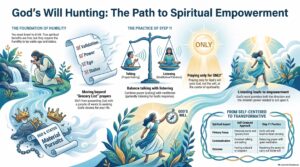
Pastor Paul: Step 11 – God’s Will Hunting
Sermon August 30, 2026 “The Spirituality Of The Twelve Steps”
-
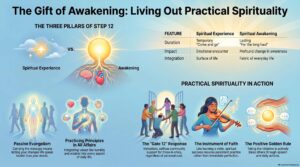
Pastor Paul: Step 12 – The Gift of Awakening
Sermon September 6, 2026 “The Spirituality Of The Twelve Steps”
-
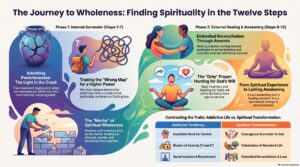
Ai’s take on Pastor Paul’s 12 Step Sermons
Sermon September 6, 2026 “The Spirituality Of The Twelve Steps”
Leave a Reply